







5 Book Reviews You Need to Read This Week
"Reading it is like opening the hall closet and having the contents of an antique junk shop, laced with spiky and rusted farm implements, spill out and maim your dog."
Our feast of fabulous reviews this week includes Dwight Garner on Annie Proulx Stories, Clare Clark on Louise Kennedy’s Stations, John Semly on William Gass’s The Tunnel, Daniel Mason on Tom Drury’s West of Loveland, and Nick Holdstock on William T. Vollman’s A Table for Fortune.
Brought to you by Book Marks, Lit Hub’s home for book reviews.
*
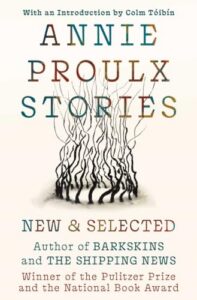
“Annie Proulx is an American eccentric, a writer whose dense, cluttered style is wall-to-wall overload. She’s a putter-inner, not a taker-outer. Like an outsider artist, she fills even the far margins of her canvases with bizarre stick figures and grim tableaux. There is no one like her. She has a new, career-spanning collection of stories out now. Reading it is like opening the hall closet and having the contents of an antique junk shop, laced with spiky and rusted farm implements, spill out and maim your dog. I mean this as praise.
…
“What’s most essential, and most primal, about Proulx’s stories is the freight of doom she loads into them: chain-saw accidents, deaths by emu claws, babies run over by trucks, amputated limbs, terrible car crashes, brain damage, deformation, fires that kill, freelance castration, murders, kids trapped in mine shafts, heads squashed by rodeo cattle. It’s as if the characters have fallen out of, or into, Michael Lesy’s Wisconsin Death Trip, that catalog of woe.
…
“I’m aware I’ve made the bulk of Proulx’s stories sound insane. And they are. But the inundation is purposeful and artful. From her chaotic style she coaxes out wild, wind-chapped poetries, as if she were the caller of a cosmic hoedown.
Her crowded verbiage contains nested critiques of modernity, of every sort of streamlined ease. A lot of her stories contain sideways glances at the new money coming into town, doctors buying up the old ranches and turning them into weekend homes with American-eagle door knockers. Nothing in Proulxland is pasteurized for your protection.
Her densities put you in mind of all the great, clanking accumulators: James Joyce’s associations, stacked like pancakes; Gustav Klimt’s encrustations of paint; Charles Ives’s garage-sale polytonalities. Stephen King once said that his stuff was the literary equivalent of a Big Mac and fries. If that’s true, then Proulx’s writing is the equivalent of a platter of gizzards, chicken feet and deviled kidneys.”
–Dwight Garner on Annie Proulx Stories: New & Selected (The New York Times)
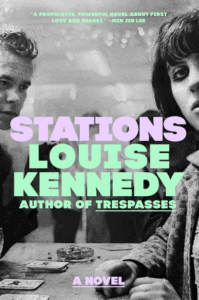
“The novel traces the warp and weft of their relationship over the next 25 years. Structured like a sporadically kept diary, clusters of dated entries disrupted by long gaps, it has echoes of David Nicholls’s One Day; but Kennedy’s London is altogether grimmer and more brutal, a city of squats and gas heaters and not enough change for the payphone. Her people are also more damaged, an Irish diaspora fractured by displacement, scarred not only by poverty and violence and addiction but by shame and loss…Kennedy’s émigrés flee the old country, they build new lives, construct new families, but they carry the weight of the past always with them. However far they travel, they can never escape from themselves.
Kennedy moved to London herself as a young woman and evokes the 1980s city with almost hallucinogenic precision, but her greater power lies in her remarkable humanity. Her characters are messy, flawed, often shatteringly self-destructive but, mapped with her fierce compassion, they march straight off the page. As a teenager Róisín is bolshy and obstreperous; she is also funny and filthy and generous and agonizingly vulnerable. As she gets older, she gets better—sometimes—at managing herself but she never really changes. The way Kennedy conjures her, we do not want her to.
Stations is at its heart a love story, a furious, tender, potty-mouthed paean to loyalty and generosity of spirit. It is also an elegy to a generation of lost Irish boys, a heartbreaking testament to the violence and fear passed down from father to son. In its title, Stations acknowledges the transience of the diasporic experience, the trains and boats and coaches, but, steeped as the book is in an in-the-bone Catholicism…it carries too the idea of the Stations of the Cross, the 14 images of Jesus on the day of his Crucifixion.
…
“Can cycles of anguish or neglect ever be broken? Is love in all its frustrating insufficiency enough to save us? Kennedy’s novel is too subtle and clear-eyed to offer easy answers, but her questions will burn themselves into your heart.”
–Clare Clark on Louise Kennedy’s Stations (The Guardian)
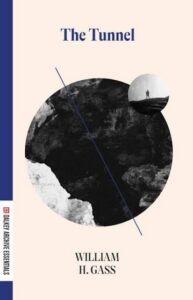
“Having required decades to write and rewrite, William Gass’s The Tunnel has always been a difficult novel to read. An enormously long, often gratingly obnoxious and violent book rendered in overblown prose, it is also shot through with squiggly doodles and diagrams and bawdy limericks and all kinds of lexicographical shenanigans. But that’s only part of what makes it difficult to read. Exasperatingly demanding, defiantly highfalutin, and richly rewarding, The Tunnel is also just hard to find: It was long out of print, and old copies regularly fetch hundreds of dollars in used-book marketplaces. For this reason, Dalkey Archive has taken on the task of reprinting the book yet again. This time it has done so in full color, as the author intended, and with a companion volume called The Tunnel Reader…The timing is auspicious, for not only is Gass’s book intimidating and frustrating and brilliant, but it is also a study of the ugly, often inchoate nature of the American authoritarian character, and how a crude politics of exclusion and resentment rises from the bile of a more basic resentment—what Gass terms ‘the fascism of the heart.’
…
“His burrowing deep into his own internal (and infernal) world finds its metaphorical expression in the titular tunnel, which is also not a metaphor: In the midst of all this psychic digging, Kohler begins to excavate a tunnel in the floor of his basement office, hiding the mud and dirt in his wife’s antique wardrobes. It’s not exactly clear what this tunnel business amounts to: an attempt to break loose from his stifling, sexless home life? An effort to escape himself, or to dig his own shallow, silty grave? Or merely ‘a gesture which will symbolize my desperation’? Whatever the purpose, the image of a man boring into increasingly tight, dirty spaces befits the feeling of The Tunnel itself, as it slithers into the hollows of Kohler’s repugnant psychology. It is a pitiless, pitch-black map of the human soul—or, rather, of the gaping hole marking its absence.
…
“Proust, he writes in one appreciation, typifies this high ideal, allowing the reader ‘to live for a while as we ought, in a fully realized world.’ The Tunnel is a grand expression of this idea, applied to an imperfect consciousness; it’s as if Proust wrote The Turner Diaries. It is not a typical stream-of-consciousness novel in the modernist tradition but a creation of that consciousness. Kohler is the text—to even classify him as an ‘unreliable narrator’ would be senseless, as there is no external truth to judge him against. Everything that happens in The Tunnel happens inside Kohler’s mind. ‘It’s time,’ he announces to the reader, ‘to hide inside my work, which is, of course, a fortress also made of language: the castle of what comes between commas.’
…
“…this is not a historical account of fascism but rather a psychological and often metaphorical one. And it follows in a proud anti-Enlightenment tradition. If it was, as Adorno said, barbaric to write poetry after Auschwitz, then perhaps crude cartoons, dirty limericks, perverted daydreams, dark fantasies driving ever deathward, fart jokes, and other ‘obnoxious effluvium’ (in Kohler’s words, but also Gass’s) constitute an appropriate—and appropriately barbarous—new form.”
–John Semly on William Gass’s The Tunnel (The Nation)
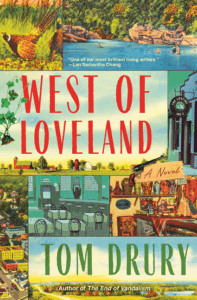
“In a 1956 interview for The Paris Review, William Faulkner described his early realization ‘that my own little postage stamp of native soil was worth writing about … a cosmos of my own.’ This postage stamp became the fictional Yoknapatawpha County, a setting that summoned, across his greatest books, a world of such concrete geography that Faulkner later could ‘survey and map’ it in a prefatory illustration for a volume of his collected works. Tom Drury’s West of Loveland also opens with a map, a stylized grid showing not only the network of roads that connect the towns of Grouse County, Drury’s own Yoknapatawpha, but also the cryptic landmarks that anchor the plot: the Swedish House, the Earring, the Gates of Hell, the Gun and others. Part quilt, part puzzle, part network diagram, it is an apt metaphor for the novel that follows, with its interweaving of lives.
…
“It is testament to Drury’s loving, singular portrayals that a cast of such breadth never overwhelms. While readers of his three earlier Grouse County novels will certainly feel the pleasure of encountering old friends, West of Loveland can be read satisfyingly on its own. The characters feel quickly familiar. The novel attends to their quiet conversations, their modest meals, their everyday work, whether caring for the sick, staffing a thrift shop or demolishing a silo. ‘Quiet’— in the best sense—is a word I often encountered in descriptions of Drury’s particular cosmos. Even his many felicitous turns of phrase—and there are many—are so unassuming that it takes some time to realize how powerful or clever they are.
…
“I hope there is such a cosmos. Yet I suspect I won’t be the only one to wonder if such prevailing goodness, such decency, is less a description of how we are than how we could be. Perhaps the map on the frontispiece is not just an aid for reading, but a suggestion that the book itself is a kind of guide, showing us a path toward a tolerance and civic engagement that seem as threatened as Grouse County’s fields and farms.
‘We live in a time when the literature most likely to be valued by serious people is intense, recalcitrant and extreme,’ wrote Irving Howe in 1953. And yet, he continued, we could also celebrate another kind of literature, one that values ‘milder virtues which can cause only impatience in many modern minds.’ These are the works of ‘writers of sweetness,’ who, like Drury, ‘do not assume evil to be the last word about man,’ or insist that ‘even if it is the last word, there are others to be declared before we reach it.’”
–Daniel Mason on Tom Drury’s West of Loveland (The New York Times)
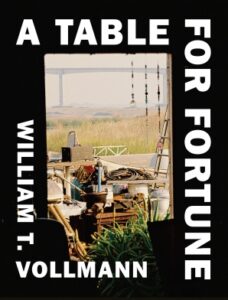
“The 250th year of the American experiment seems to invite a reckoning. For a young country, the United States is overblessed – or burdened – with myths about its foundation and how the nation has conducted itself at home and abroad. William T Vollmann’s 3,000-page novel A Table for Fortune is an epic attempt, 15 years in the making, to engage with the US’s past and present at an institutional and a personal level. The four simultaneously published volumes offer both a family story and an insider’s history of the CIA, in order to show the consequences of the quest for liberty and the belief in American exceptionalism.
…
“Though the CIA has been fertile ground for many great American novelists—Don DeLillo, Norman Mailer—Vollmann is perhaps the first to represent the culture and daily activities of the agency in granular detail. His great gambit is to frame this as a dark workplace comedy of minor resentments, sexual tension and office banter. These sections are narrated by the institutional voice of the CIA itself in a relentlessly sardonic tone rife with acronyms, codenames and jargon rendered in multiple fonts. The mordant humor of the narrator, who regards all forms of death and suffering as ‘fun,’ has a seductive quality that allows Vollmann to educate the reader about a broad sweep of geopolitical subjects ranging from the Angolan civil war to the interrogation methods of the Stasi, and in doing so chart the hypocrisies and double standards of the agency.
…
“The inordinate length of the novel is justified by the amount of historical material it has to cover. As one of DAVE’s bosses says, ‘all we care about here is telling you the truth. The only way to tell it is detail by detail.’ The novel’s recreation, on almost a day-to-day basis, of the US’s gradual ensnarement in global, unwinnable conflicts, combining the domestic and the political, resembles Uwe Johnson’s equally epic Anniversaries, which culminates in the Soviet occupation of Prague. There is a similar sense of watching a car crash in super-slow motion.
…
“In the last volume the comedy becomes increasingly bitter. As an elderly DAVE moves around his home, he comes across a ‘basket filled with neatly rolled white towels, just in case somebody wanted to bleed to death.’ A Table for Fortune offers a profoundly sorrowful diagnosis for the state of a semiquincentennial US apparently no closer to resolving the problem of how best to reconcile questions of individual freedom with the role of the state. While the book supplies a multiplicity of opinions on this vexed question, it offers no definitive answers. Where would be the fun in that?”
–Nick Holdstock on William T. Vollman’s A Table for Fortune (The Guardian)

Book Marks
Visit Book Marks, Lit Hub's home for book reviews, at https://bookmarks.reviews/ or on social media at @bookmarksreads.