







The Annotated Nightstand: What Rebecca Perry is Reading Now, and Next
Featuring Anne Carson, Federico García Lorca, and Will Keohane
In Rebecca Perry’s Booker shortlisted May We Feed the King, a woman who suffers from a loneliness, its source purposefully kept fuzzy, is devoted to her remarkably niche work of reconstructing history through staged meals. The protagonist knows where to get the perfect plastic chicken leg, has a deep appreciation for a fake fish with the bright red beneath its gills. She is expert at her craft, confident and unbending in her approach when questioned.
This curator takes a commission to recreate “scenes,” as she calls them, in an historic castle. For accuracy, she requests for access to the archives. With the aid of the castle’s archivist, the speaker soon tips into the life of a Medieval king and his court (soon “my King”). As her curiosity becomes all-consuming, so does the novel’s plot, and we are pitched into the intrigues of centuries ago.
The King sits uneasily in his throne of power. His intimates are his attendant, his wife, his wife’s cousin. Perry does a fabulous job of showing how rumors are conjured and subsequently fly from lips to ears again and again, how remarkable power casts a spell on those proximate. Was it a shadow in the window or was the King, his wife, and wife’s cousin engaging in a glorious threesome? Or the King merely sitting at his desk, head in hands, overwhelmed? For anyone who is drawn to the portal archives can create, this all is fragrant of catnip.
Perry is one of those rare writers who make what feels like (to this poet) the quantum leap between verse and literary fiction. Her language is simultaneously lush and stately, delivering just enough. As when the king moves through his garden and regards “the perfection of the bleeding heart, its flowers dangling in an orderly line, juddering in the breeze.” The Booker judges describe how May We Feed the King is “a wonderfully enticing, and eye-opening, combination of themes, woven together with an extraordinary delicacy of touch.”
— Diana Arterian
*
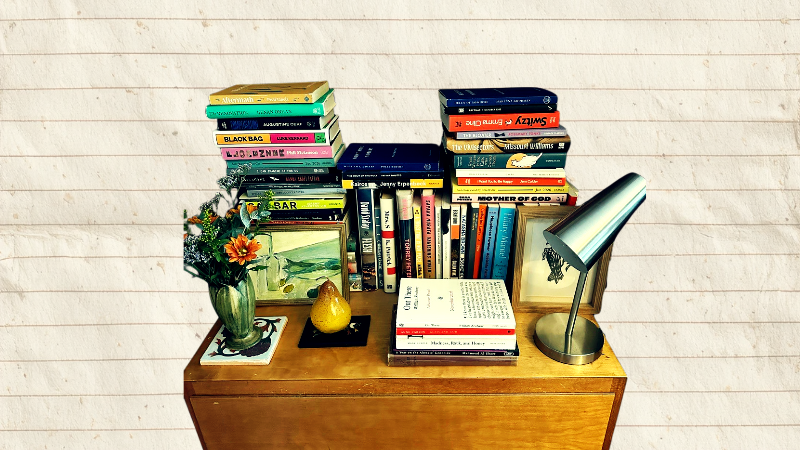
My nightstand is piled high with books I have read and have yet to read. Every now and again it gets so out of control I have to take them all off and start again. When that happens, I swear I’ll keep the pile limited to a strict TBR, but it never happens.
Objects on my nightstand:
A few flowers in a little vintage wooden tulip vase. If I don’t have flowers a little spider plant sits on that tile.
An oil still life of fish and lemons that my partner bought me for my 40th birthday – awaiting hanging.
A pear candle. Friends and I went to Casa das Velas Loreto in Lisbon – it’s a tiny, beautiful shop that only sells liturgical and baptismal candles. They only take cash. May We Feed the King hadn’t come out yet but I had to buy it. It’s sitting on an Italian pietra slate panel inlaid with birds – my friend (the writer) Amy Key bought it for me to remember my grandad after he died.
A framed paper cut by the artist Andrea Oke. Amy and I were writers in residence at Halsway Manor, the national centre for folk art, a few years back. We created a pamphlet of poetry inspired by the archives there and Andrea created a series of paper cuts to illustrate it. This one shows a knife nestled among a bunch of leeks.
Books on my nightstand:
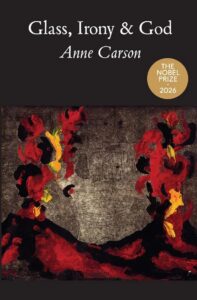
Anne Carson, Glass, Irony and God
A brilliant book which contains ‘The Glass Essay,’ a long poem about Carson’s mother and Emily Dickinson. It’s a masterclass and I use it often when I teach or run workshops (which isn’t often). Sometimes I just pick it up and read a page or two.
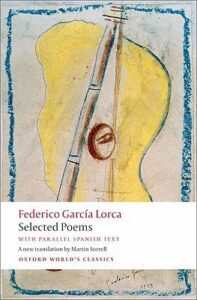
Federico García Lorca, Poems (tr. Stephen Spender and J.L. Gili)
A first edition of Lorca’s collected works, bought for me by my now partner of 16 years for the birthday I had one month after we met. Lorca is my first writing love.
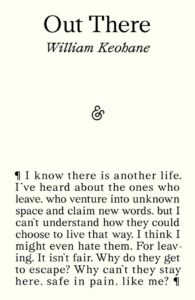
Will Keohane, Out There (proof)
A beautiful, tender, sharp book about gender transition and many other things.
Highly anticipated books on my TBR: are A Year on the Abyss of Genocide by Mahmoud Al-Shaer (which I received as part of my brilliant PalFest Bookshelf subscription), The Hour of the Wolf by Fatima Bhutto and Emma Cline’s Switzy.
Diana Arterian
Diana Arterian is the author of the recent poetry collection Agrippina the Younger (Northwestern UP, 2025), which received the 2026 William Carlos Williams Award from the Poetry Society of America. She is also editor and co-translator of Smoke Drifts (World Poetry Books, 2025), a collection of Nadia Anjuman's poetry. A Poetry Editor at Noemi Press, Diana has received fellowships from the Banff Centre, Millay Arts, and Yaddo. She writes “The Annotated Nightstand” column at Lit Hub and lives in Los Angeles.