Sam A. Miller on YouTube Storytelling and Choosing Science Fiction
In Conversation with Whitney Terrell and V.V. Ganeshananthan on Fiction/Non/Fiction
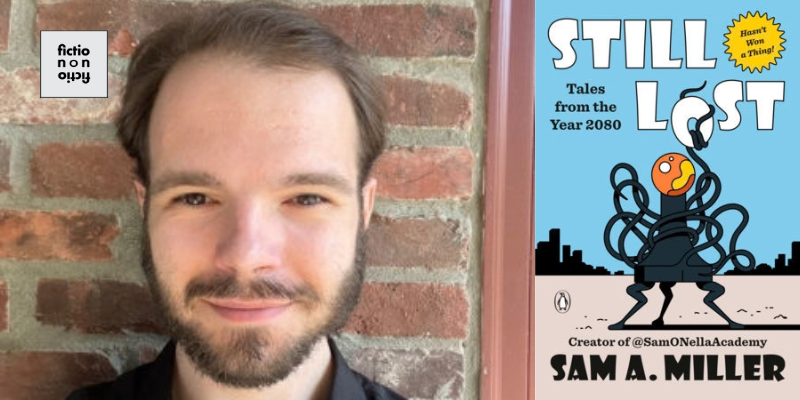
Fiction writer and popular YouTuber Sam A. Miller joins co-hosts Christian Barter and V.V. Ganeshananthan to talk about his debut story collection, Still Lost: Tales from the Year 2080, as well as his educational and comedic videos. Miller reflects on how he got started on YouTube a decade ago, when he was an adolescent, and amassed 4.8 million followers by developing Sam O’Nella Academy, a channel with a scrappy, homemade feel and distinct illustrations. Miller discusses the genesis of the unusual aliens who set the stage for most of Still Lost’s human-centered stories by solving potentially world-ending problems like climate change right off the bat. He explains why he decided to self-publish the science fiction collection and how it found its way to a traditional publisher. He also shares his science fiction influences and talks about how his personal history with addiction shapes the book’s final story. He reads from Still Lost.
To hear the full episode, subscribe through iTunes, Google Play, Stitcher, Spotify, or your favorite podcast app (include the forward slashes when searching). You can also listen by streaming from the player below. Check out video versions of our interviews on the Fiction/Non/Fiction Instagram account, the Fiction/Non/Fiction YouTube Channel, and our show website: https://www.fnfpodcast.net/ This podcast is produced by Christian Barter, V.V. Ganeshananthan, AJ Abernathy, Grace Workman, and Sienna Hoopingarner.
Still Lost: Tales from the Year 2080 by Sam A. Miller • Sam O’Nella Academy – YouTube
Others
Stories of Your Life and Others by Ted Chiang • Project Hail Mary by Andy Weir • Blindsight by Peter Watts • Wheelers by Ian Stewart & Jack Cohen
EXCERPT FROM A CONVERSATION WITH SAM A. MILLER
Christian Barter: Your YouTube channel also covers a wide range of topics. So, why did you choose to write science fiction? You seem like a writer who could have written in any genre.
Sam A. Miller: I appreciate that. I’m not sure I’d be immensely qualified for historical fiction, if I’m being honest. I consider myself kind of a generalist, which is a nicer way of saying I don’t know shit. A broad base, but no expertise in anything, you know. And so, I think science fiction is best suited for that because I think a lot of the appeal of the genre is taking these disparate things like technology, philosophy, and merging them together, and creating something better than the sum of its parts.
V.V. Ganeshananthan: Absolutely. I just want to point our listeners also at the back of the book. You did this really cool thing where you have story notes, which is different than, I don’t know, citations. It’s a little bit more like in Best American Short Stories, they have these little squibs at the back where the writer talks about how the story came to be, and I really liked having these windows into things like “Being A Nothingness” or into the [alien] Xenos, and so these are like cool little liner notes. How did you decide to do that? It’s not the norm.
SAM: In Stories of Your Life and Others by Ted Chiang, he did that, and I thought it was just fascinating to see what was going on in his head. I think also when it comes to certain kinds of more human experiences, I wanted to make it clear that they come from a place of authenticity, particularly with the last story. I speak a bit on addiction, and so I wanted to go a bit into my history on that, just to make it abundantly clear that I am coming from this place. I’m not attempting to portray someone else’s experiences inauthentically. I’d also like to make it clear through these story notes that—I use these characters as punching bags occasionally, and I wanted it to be clear in case somebody saw themselves in these characters, I am not punching at you. I am punching at myself. All of these characters that go through this growth are in some way something I have experienced… a lot of it is me talking to my past self.
VVG: Sure, and that self-deprecation is also a fundamental principle of comedy and humor, which is a lot of what your stories are doing too. I really liked the little windows into things like what the first draft of the story “Agency” was like, which is about a version of football players who are monstrous, and sometimes if you were referencing a text, and I didn’t know the text, sometimes I was helped into understanding all of the layers of the story.
I also know that the book in this form is not the way that it was originally published, because you were self-published first, which is fascinating to me. You and I now share a publisher. I’m also published by Penguin Random House. So, how did you decide to self-publish and promote Still Lost? And then, how did the book find its way to Penguin Random House?
SAM: Self-publishing was kind of a no-brainer for me. I have a very DIY ethos, as evidenced by the entire nature of my channel. I am independent to a fault in that way, but at the same time, my ability to get my own voice out is limited. Also, by the way, thank you for inviting me again. But just to see what would happen, I basically had a fake copyright page in the self-published version of that book. I didn’t have any actual copyright things to put, so it was just a bunch of goofy stuff. But among that was a thing saying, “Hey, if you are a literary agent, email me here,” and then a literary agent emailed me and introduced me to Penguin and I realized there are a lot of opportunities to be had here to see this thing succeed and I couldn’t say no.
VVG: So the version of the book that you self-published, I was looking at—maybe it was your Amazon page, and someone had gotten a shipment of the old book, and they were like, “What is this? This is different than what I was expecting. And I thought, “This person kind of has the collector’s edition now, and they don’t know.” Maybe it was Reddit. Anyway, they are different! They have different covers, and then they have some things in common. You added some stories. Can you talk about the changes between the versions?
SAM: That’s true, yeah. So the new one has two new stories. One of which was “Agency.” The premise, as you said, is these enhanced athletes in what is called the UNFL, Unrestricted National Football League. They’re essentially allowed to do whatever drugs or hormones or surgeries or gene therapies they possibly can, simply to make them better at the game of football. And that is a very funny, exploitable premise on its surface.
And then I started writing it, and it was just very predictably grim and dark. Just this man, essentially destroying himself while his friend watched. It was very similar in arc to the last story, “Beat,” but again without the personal authenticity required to justify that kind of darkness. And on top of it, it just wasn’t very funny. So, what I did to make it work this second time around is I said, Hey, this is the future, right? So, what if you know the CTE or the in-universe equivalent to CTE? What if that was reversible? You know, the stakes are for sure lower and it’s a bit less serious, but also it makes this work. I think it makes it so you can laugh a bit about this guy being completely addled because you know he can be saved from that condition. In the same way, you can laugh at a drunk person because you know they will be sober sometime in the near future.
Transcribed by Otter.ai. Condensed and edited by AJ Abernathy, Grace Workman, and Sienna Hoopingarner.

Fiction Non Fiction
Hosted by Whitney Terrell and V.V. Ganeshananthan, Fiction/Non/Fiction interprets current events through the lens of literature, and features conversations with writers of all stripes, from novelists and poets to journalists and essayists.