Prone To Be Productive: In Praise of Writing in Bed
Megan O’Grady: “I don’t know about magic, but something happens in my bed, which is where I tend to think best.”
The most famous bed—in art, anyway—is probably Tracey Emin’s. Strewn with vodka bottles, bloody undies and used condoms, “My Bed” sold for two and a half million pounds in 2014. Emin’s masterpiece thumbed its nose at a tradition of recumbent feminine flesh on tousled white sheets (think Titian’s Venus of Urbino, Manet’s Olympia, or any number of bosomy Lucian Freud nudes). It also, low key, seemed to honor the many women like me who rarely make their beds, in part because they are so often in them.
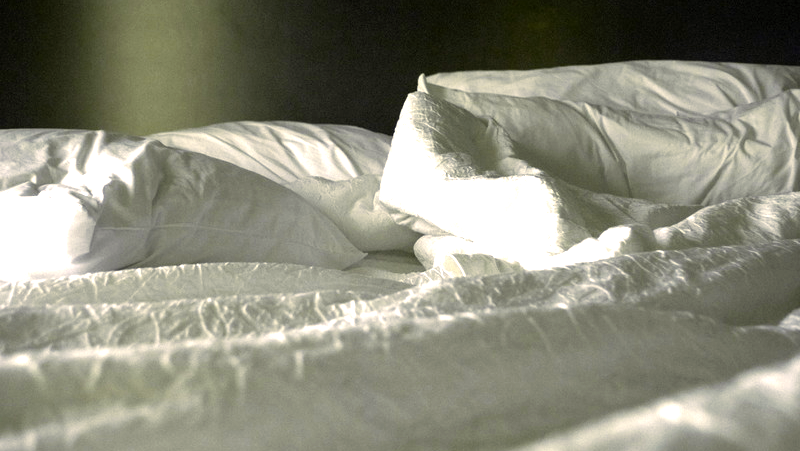
I am a completely horizontal author, to borrow Truman Capote’s phrasing. I’m in bed as I write this. By afternoon, my prone body will be surrounded by art books, apple cores, unspecified wrappers, printed-out transcripts, a pen or two, my phone and laptop, old notebooks, reading glasses, a mug of tea, a bowl of crumbs, and an imperious Boston terrier: a composition, certainly, though one that reads less as artistic transgression than as Viking funeral pyre, ready for a flaming arrow to set the whole thing ablaze.
Art…had always been the thing that kept me from absenting myself from my own life entirely.
I began writing in bed in my early 30s, when I discovered that I could conduct much of my introverted life from its shelter. A book columnist at the time, I read, wrote, and spoke to my editor from bed: an enviable arrangement for an obsessive reader with Crohn’s disease. “Still in bed I see!” my boyfriend might have, at times, been given to “joking,” but I never felt shame in writing where I did—why would I, when I’m in such excellent company? Colette, Mark Twain, and William Wordsworth all wrote habitually from bed, for reasons having to do with infirmity, comfort, and warding off distraction; Frida Kahlo painted self-portraits from bed, including the dreams that transcended her physical confinement.
My favorite bed-writer is Edith Wharton, who wrote longhand, dropping pages to the floor for her secretary to gather and type up in an adjoining room. She wrote in bed to avoid having to put on a corset, she said. Rigid garments, bright light, zoom faculty meetings, traditional measures of productivity and accountability: these things have no place in bed. The bed welcomes into its soft embrace the un-optimized self with her unmade-up face and unshowered body, her misanthropic tendencies and nebulous sense of time, her contentment with no public life at all. The bed resists public-facing things, hence its charge as a womb to tomb motif. The bed abides.
Early in my forties, when I found myself with an academic job, a family, and improved health, I joined the upright members of society, writing at a proper desk in a proper office. But a few years ago, when I began working on my book, How It Feels to Be Alive: Encounters with Art and Our Selves, I returned to my bed—60 x 80, rubber latex covered with a blank page of white cotton percale—not a workspace so much as a state of mind, a magic carpet and confessional combined. “This is where the magic happens,” as the celebrities giving house tours on Cribs, the old MTV show, would say when they arrived at the bedroom.
It seems counterintuitive now that I set out to write a phenomenology of art—that is, an investigation into art as a complex, ambiguous, and potent aspect of lived experience—in the same place to which, for years, I retreated from life almost entirely. Somehow, in returning to my old comfort zone, brimming over with half-strung thoughts and images I thought/hoped might link up into a coherent whole, my reactive, linear, rational brain gave way to the generative, tender, untrodden one. I don’t know about magic, but something happens in my bed, which is where I tend to think best—or more receptively, anyway, closer to the transition from theta to alpha brainwaves (which aren’t waves, in fact, but electrical pulses), closer to the connective tissue of self and the peculiar insights embedded within it, closer to the transmissions of wonderment and critique detectable in art. It was the right place for writing something I thought of as an investigation, an experiment that, like most creative projects, seemed a little quixotic and might or might not pan out.
It is in bed that the boundlessness of the subconscious meets the reality of the body. And it is here, while making things, that I will inevitably leave others unmade.
My mentor in graduate school, E.L. Doctorow—the person who first explained to me what criticism was and suggested that I might write it—liked to describe writing as something like driving at night in the fog. It’s a metaphor that tracks for me: you can only see as far as your headlights illuminate, but you can make the entire trip that way. How It Feels to Be Alive merges a few lanes of writing, personal, critical, biographical. What I learned from writing it is that art (of all kinds, including books and music) had always been the thing that kept me from absenting myself from my own life entirely.
One day, not long after I finished the book and my husband and I were doing a bit of housekeeping, he pointed out the outline of my body imprinted in the mattress: domestic archeology as intimation of mortality. The sight of this reminded me of the great artist of beds (with all due respect to Emin), the late Italian painter Domenico Gnoli, whose eerily exacting renderings of them at close range—often with a sarcophagus-like human outline under their carefully made surfaces—were much admired by Italo Calvino.
He was only 36 when he died of cancer, having never reached so-called “artistic maturity,” but I think Gnoli knew what he was getting at, even if he couldn’t have known just how little time he had left in which to do it. It is in bed that life begins and ends, where the life we envision abuts the one we experience. It is in bed that the boundlessness of the subconscious meets the reality of the body. And it is here, while making things, that I will inevitably leave others unmade.
__________________________________
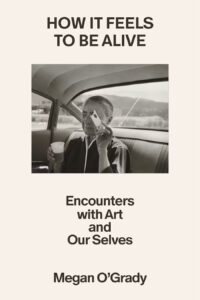
How It Feels to Be Alive: Encounters with Art and Our Selves by Megan O’Grady is available from Farrar, Straus and Giroux, a division of Macmillan.

Megan O'Grady
Megan O’Grady is a critic and an essayist. She was a writer at large for T: The New York Times Style Magazine, where she created the Culture Therapist column. Her reviews and essays about art and life also appear in The New York Review of Books, The New Yorker, and The New York Times Book Review. She was a contributing editor at Vogue and a fellow at the Nieman Foundation for Journalism at Harvard University. Currently, she is an assistant professor of art and art history at the University of Colorado in Boulder, where she lives with her family.