On the Early—and Unlikely Friendship—of John Adams and Thomas Jefferson
Jim Rasenberger Considers the Early Congressional Alliance of the Revolutionary War
John Adams liked to point out that Thomas Jefferson came late to the revolution. Before arriving in Philadelphia in the spring of 1775, the Virginian “knew more of the Eclipses of Jupiters Satelites than he did of what was passing in Boston.” That wasn’t quite fair. But it’s true that Adams had been sowing the seeds of independence far longer than Jefferson, first in Boston in collaboration with his rabble-rousing cousin, Samuel Adams, and then in Philadelphia, where he’d served in the First Continental Congress in 1774. Jefferson, having skipped the First Congress entirely, showed up late to the second.
He’d missed an eventful spring. In April of 1775, the first blood of the war had been spilled at Lexington and Concord. In May, a group of ragtag volunteers known as the Green Mountain Boys, led by Ethan Allen and Benedict Arnold, had launched a midnight attack on Fort Ticonderoga, on Lake Champlain, capturing British artillery.
Then came reports from overseas that a large fleet, carrying British soldiers and Hessian mercenaries, was headed for America. As urgent news flowed into Philadelphia that June, Congress sought to transform itself from a motley group of farmers, lawyers, and merchants from thirteen diverse colonies into an effective wartime alliance, while trying to create an army, as Adams put it, “out of nothing.” Five days before Jefferson arrived, on June 15, 1775, Adams had nominated another delegate from Virginia, George Washington, to command that army.
Despite the crowds, the rousing music, and the excitement, Washington’s departure was a solemn affair, freighted by the stunning fact that the American colonies were now truly at war with the British Empire.
The first meeting between Adams and Jefferson may have occurred the evening of Jefferson’s arrival, June 20, at the City Tavern on Second Street, across from the house where Adams boarded with the Massachusetts delegation. If not that evening, then it would have been the next morning, inside the assembly hall of the Pennsylvania State House (now Independence Hall), when Jefferson presented his credentials to Congress. The other delegates knew about Jefferson, mainly from an anti-British pamphlet he’d written, A Summary View of the Rights of British America, that had already gained the Virginian—in Adams’s words— “a reputation for literature, science, and a happy talent at composition.” A delegate from Rhode Island named Samuel Ward mentioned the arrival of “The famous Mr. Jefferson” in a letter home. The new delegate appeared to be, Ward wrote, “a very sensible, spirited, fine fellow.”
Two days after Jefferson’s arrival—Thursday, June 22, 1775—rumors began to reach Philadelphia of a fierce battle between British and American forces in Boston, on a rise called Bunker Hill (actually Breed’s Hill, but the name of the adjacent hill stuck). “We wait to hear more particulars,” John Adams wrote to Abigail. “If there is any Truth in this Account, you must be in great Confusion. God Almightys Providence preserve, sustain, and comfort you.”
The following morning, June 23, delegates and citizens of Philadelphia took to the streets to give George Washington a grand send-off as he began his journey north to take command of colonial forces in Boston. Despite the crowds, the rousing music, and the excitement, Washington’s departure was a solemn affair, freighted by the stunning fact that the American colonies were now truly at war with the British Empire. Adams told Abigail that watching Washington ride off made him yearn to follow the general north to the “Pride and Pomp of War.” But it was not to be. “I, poor Creature, worn out with scribbling, for my Bread and my Liberty, must leave others to wear the Lawrells which I have sown.”
He was “incessantly employed” in committee meetings and other congressional business from early in the morning till ten or so at night.
Not until the night of Saturday, June 24—a full week after the battle—did an express rider gallop up to the boardinghouse on Second Street where Adams and the rest of the Massachusetts delegation were sleeping. Rousing them from their beds, the messenger gave them the first full and accurate account of Bunker Hill. “An hundred Gentlemen flocked to our Lodgings to hear the News,” according to Adams. They learned the battle had lasted a mere hour, but had taken an extraordinary toll. American losses were devastating, approximately 140 killed and another 300 wounded—about a fifth of the men who’d fought.
Bunker Hill was technically a loss for the Americans, since the British ended up with the hill, but it was a moral victory. The Americans had inflicted a significant cost on British forces, who suffered more than one hundred officers and a thousand regulars killed or wounded. One of the many delegates to draw too much confidence from the outcome was Thomas Jefferson. “Nobody now entertains a doubt but that we are able to cope with the whole force of Great Britain, if we are but willing to exert ourselves,” he wrote to a friend back home. “As our enemies have found we can reason like men, so now let us show them we can fight like men also.”
Congress met in a chamber, forty feet by forty feet, on the eastern flank of the Pennsylvania State House. Three tall windows on each side let in ample light from the north and south. Despite the summer heat, the windows were often closed to keep out horseflies and the long ears of loyalist spies, so the air inside was stifling and pungent. Delegates powdered their hair or wigs with lavender and citrus to cast halos of fragrance around their heads, but that wasn’t much defense against the musk of fifty or so irregularly bathed male bodies buttoned up in frock coats in the middle of a Philadelphia summer.
They broke free when they could into the fresh air of the State House Yard, a pretty square of shade trees and walking paths surrounded by a seven-foot-high brick wall. Adams often conferred there with Samuel Adams or one of the other delegates, strolling under the trees, passing cannonballs piled up in preparation for a possible British attack. Then back inside they went to grapple with a numbing array of challenges. “Such a vast Multitude of Objects,” wrote Adams, “that We know not what to do first.”
When he’d initially arrived in Philadelphia with his more famous and charismatic cousin for the First Continental Congress back in 1774, John Adams had felt humbled to be among “a Collection of the greatest Men upon this Continent,” acutely conscious of his “own insufficiency for this important Business.” Those humble feelings didn’t last long.
On the contrary, Adams had never felt more alive.
By the summer of 1775 Adams was the most vocal and commanding man in the assembly hall, all five foot seven of him elevated over his fellow delegates by force of argument and sheer energy. He was “incessantly employed” in committee meetings and other congressional business from early in the morning till ten or so at night. Then it was off to the City Tavern for more debate or discussion, then back across Second Street to Mrs. Yard’s boardinghouse to dash off a letter to Abigail or read before bed. Then up at dawn to do it all over again. The animating occasion he’d dreamed of two decades earlier had arrived and he was meeting it with all his powers.
Not everyone appreciated the exertions. To those who disagreed with him, Adams was a tireless pest trying to force his views onto more moderate and prudent men. But to allies like Richard Stockton of New Jersey, he was indispensable—“the Atlas of American Independence,” as Stockton called him.
The term suited Adams well. He saw himself as bearing the weight of the universe, martyring his happiness and health to the cause of America. In letters to Abigail and friends, he complained of low spirits, insomnia, rashes, and failing eyesight. “I have Suffered infinitely,” wrote Adams, “at a Time when, a vast Variety of great objects were crowding upon my Mind.” This did not mean that he was unhappy. On the contrary, Adams had never felt more alive.
Adams’s primary task in these months was to drag and push his more reluctant colleagues to declare independence from Britain. He’d initially hoped for a peaceful resolution to the conflict with Britain, but after Lexington and Concord he realized that peace was not possible. Delegates who still held out for reconciliation—there were many—suffered from “a fatal Delusion,” he wrote, “against the clearest Evidence.” Pushing too hard, though, could alienate them. “America is a great, unwieldy Body. Its Progress must be slow. It is like a large Fleet sailing under Convoy. The fleetest Sailors must wait for the dullest and slowest.”
Despite his best efforts to play nice, Adams couldn’t help but show flashes of contempt for the dull and the slow. Inevitably, he made enemies. John Dickinson was the most formidable of these. Celebrated throughout the colonies as the author of Letters from a Farmer in Pennsylvania, a series of well-argued objections to British taxes, Dickinson had done as much as anyone to get the country to the doorstep of rebellion, but now he hesitated. Things were moving too fast, the risks were too great. Adams suspected that Dickinson’s Quaker mother and wife had talked him into his fearful state. “If I had had such a mother and such a wife,” Adams later said, “I believe I should’ve shot myself.”
One day, following a heated exchange on the floor of the assembly hall, Adams was walking out to take the air in the yard when Dickinson charged after him in a fury. “Look Ye!” shouted Dickinson. “If you dont concur with Us, in our pacific System, I, and a Number of Us, will break off, from you in New England, and We will carry on the Opposition by ourselves in our own Way.”
“Mr. Dickinson,” responded Adams serenely—in his telling—“there are many Things that I can very chearfully sacrifice to Harmony and even to Unanimity: but I am not to be threatened into an express Adoption or Approbation of Measures which my Judgment reprobates.”
Adams’s interest in Jefferson in these early days was more pragmatic and political than it was personal.
A short while after that exchange, British agents intercepted and published a letter in which Adams described Dickinson as a “piddling Genius.” When news of the letter got back to Philadelphia, Adams later recalled, “I was avoided like a man infected with the Leprosy.” The conciliators despised and shunned him, while the “true-blue Sons of Liberty” pitied and avoided him. Benjamin Rush later wrote that Adams was “an object of nearly universal detestation.”
But not entirely universal. He still had friends and allies, including men who may have disagreed with some of his conclusions but admired his integrity and his tenacity. Rush was one such friend. Another was Richard Henry Lee, scion of one of Virginia’s oldest and most prominent families. A gun accident eight years earlier had blown off four fingers on Lee’s left hand. Over what remained of the stubs, Lee wore a black silk glove, which he waved about for dramatic effect when he rose to speak in Congress, often in favor of some new resolution that had been made by John Adams.
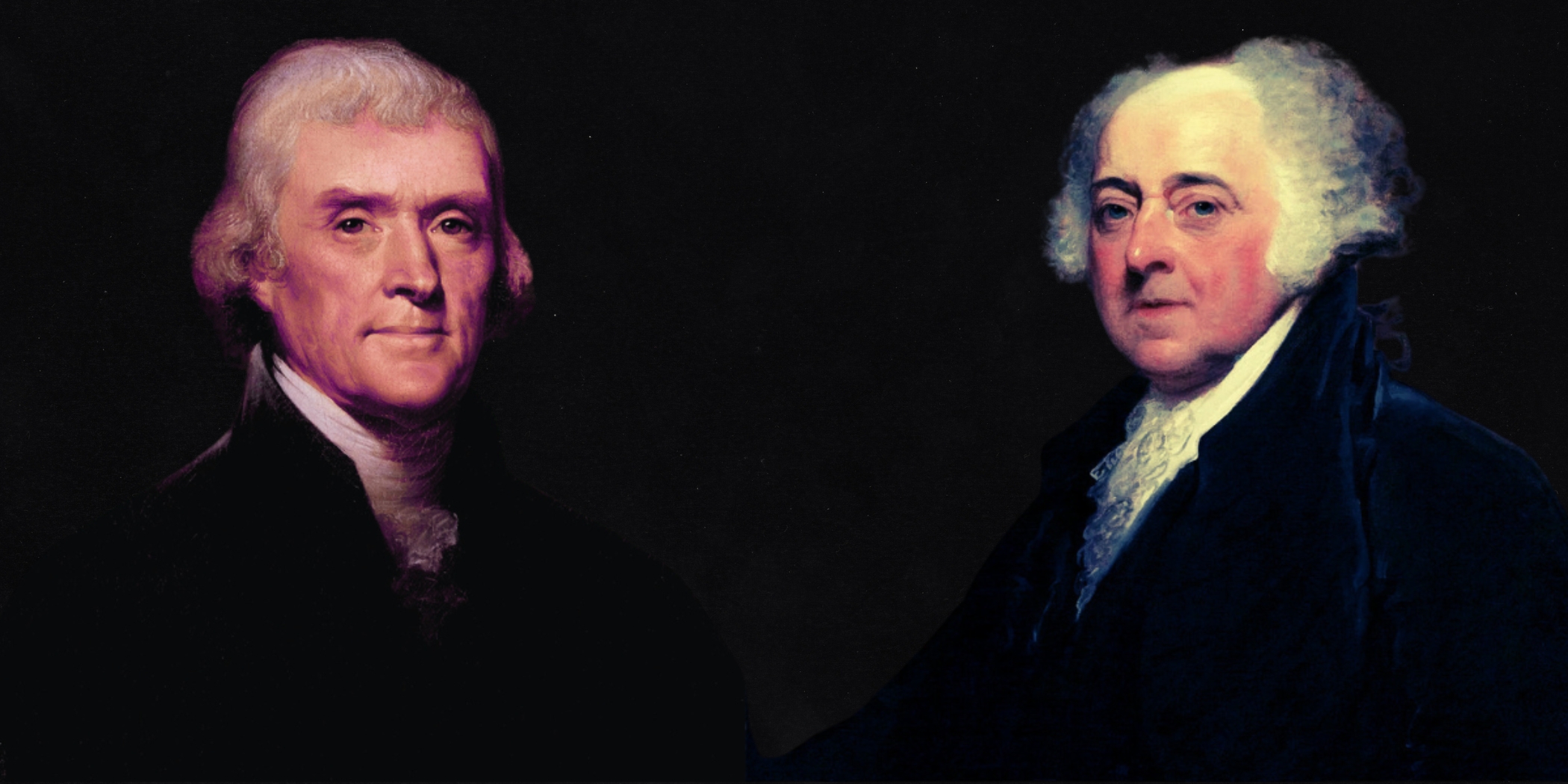
And then there was Jefferson. The two men were not yet close in 1775, but they served together on several committees and admired each other. Jefferson would later recall Adams in those years as “our Colossus on the floor.” Jefferson himself hardly ever spoke on the floor. “The whole time I sat with him in Congress, I never heard him utter three sentences together,” Adams later recalled. Mute as he was in full sessions, in smaller committee meetings Jefferson was “so prompt, frank, explicit, and decisive,” wrote Adams, “that he soon seized upon my heart.”
Adams’s interest in Jefferson in these early days was more pragmatic and political than it was personal. Other delegates tended to view the Massachusetts men, especially the Adams cousins, as hotheads bent on rebellion. Adams knew that by allying himself with gentlemanly Virginians, he could soften and broaden his push for independence. Hence his nomination of Washington to lead the Continental Army, and hence his partnership with Richard Lee, who acted as a kind of front man for some of Adams’s bolder measures. Before Jefferson became a friend, he was another useful Virginian.
Jefferson proved his usefulness soon after his arrival, when he was placed on a committee with John Dickinson to draft a declaration—not the declaration, which was still a year away, but rather a list of complaints for King George III. The document was called the Declaration on the Causes and Necessity of Taking up Arms, and it concluded with the statement that the Americans were “resolved to die Freemen rather than live Slaves.” Dickinson urged Jefferson to tone down the language, but even after revisions the document was strong enough to please Adams. “It has Some Mercury in it,” he wrote.
For all their conspicuous differences, Adams and Jefferson shared some important similarities that bound them in these early days. Both were highly educated, a rarity at a time when fewer than a dozen colleges (with just a few dozen students in each) served a population of 2.5 million. Adams had graduated from Harvard, Jefferson from William and Mary. Both had gone on to study and practice law. Even among educated men, both were exceptionally well-read. Jefferson devoured books with a “canine appetite,” as he later put it.
The same was true of Adams. Both were steeped in the science and political philosophy of the Enlightenment, and in the classical literature of the Greeks and Romans. While the likes of Bacon and Montesquieu and Locke taught them how to think with open yet skeptical minds—and to comprehend natural law and human rights—Cicero and Cato and Seneca showed them how to act with civic virtue. Where these influences ultimately took them would be different places, but they gave Adams and Jefferson an intellectual common ground.
The road to revolution had begun for both in 1765 with the Stamp Act, Britain’s first serious attempt to impose taxes on Americans to defray the costs of the French and Indian War. It was not so much the tax itself that inflamed Americans as the high-handed way the British imposed it, with no consideration of Americans’ opinions. Boston quickly became the center of the resistance to British taxes, and John Adams was soon drawn by his cousin Samuel Adams into a coterie of rebels, becoming a kind of in-house legal counsel for the Sons of Liberty. Though far from a revolutionary by nature, John was a stickler for law. As he saw it, the British were contravening their own laws in their treatment of Americans. Standing up to British tyranny was not breaking the law, but upholding it.
Thus, for the first time, Jefferson combined the argument for American liberty with an argument against African slavery.
When seven British soldiers opened fire on an unruly mob of Bostonians on a snowy evening in March of 1770, killing five men, Samuel Adams saw a propaganda opportunity to portray the British as savage occupiers perpetrating a “horrid massacre.” For John Adams, the Boston Massacre was an opportunity to demonstrate Americans’ respect for the rule of law, including the fundamental right of the accused to a fair trial and adequate defense. He took on the thankless task of defending the senior officer of the British soldiers. For his troubles, he was jeered by mobs, had stones thrown at his windows, and lost numerous friends, all of which, to Adams, proved the virtue of his actions. Adams considered his representation of the British soldiers “one of the best Pieces of Service I ever rendered my Country.”
The long-simmering feud with Britain came to a boil at the end of 1773, when a group of Bostonians dressed up as Indians and dumped a large freight of British tea into the harbor. The British escalated by imposing the Coercive Acts—or Intolerable Acts, as Americans called them—further establishing that the king and Parliament were as tyrannical as Samuel Adams said they were. If John Adams had any doubts about the cause of American liberty, they were gone now.
Later, he’d recall a poignant conversation he had in July of 1774 near Casco Bay, in what is now Portland, Maine (still part of Massachusetts at the time), where he’d traveled for his law practice. Adams took a walk early one morning up Munjoy Hill, high over the bay, with his old friend Jonathan Sewall, now attorney general for the British Crown. As the two men looked out over the sea, Sewall made a last-minute pitch to Adams to come and join Great Britain’s side while there was still time, warning that “her power was irresistible and would certainly be destructive to me,” Adams later recalled. Adams thanked Sewall for the advice, but told him he was wasting his time. “I had passed the Rubicon,” he told his old friend; “swim or sink, live or die, survive or perish with my country, was my unalterable determination.”
The year 1774 brought Jefferson across the Rubicon, too. That summer, at Monticello, surrounded by his books in his hilltop library, he’d composed the pamphlet that made him famous not just in Virginia but in Philadelphia. Jefferson’s A Summary View of the Rights of British America was one of the strongest and best articulated cases yet against the British, and the fact that it was written by a Virginian, not a Bostonian, gave it more impact.
A Summary View boldly asserted the right of Americans to self-rule and freedom from Britain’s “systematical plan of reducing us to slavery.” Along with metaphorical slavery of white Americans, the British were guilty of imposing the “infamous practice” of actual slavery on the colonies. It was the fault of the British that tens of thousands of Black people now labored in bondage on American soil. “The abolition of domestic slavery is the great object of desire in those colonies.” Thus, for the first time, Jefferson combined the argument for American liberty with an argument against African slavery.
But this is a story filled with irony, and here at the outset is one of the defining ironies of Jefferson’s life. As 1774 marked his debut as a champion for the cause of human liberty, it was also the year Jefferson came into possession of an inheritance from his wife’s recently deceased father. The inheritance gave the Jeffersons almost 11,000 acres of Virginia land and 135 slaves, adding to the 52 slaves they already owned, thus doubling “the ease of our circumstances” and making Jefferson one of the largest property owners in Virginia. It also subjected him to the financial debts that he inherited from his father-in-law with the land and slaves.
Debt and slavery were the twin evils that would haunt Jefferson for the rest of his life and undermine the idea most associated with his name: liberty.
__________________________________
Excerpted from A Perfect Coincidence: The Extraordinary Friendship and Astonishing Deaths of John Adams and Thomas Jefferson by Jim Rasenberger. Copyright © 2026. Reprinted by permission of Scribner, an Imprint of Simon & Schuster, LLC

Jim Rasenberger
Jim Rasenberger is the author of five books—A Perfect Coincidence; Revolver; The Brilliant Disaster; America, 1908; and High Steel—and has contributed to the New York Times, Vanity Fair, Smithsonian, and other publications. A native of Washington, DC, he lives in New York City.