Lucy Sante Recommends Five Books About Her Most Important Tool as a Writer: Memory
The Windham-Campbell Prize Winner on Works by Frances A. Yates, Vladimir Nabokov, Donald Westlake, and More
Memory is my most important tool as a writer. I’m fascinated by how memory works, how it is organized, all the methods that have been developed to increase it and explore it and to summon images from the depths of the past. I write about my own memories and those of other people because that is the history I pursue: the subjective experience of time.
*
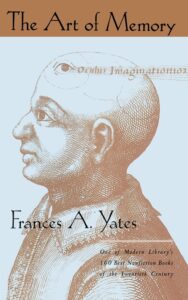
Frances A. Yates, The Art of Memory
It was pure kismet when, during college, feverish and flying on Robitussin, I had this book drop into my hand at the corner bookstore. Three pages in, I had entered a new continent. By that time Dame Frances had established the idea of theaters of memory—imaginary architectural structures, replete with columns and alcoves and windows, where items can be placed for later recollection. Remembering those items simply involves a mental walk. The idea was first proposed by Cicero and lived on through the hermetic tradition. It has affected my thinking ever since.
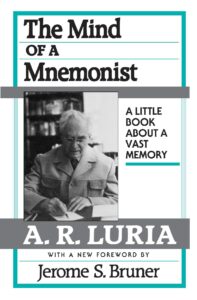
A. R. Luria, The Mind of a Mnemonist: A Little Book About a Vast Memory (translated by Lynn Solotaroff)
S., the subject of A. R. Luria’s case study, devised theaters of memory all on his own, distributing his items along Gorky Street in Moscow. “It appeared that there was no limit either to the capacity of S.’s memory or to the durability of the traces he retained,” writes Luria. S.’s memory was intensely visual, converting speech into pictures, and also synesthetic; every sound had its visual analogue. S. possessed a superpower, and a trip through his mind is wondrous. There is one tragic aspect, though: he was unable to edit or limit his constant firehose of memories.
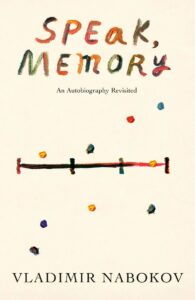
Vladimir Nabokov, Speak, Memory: An Autobiography Revisited
“How small the cosmos…how paltry and puny in comparison to human consciousness, to a single individual recollection, and its expression in words!” Even better when that power of recollection is amplified by imagination, an entomological fascination with the English language, and boundless self-confidence. Nabokov’s voice is both inside and far outside the story, looking down on his diorama with outsize field glasses, like Orson Welles as a narrator. The prose is hypnotic, all the more so for its many digressions and parentheses, unveiling tiny set pieces like so many Fabergé eggs.
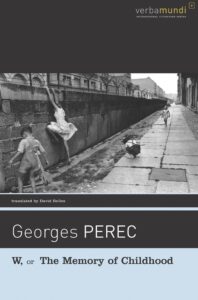
Georges Perec, W or the Memory of Childhood by (translated by David Bellos)
“I have no childhood memories,” wrote Perec, author of Life: A User’s Manual. He lost both his parents before age seven, his father to combat and his mother to Auschwitz. What he does come to remember is a story he wrote when he was thirteen, about a voyage to an “olympian” utopia that is gradually revealed to be a concentration camp. He alternates chapters between the reconstructed story and his sparse actual memories, which he pursues down to the last minuscule detail. The space between the two narratives is vast and echoing; the vibration it produces is his evocation of the Shoah.
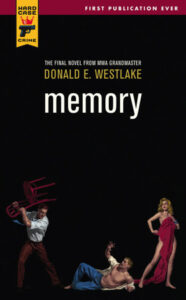
Donald Westlake, Memory
Prodigious crime novelist Westlake wrote Memory in 1963—the same year as The Outfit and The Score, two of the best Parker books—but it was rejected everywhere and published posthumously. Paul Cole has been caught in flagrante by an angry husband and severely beaten, leaving him with amnesia. Now he has to try and reinhabit his former life, which appears to him like someone else’s, while he can scarcely remember the previous day. Deeply harrowing, obsessive and recursive, weirdly plausible, twice as long as most Westlake novels, Memory invites the adjective “Kafkaesque” and does not disgrace it.
__________________________________
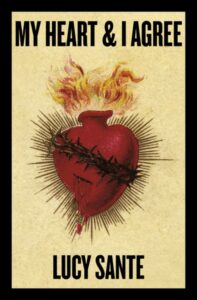
My Heart & I Agree by Lucy Sante is available from Verse Chorus Press.
The Windham-Campbell Prizes were the brainchild of lifelong partners Donald Windham and Sandy M. Campbell. The couple were deeply involved in literary circles, collected books avidly, read voraciously as well as penning various works. For years they had discussed the idea of creating an award to highlight literary achievement and provide writers with the opportunity to focus on their work independent of financial concerns. When Campbell passed away unexpectedly in 1988, Windham took on the responsibility for making this shared dream a reality. The Prizes are administered by Yale University’s Beinecke Rare Book & Manuscript Library, and nominees for the Prizes are considered by judges who remain anonymous before and after the prize announcement.
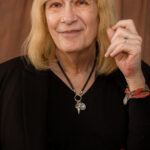
Lucy Sante
Lucy Sante is the author of Low Life, Evidence, The Factory of Facts, Kill All Your Darlings, Folk Photography, The Other Paris, Maybe the People Would Be the Times, Nineteen Reservoirs and I Heard Her Call My Name. Her awards include a Whiting Writers Award, an Award in Literature from the American Academy of Arts and Letters, a Grammy Award (for album notes), an Infinity Award from the International Center of Photography, a Windham-Campbell Prize for Non-Fiction and Guggenheim and Cullman Center fellowships. She recently retired after twenty-four years teaching at Bard College.