Lucy Ives Offers a Few Creative Prompts to Knock You Off Kilter
On Writing Without Measurement
This first appeared in Lit Hub’s Craft of Writing newsletter—sign up here.
I write prompts in the way someone else might write poems, micro-fictions, philosophical aphorisms, or other very small items of literature. Some of my prompts seem like paradoxical jokes: walk ten miles and write five words, or go across the room and write 10,000 words. But they are serious refutations of certain received ideas; they are about seeing how broader social measurements regarding what matters can be wildly inaccurate.
For example, we tend to think of a single sentence as inconsequential. Like, who cares? But if you have the experience of taking a long walk and writing a sentence, and you feel satisfaction, you might see how that sentence is amazing, how it’s totally worth it to walk ten miles to find it. By the same token, what if you went across your room and that act generated thousands of words? What does that tell you about just being present in your room?
How can this be? It’s a relief to realize that something we ostensibly don’t care about, or don’t notice, is a precious resource. These prompts might knock you off kilter and help you uncover something whose value can’t be measured and has nothing to do with measurement.
exercise for escapists
Choose a topic.
Now write a very short essay or poem about a very short essay or poem you will write on this topic.
Explain what the very short essay or poem on the topic will be about, what it will consist of—name the chapters and styles you will employ, words and metaphors, subject matter, arguments, interpretations the reader will certainly arrive at, and so on. Use the space of the very short essay or poem to exhaustively detail the very short essay or poem you will write on the topic.
Whatever you do, do not actually write the very short essay or poem on the topic. Write only the very short essay or poem on the very short essay or poem on the topic.
exercise for destruction of boredom
Give a friend, acquaintance, or neighbor an unexpected gift. Let the gift be as small and inexpensive as possible (free, if you can swing it). Document what takes place. Begin a diary of gifts you give and receive.
exercise for habitation
This is a versatile exercise, one that may be used both for creating new texts and for revising preexisting descriptions and narratives. If starting from scratch, see how far you can take this act of recollection.
The process:
1. Think of a room, vehicle, item of furniture, backpack, or other relatively intimate container that you no longer possess or have access to.
2. Now consider a compartment or small enclosure inside it—drawer, closet, corner, pocket.
3. Using your memory and/or imagination, make a detailed inventory of the possible contents of this small enclosure. Do your best to make this inventory as accurate as possible, (re) creating the space and feelings it evokes.
4. From your inventory, select one item that seems in some way charged, full, or otherwise significant.
5. Write the “life story” of this item—where it came from, how it came to you and why, what purpose it served, where it went, and what the future holds for it.
_______________________________________
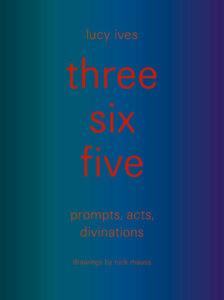
Adapted excerpt from three six five: prompts, acts, divinations (an inexhaustible compendium for writing) by Lucy Ives, with drawings by Nick Mauss, published by siglio, 2026. All rights reserved.

Lucy Ives
Lucy Ives is a novelist and critic. Her most recent books, both from Graywolf Press, are Life Is Everywhere: A Novel and An Image of My Name Enters America: Essays, winner of the 2024 Vermont Book Award in Creative Nonfiction. Ives’s work has appeared in Artforum, Harper’s, The New York Times Book Review, The Paris Review, and Vogue, among other publications. A recipient of an Andy Warhol Foundation Arts Writers Grant, she has taught at Brown, Cornell, and New York Universities. Ives previously collaborated with siglio as the editor of The Saddest Thing Is That I Have Had to Use Words: A Madeline Gins Reader.