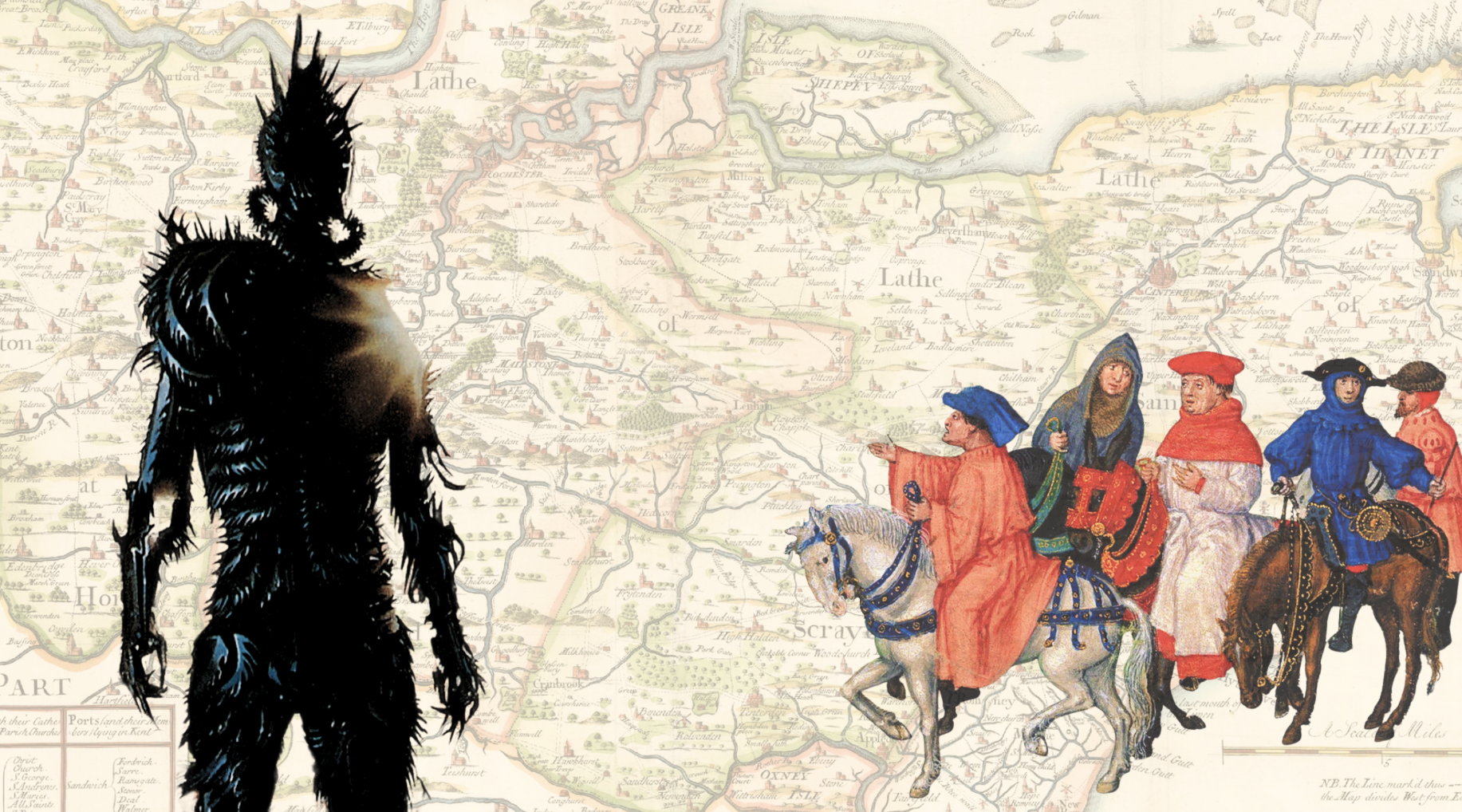
On the Road to Canterbury Reading Dan Simmons Sci-Fi Adaptation of Chaucer’s Classic
Adrian McKinty Searches For Fellow Pilgrims, a Copy of Hyperion in His Pack
The science fiction writer Dan Simmons passed away on Feb 21, 2026 at the age of 77. When I was living in Denver, working as a school teacher and attempting to break into novel writing, I got to know Dan a little bit. He lived in Longmont, Colorado and he had been an educator for nearly thirty years before retiring to write full time.
I kind of lost contact with Dan after I moved to Australia but I was pleased that his books had found a new readership after the HBO adaptation of The Terror. I’d heard that Dan had moved rightwards in his politics and become grumpy with his publishers, but there was no trace of this in his generous New York Times obituary (although the Guardian mentioned a furor around his novel Flashback which was supposedly and quaintly “pro Tea Party”).
I’d read several of Dan’s books but somehow I’d missed his most famous sci-fi novel of all, Hyperion, a retelling of The Canterbury Tales set in the far future. In late March I found myself in London with a canceled meeting and a day off to do whatever I wanted. I decided that what I wanted to do was to go to Canterbury (I had never been before) and since I’d already plowed through Canterbury Tales in college I thought that maybe I would try to read Dan’s book, Hyperion, along the way.
I’m not a pilgrimage guy and don’t really know how they work but this would, I supposed, be a pilgrimage of a sort thinking about Dan, Chaucer, mortality—all that good stuff, and maybe on the road I’d meet fellow pilgrims who would tell me their stories.
I set off from Hazlitt’s Hotel in Soho which is a book-stuffed literary hideaway in Central London. I walked through Bloomsbury to St. Pancras Station. I had lived in Bloomsbury before when I was a student so I was pretty familiar with the blue plaques everywhere letting you know where Virginia Woolf and the other members of the Bloomsbury set lived, worked and shagged.
I had begun a paperback version of Hyperion over breakfast and continued listening to the audiobook as I walked.
At St Pancras I discovered, with a little pang of disappointment, that the train to Canterbury was an express that only took an hour. If you’ve read Chaucer you’ll recall that the journey from Southwark to Canterbury took three or four days, allowing the pilgrims plenty of time to get to know one another and swap tales. But an hour? Henry Thoreau was not wrong when he said that the gain in speed and time from the locomotive and the telegraph was accompanied by an ineffable loss that we couldn’t quite put our finger on.
Hyperion is a richly layered sci-fi book that deliberately echoes the structure and thematic concerns of Canterbury Tales.
At platform 13 as I waited for the eleven o’clock train I had my first encounter with a fellow pilgrim. A white-bearded, possibly Scottish, man in jeans and a black hoodie lugging an enormous rucksack asked me if this was the platform for the Canterbury train. I told him confidently that it was. We looked at one another for a moment, both of us perhaps on the verge of revealing part of our tumultuous inner narrative. Then the man nodded awkwardly and sidled along the platform.
The train arrived on time and I entered an open plan carriage and found a seat with a table. The few other passengers were engrossed in their phones so I continued with the paperback version of Dan’s novel.
Hyperion is a richly layered sci-fi book that deliberately echoes the structure and thematic concerns of Canterbury Tales while also drawing deep symbolic and emotional resonance from the life and poetry of John Keats. Set in a far-future universe dominated by the Hegemony the novel follows seven pilgrims journeying to the distant world of Hyperion, each tasked with telling their story as they travel toward a mysterious and probably deadly encounter with the Shrike, a godlike alien being. Each pilgrim’s tale is told in a distinct narrative style, ranging from detective noir to tragic romance to theological inquiry. This storytelling framework allows Simmons to explore the broader universe indirectly, building a mosaic of perspectives rather than relying on a single narrative thread. The journey itself becomes as important as the destination, emphasizing themes of faith, redemption, and the search for meaning.
Each pilgrim is drawn to Hyperion for a private reckoning with the Shrike, and their motivations reveal a spectrum of human concerns. The Consul whom we meet first embodies political disillusionment and revenge against the Hegemony. The Scholar, Sol Weintraub, presents one of the most emotionally powerful stories: his daughter ages backward due to a mysterious illness contracted in the Shrike’s lair, The Time Tombs.
The first full tale is maybe the best one in the book, the Priest’s Tale, which explores religious faith and horror through a Priest’s encounter with a Christ cult that somehow existed thousands of years before Jesus’s appearance on Earth. The Priest tells the story of his mentor who found the cult on Hyperion and also stumbled upon a parasitic cruciform that granted a grotesque and terrifying form of resurrection that saw him effectively electrocuted, crucified and resurrected every day for years.
I was hungry now and I vaguely remembered Chaucer’s “Cook’s Tale” and how the cook had bragged about the quality of his meat pies.
The seven pilgrims are a microcosm of humanity and their shared journey underscores the central idea that storytelling is not merely a way to pass time, but a means of preserving meaning in a universe on the verge of an apocalyptic war that will likely end all human life. Hyperion, it turns out, is good classic sci-fi in the vein of Asimov, Clarke or Le Guin and I wish I’d read it before I left Colorado so I could have asked Dan a million questions about it.
“Next stop Canterbury,” the conductor announced and I put down the book and switched back to the audio version.
Canterbury West Train Station was a little bit out of town which was perfect as it allowed me to walk through the delightful medieval or possibly faux medieval buildings on a fine spring day. I was hungry now and I vaguely remembered Chaucer’s “Cook’s Tale” and how the cook had bragged about the quality of his meat pies. A Google search took me to the Old Weavers Restaurant where I had a fantastic beef steak and Guinness pie and drank a Whitstable Bay Organic Ale, possibly the kind of beer people were drinking in Chaucer’s day.
I still hadn’t spoken to anyone on my journey so I conversationally asked the waiter if he was a local. He said no, left the bill and abruptly walked off.
I arrived at the Cathedral around one o’clock and was a little taken aback by how few visitors there were. (I learned later that a meningitis outbreak in Canterbury had led to the cancelation of many coach and school trips.)
I made my way through the beautiful, surprisingly empty building and found myself at the shrine of Saint Thomas Becket.
The murder of Thomas Becket in 1170 was one of the most shocking events in medieval England; Becket, once a close friend and ally of Henry II, became Archbishop of Canterbury and defended the independence of the church against the king’s authority. Frustrated by Becket’s resistance, Henry reportedly exclaimed “who will rid me of this turbulent priest!” Four knights traveled to Canterbury Cathedral, found him and killed him. His death quickly turned him into a martyr, shocked Christian Europe, and forced Henry II to publicly repent.
I finally left the cathedral and made my way back through the town, stopping at a pub to read another hundred pages of Dan’s book.
One of the most comprehensive books about the secular-religious civil war in this period and the reverberations that followed in the wake of the Archbishop’s death is John Guy’s Thomas Becket: Warrior, Priest, Rebel, Victim. If, however, that’s too much for you, TS Eliot wrote a short, surprisingly dull verse drama about these events, Murder in the Cathedral, and Peter O’Toole plays Henry in an even duller film Becket (1964). Although, of course, O’Toole completely redeemed himself by playing Henry II again a couple of years later in the garrulous masterpiece A Lion in Winter (1968).
The shrine where Becket fell is marked by a stone on the floor and a modernist sculpture interpreting the murder that you’d think would be total shite but is, in fact, cool. I’m in no way religious but some places are clearly sanctified and this was one of those places. I found myself alone in the Thomas shrine for almost half an hour; I don’t know if my thoughts were profound but for me, anyway, it was a quiet, strange, arresting experience.
I finally left the cathedral and made my way back through the town, stopping at a pub to read another hundred pages of Dan’s book before getting the express back to London.
On the return train everyone was still consuming and being consumed by their phones. The English have always been a reticent lot and the smartphone has probably made this worse. EM Forster, of all people, foresaw this in his under-read science fiction novella (no really) The Machine Stops and by his injunction at the end of Howard’s End that we should “only connect!” Unfortunately I’m naturally shy and I suspect that even the great Paul Theroux who makes his living by bothering people on trains would have had trouble here. I knew I was never going to connect or get the stories of these people returning from Canterbury.
In fact that day I got no one’s story.
And I wasn’t even sure what my story was except maybe trying to figure out my relationship to a writer I’d met and liked but who possibly had gone off the deep end in recent years.
I got out at St. Pancras and went to the British Library which is just next door. I found one of the old nooks I used to work in and finished Hyperion.
You have to be a little nervous when a novelist writes a book about a character or characters being crucified, you can’t help wondering if he’s really talking about himself and his difficulties getting published and his or her conflicts with editors—of which in Dan’s case there were many. But Hyperion, I decided, isn’t about the future or crucifixion or The Canterbury Tales or John Keats. In fact it’s a meta-textual love letter to the beauty of words on a printed page. It’s about people who tell stories and people who want to listen to and read those stories. It’s a palimpsest of all the books that Dan had geeked out over in his reading life.
It’s a book for shy sci-fi nerds who are unable to talk to strangers on trains.
When I met Dan for the first time and he found out that I was from Ireland we had slipped easily into a conversation about Joyce’s Ulysses and now I began to wonder if Dan had felt constrained by genre fiction or whether writing in horror, thriller and sci-fi had freed him to say whatever he pleased within the tropes of the genre.
I don’t know the answer to that but I do know that for Dan stories, poetry and the written word were vital components of the good life and what philosopher Michael Oakeshott called The Great Conversation of Mankind.
On Keats’s grave in Rome (“the holiest place in Rome” Oscar Wilde famously quipped) his epitaph reads “Here lies One Whose Name was writ in Water” but in Hyperion Dan asks us to consider a universe where Keats’s verse and Chaucer’s characters live even as the Earth dies and the stars burn out.
For a teacher and reader like Dan it was books all the way down.
The written word as a candle in the dark.
This was the Dan Simmons I knew, a civil rights advocate, a passionate defender of libraries, special ed., books and public schools. This was the Dan Simmons I would choose to think about and remember after my pilgrim’s journey.

Adrian McKinty
Adrian McKinty was born and grew up in Belfast, Northern Ireland. He is the author of the DI Duffy series of detective novels and the 2020 NYT bestseller, The Chain.