







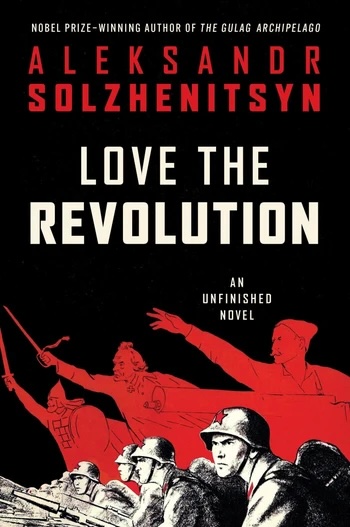
In 1948, Aleksandr Solzhenitsyn, then twenty-nine and incarcerated in a Soviet facility—serving an eight-year sentence for having criticized Joseph Stalin in his private correspondence—began writing an autobiographical novel titled Love the Revolution. The novel, which was never completed, was published in Russia in 1999, and will come out in English for the first time next month from HarperCollins. The setting for this passage, adapted from the fourth chapter of the novel, is Durnovka village, January 1942—the first wartime winter after the Nazi invasion of the USSR. The autobiographical protagonist, Private Gleb Nerzhin—assigned to a horse-drawn convoy, but ever striving to achieve his coveted goal of joining the artillery—finally sees his fate begin to change, with the arrival in his platoon of Political Commissar Petrov and Junior Lieutenant Brant.
—Ignat Solzhenitsyn, middle son of Aleksandr Solzhenitsyn
*
Brant’s Magnificent Night
On the anniversary of Lenin’s death, 21 January, a quiet warm evening suffused with a moist, melancholy mist, the company’s new political commissar, Petrov, came to the platoon to give a talk on Lenin. He had flaxen-colored hair, blue eyes, a snub-nosed face, an unremarkable voice, and an equally plain way of speaking. Illuminated by the yellowish light of a kerosene lantern in one of the farm’s rooms, Petrov offered a modest narrative on Lenin, emphasizing the importance of victory in the current circumstances. After the talk, Nerzhin resolved to come up, ask about the fate of his reports, and get Petrov’s advice concerning his grievous predicament.
“Ah, so it was you who wrote! And here you are in the flesh. Well, we did forward two of your reports to battalion HQ. Only they’ll probably be filed there and go no further. Reports of the rank and file aren’t generally sent on to the HQ of the military district.”
“So, what am I to do, Comrade Political Commissar? How can I get into the artillery?”
“When we move to the front lines, that’s where we’ll maybe have a chance to transfer you to some other unit.” He looked at Gleb with commiseration. “It’s really too bad, I know that mathematicians are needed in the artillery. I’ve seen units where several such men are at work. So where could I send you? How about the artillery depot? As a clerk? That would be easier—you’d be balancing books.”
This proposal would have been highly offensive were it not for Petrov’s unquestionably good nature. But no, never! Depot? clerk?—it would be a completely worthless transfer. Nerzhin shook his head.
The commissar gave an understanding smile:
“All right . . . I’ll keep my eyes open, of course. But I can’t promise to help. I just can’t.”
Yet he did help, and with Brant’s participation.
It began on a tumultuous February night for the platoon. In the evening, when everyone had already dispersed to their lodgings for the night, orderlies started running though the village, directing the men to gather on account of an alarm. The news was especially upsetting for those who had established good relations with their landladies, while Nerzhin’s heart skipped a beat in hopeful anticipation. Unused to this kind of thing, the convoy men rose from their beds unwillingly in response to this mystifying alarm, twisted on their footcloths, fastened their coats against the cold, and limped off toward the dairy farm. There, in a barracks-like room originally meant for calves, an attempt was made to draw up the men in fours, and, with the place tightly packed, some room still remained in front for the entrance of Junior Lieutenant Brant in his smoky-grey greatcoat crisscrossed by taut leather straps. After inattentively listening to the report of the awkward second-in-command, he began hurling lightning orders and opinions in a way that could make one think that the farm was already surrounded by Germans and that one would have to fight one’s way though fifty kilometers of enemy-held territory to reach safety. This menacing impression was only amplified when, in the midst of his rapid-fire orders, a door opened behind him, and two young convoy men stepped in timidly—they had not been alerted by orderlies because they’d been out romancing girls. Brant’s large eyes, set against the lamplight, seemed to fill with blood:
“Silence!”
(They were already silent.)
“Make no excuses!”
(They had made none.)
“You’ve forgotten your military duty!!” Brant raised his hand in a tragic gesture, extending his index finger, which cast a shadow over half the ceiling. “You are undermining our mission! I’ll make you . . .”—Brant had to catch his breath—“I’ll teach you to obey!” And then he roared with redoubled force: “There is a war going on!!! Yes!!” He cast a sharp glance at the platoon crowded in the cramped calf quarters and once again repeated that phrase to which he’d taken a fancy, uttering it as though he were the first to bring this news to the platoon: “There is a war going on!!! Get into formation! We must defend the Fatherland! Sergeant, I see no formation!”
But before the second-in-command had time to ask for permission to straighten out the ranks, Brant shouted at him in a tragic tone of voice:
“Forget it! It’s too late! You had months for that! It’s too late!!”
With mounting terror, the platoon began to see what grave danger it was in. But Brant—as if it had been not he shouting just now but, rather, an overly excitable underling three ranks his junior—switched to a coldly restrained and solemn tone:
“Attention, please. Comrade soldiers. In two hours, we depart Durnovka village. You need to receive fodder for the horses. Sergeant, distribute the platoon’s entire reserve. You must also have harnesses in full working order. Also, double-check how the horses are shod. Furthermore, whatever dry rations are available must be distributed to soldiers.” (The platoon sometimes received items listed in the army’s fourth category: flour, millet, and even meat on occasion.) “That’s all! Collect your belongings from your quarters. That’s all!!”
The ensuing turmoil and mad dashing about went on for several hours that night. Lanterns flitted back and forth by the stable, the sergeant cursed nonstop, all was abuzz with the voices of convoy men, there was a fight over a pail, in the dark someone nabbed somebody else’s knapsack for oats, and two carts collided somewhere, causing the axles to crack in one of them. Only the horses remained calm—they snorted their displeasure but obediently allowed collars to be placed on their necks.
Amid the creaks and rumbles of carts, the shouts, the peasant oaths, the flickering of lanterns, the neighing of horses—the tall, striking figure of Brant did not consider it beneath himself to rush around like Aleksandr Nevsky on the field of battle [as depicted in Sergei Eisenstein’s eponymous 1938 film. —Ed.]. Discovering ever new ways of projecting his voice, he kept appearing all over the place, shaking his fists and shouting that he wouldn’t stand for it, invoking the guardhouse (which didn’t even exist in the company), threatening to tear off heads or do something even more terrifying. And although the overstated absurdity of his threats crossed beyond anything that induced fear, it nevertheless achieved the result sought by Brant: to shake up the men, who’d sat all too long in peace and security. The behavior of the platoon’s commander left no doubt about one thing: in a few hours, and a dozen kilometers away, the platoon would be obliged to engage in battle.
Amid this hurly-burly, Nerzhin, too, caught it from Brant. He didn’t have time to clarify in his mind exactly how the carts were supposed to leave the farm, and didn’t take his proper place in the group of five carts to which he’d been assigned, with the result that he ended up to the side of the column. Brant, with giant strides, flew up to him in a fury, and even in the darkness flashes of his rage were easy to picture:
“Where the hell are you standing? Taking a military unit to a dive bar?? I’ll break your ar-r-rms and l-l-legs! . . .”
It was a magnificent night for David Brant.
Meanwhile the company’s veterinary intern, who had arrived with Brant, was examining the horses and found six sick ones that needed to be left behind. When Melodia and Iskra were already standing in the final row of carts, Nerzhin was summoned to the platoon commander. Brant was standing in the small separator room of the dairy farm, dimly illumined by a kerosene lantern and with his arms crossed à la Peter the Great contemplating the founding of St. Petersburg [as depicted in Aleksandr Pushkin’s famous 1833 narrative poem “The Bronze Horseman”—Ed.]. When Nerzhin entered, Brant cast him a tragically solemn glance that contained no trace of his recent outburst and proclaimed:
“Well, Nerzhin! You will always remember David Isaevich Brant.”
Nerzhin was unsure: Was this a farewell? Would Brant not be going with them?
Then Brant for some reason shifted to a tragic whisper:
“You’ll be staying here with the sick horses. You won’t be leaving. I did this for you. Hand over the cart and horses to Polulyakhov.”
The logic of the conversation, as envisaged by Brant, suggested that this was the point where Nerzhin should express gratitude.
But if they were going to the front?!
“David Isaevich! May I ask where the platoon is going?”
Brant gave a crooked smile that simultaneously expressed pity, sorrow, and doom:
“The platoon is going where the company is going. And the company is going where the battalion is going.”
“And the battalion?” Nerzhin made bold to ask directly—also in a whisper now—about this major military secret.
Brant made no effort to conceal it:
“To the Khopyor River. We’re going to build a new bridge that will secure communications during the spring floods.”
“Ah, so it’s not to the front . . .”
Brant drew himself up with dignity:
“This is more important than the front!”
“Will it be for long?”
Brant shrugged his shoulders:
“I’m a military man. How should I know?” He raised his voice, making it sound merciless: “I receive an order”—then, shifting his tone to one of austere self-sacrifice—“I say ‘aye-aye’. I’m a soldier, Nerzhin. When you’ll become a soldier, you’ll understand.”
Brant glanced at the reflection of his heroic pose on the dark panes of the shuttered window and added quietly:
“It’ll take three months or so.”
“And then you’ll return here?” Nerzhin himself didn’t notice that he’d said “you’ll return” rather than “we’ll return.”
Brant once again signaled ignorance by shrugging his shoulders: he was a soldier, after all.
“I know, Nerzhin, that it would have been difficult for you. That’s why I’m leaving you here, with the ailing horses. Of course, you don’t know a thing about horses, but Poryadin will stay with you and will be in charge in that respect. You are going to visit the post office and collect the mail for all of us . . . You will always remember David Isaevich Brant, Nerzhin.”
And indeed that’s how Brant remained in Nerzhin’s memory: standing in a dimly illumined separator room amid milking pails, dressed in his perfectly fitted smoky-grey greatcoat, and uttering that proud phrase that would prove to be prophetic.
__________________________________
From Love the Revolution by Aleksandr Solzhenitsyn, translated from the Russian by Alexis Klimoff and Michael Nicholson. Used with permission of the publisher, Harper Perennial. Copyright © 2026.