I never liked cleaning my room. At home, I would let dust coat my windows like dryer lint before finally listening to mama and taking a wet paper towel to the glass. My clothes, a mountain range of frilly skirts, dark jeans, and long-sleeve dresses on my bedroom floor. Baba said we must—and that was the word he used, “must”—keep the house clean. He worked his whole life for this house, he would say, then tell us, again, how he got here, that he moved here all alone when he was in his twenties, with two hundred dollars and a brown suitcase and three words in English: “water,” “church,” and “Lemonbalm,” the street where his cousin lived. He was proud of the house. “Four bedrooms, three bathrooms, a pool, and a hot tub,” he would tell anyone who asked. The contracting company he hired did most of the work, but the paint, all the paint in the house, came from his own company. The violet in the dining room. The cloudy white of the kitchen cabinets. The teal ceiling in his office.
Today I sweep crumbs, gritty as sand, off the car seats and into my palm. I consider eating them but then notice a dead ant in the pile and toss it all out the door, the dried grains of rice, the bits of crackers and granola bars. The ant, curled like a comma in my palm. I reach into my backpack for the red hibiscus flower I picked from a bush earlier this morning and stick the stem into my seatback pocket, the flower bright as a flame against the gray seat.
Later, while Rafa plays with his toy cars, vrooming them over the headrests, honk-honking them, and while mama reads an old newspaper she found in the trunk, using her finger to follow along, mumbling to herself, I reach across them to pick up tissues, empty water bottles, dirty clothes. The way things pile up so quickly afterward, it is like they do not notice. While we are getting ready for bed, I wince at mama’s newspaper splayed out on the passenger seat, unfolded. I check the front seats, then the back. There are toy cars in every cup holder.
“Could you please pick that up?” I ask Rafa, pointing to the plastic T. rex he dropped face down on the floor.
He shakes his head. “He’s sleeping.”
“I said please.”
“Say pretty please.”
“Pretty please.”
“Say pretty-pretty-most-beautiful please,” he says, crossing his arms.
I groan, throwing my head back.
Rafa smiles and picks up another dinosaur by its tail. A stegosaurus. He drops it and it lands on top of the T. rex. “What?” he says, looking up at me. “He was lonely.”
Mama sits up and lays her pillow flat on its back, the mascara and lipstick stains on the cover like the abstract paintings I learned about in art class last year—red smudge here, black line there, mostly white canvas. If the car is a museum, I am looking at the other exhibits around me. Plastic Rice Bowl Under Seat, Blue Scrubs Draped Over Headrest, Tissues Stuffed into Door Pocket, Dirty Socks in Plastic Bag.
Outside: Overfilled Fly-Buzzing Green Dumpster, Flattened Oil-Stained Pizza Box, White Napkins Covering Ground Like Snow.
*
When mama goes to work on Monday morning, we wait in the car with the windows rolled down. The air gusts inside, cooling off the car seats, the vinyl hot, steaming. It feels too hot, too humid, too sticky for the second week of November. Rafa starts to fidget around noon before mama is supposed to meet us for her lunch break. His stomach growls an angry growl, and mine a sad, low drone, and he declares himself the winner of empty stomachs. He wants a prize.
“Peanut butter cookies, please,” he says.
“Coming right up,” I say, and pretend to crack an egg into a bowl, mixing it with a plastic spoon I found under my seat. “Help me shape them into cookies?” He nods and cups the invisible dough into balls before flattening them into disks between his palms. When I take them out of the oven—a tissue box—I can almost smell them. Nutty and roasted and sweet.
Rafa pouts. “I want real ones.”
“I know,” I say. “Me too.”
The heat in the car is like an aunt who does not stop smothering us. Even with the windows open all the way, the heat is hugging us, kissing us, pinching our cheeks. Its perfume—hot, hot vinyl—sharp in our noses. I try to read to Rafa, but my stomachache makes me dizzy, and the words lift off the page and flit around me like lazy bugs, the letters sprouting wings to fly off to better places. To keep him from crying, he and I play counting games and then the quiet game, waiting for mama. When we play I Spy, he tells me over and over again what he spies with his littlest eye, and it is always parking lot-related because we are parked here, behind the clinic. He spies lampposts, uniformed delivery men, and a folded-in-half parking ticket picked up by the wind, fluttering like a butterfly, free.
*
On her lunch break, mama walks us over to the library still wearing her scrubs. The library is a one-story brick building with two white pillars up front sticking out like tusks, smooth and thin. To the left of the revolving door, there are doily-shaped pink flowers, plants with leaves as big as elephant ears.
“Here,” she says, reaching into her purse to hand an apple to Rafa and a pear to me, a handful of napkins to both of us. “From the break room.” I bite into the pear, its juice so sweet I feel like I have bitten into a sack of perfume, pale yellow juice dripping down off the side of my mouth. I wipe it with the back of my hand.
“So, what do you say if someone wants to steal you?” she asks us with her hands on her hips. It is our ritual, her question, my answer.
“That my mom would pay them to.”
Mama winks. “That’s right.”
When we finish, we toss the cores into the square mouth of the trash can. They reach the bottom in a thump. Mama pats Rafa’s head then ruffles his hair. “Be good,” she tells him, touching his cheek. “Listen to your sister.”
From one to four, I find a book, a chair in the corner, and watch the sun settle around me like an orange shawl as I turn the pages. At four thirty, pink streaks the sky, like the time mama stepped on the brakes too fast at an intersection and the tires scraped the road black.
I walk through the aisles, passing through physiology, philosophy, parenting. In the parenting section, I thumb through a thick manual titled Adolescent Child-Rearing and stop on a chapter titled “Methods of Reinforcement: Positive or Negative?” After skimming a few paragraphs, I decide that baba used negative reinforcement, that positive reinforcement makes more sense to me, and that I will practice on my brother.
*
Later that night, after mama sets herself up with her pillow, Rafa says his prayers like abuelo taught him when we last saw him, three years ago at abuela’s funeral: God, thank you for the car, for mama, for Sofia, for the peanut butter cookies today.
Mama turns her head back to look at us. “Cookies?”
“Made-up cookies,” I say.
“Oh,” she says. “What’s a made-up cookie?”
I open up the book I checked out. The index card tucked inside the book says my name, almost like it belongs to me. And it does for two weeks.
“Besitos,” mama tells Rafa when he finishes his prayers. He makes his way to the front seat and gives her his forehead, which she stamps with a kiss, her vanilla lip balm leaving an oily gloss on his skin.
After a few minutes, I turn on the overhead light on my side. It yellows the first page. For a few minutes, until my eyes get heavy and the words blur, unfocused, I am a girl on a farm eating sun-warmed strawberries, real ones, plucking off the stems and leaves in one quick pull, as if I were removing a feathery green hat from the top of each one, balding them. She must choose between man one and man two. They have names, but I am so sleepy, I cannot remember them, and besides, there are strawberries to eat—strawberries so real they could probably stain her shirt red.
__________________________________
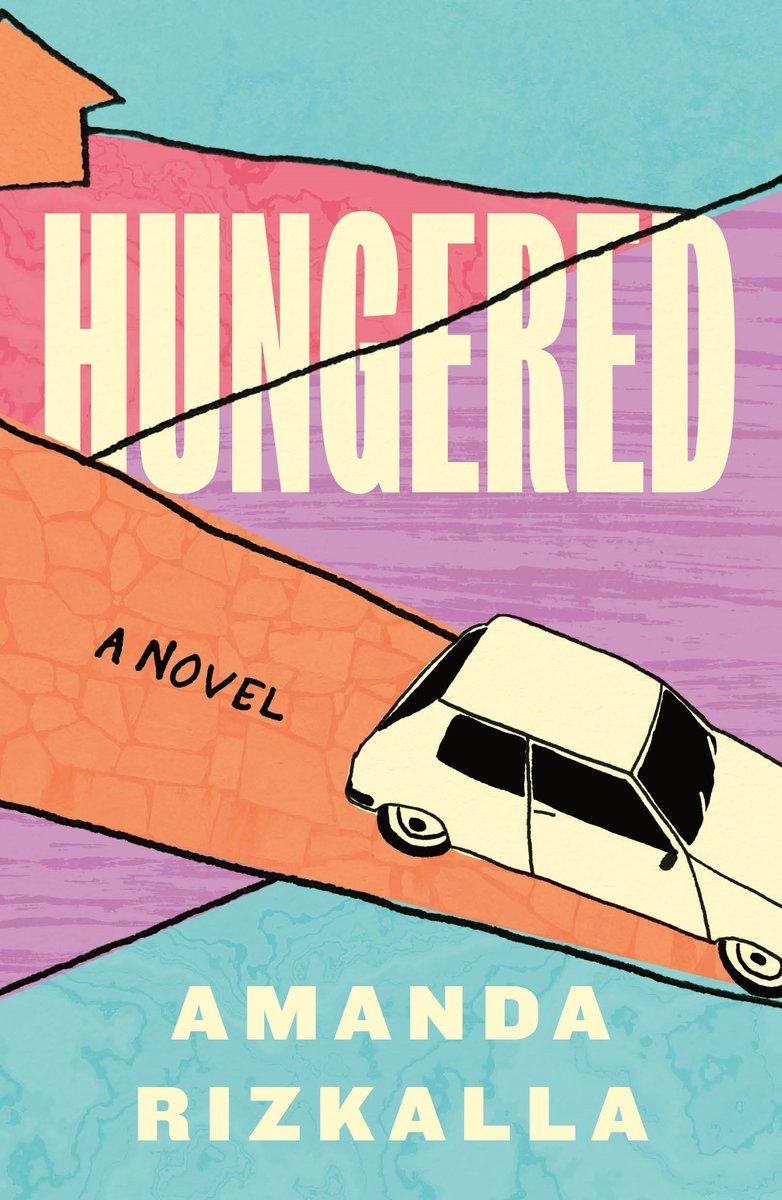
From Hungered by Amanda Rizkalla. Published by Henry Holt and Company. Copyright © 2026 by Amanda Rizkalla. All rights reserved.