Beyond Man U: One Man’s Journey Into the Depths of English Football’s Lower Divisions
Todd Smith on How a Lifelong Passion For Soccer Led Him Across the Pond
I was baptized into the sport of soccer during the raucous days of the North American Soccer League (NASL) when my dad, Gary Smith, was the head athletic trainer of the Minnesota Kicks. In the late seventies, the NASL was a traveling circus. Fans went to rowdy, beer-soaked tailgates and postgame rock-and-roll concerts. The players were primarily foreign born, with the United Kingdom being particularly well represented, and because of this, I was immersed as a child in British football culture.
I would tag along with my dad to work and roam freely through locker rooms and practices. I picked up slang like “dodgy” and “cheeky.” Places like Blackpool and Nottingham Forest and Stoke-on-Trent that I’d read about in the Minneapolis library were brought to life by the players talking about their former professional clubs. When the Kicks went to England for training and exhibition, I went, too, visiting the old grounds of English football—great fortresses of steel and concrete and fencing, where the matches were sodden and scrappy and my dad’s training room came to look like a wartime triage tent.
My favorite Kicks player was a gent from Cambridgeshire named Mike Bailey. Bailey wasn’t as popular as some of the starrier NASL imports like Pelé, Franz Beckenbauer, Johan Cruyff, and George Best, but he was a legend in his own right, a bruising midfielder with the roguish good looks—heavy muttonchops included—of a swashbuckling pirate. Known as “a hard man,” a tough tackling butcher who patrolled the midfield looking for legs to chop down, he’d been the championship-winning captain of the Wolverhampton Wanderers back in England in 1974. Bailey was Robert Plant’s favorite player, and during a Led Zeppelin concert at the Kicks’ stadium in 1977, the singer shouted him out. In my impressionable eyes, no one was cooler than Mike Bailey. Because of him, I became a Wolverhampton fan early on in life and have stayed that way ever since.
Inspired by Bailey, I became a soccer player myself. I played year-round from a young age, evolving into a runty and mouthy left-footed left back with the physicality of a honey badger. I was a three-year starter on my high school’s varsity team. Meanwhile, the NASL folded in the mid-eighties, but my dad took a job as head trainer of a new team called the Minnesota Strikers, who played in the Major Indoor Soccer League. My first job was as my dad’s locker room attendant, so I spent nights and weekends in the company of the players—these included the English-born Alan Merrick, Kenny Fogarty, Allen Willey, Steve Litt, and Brian Kidd.
As much as I dreamed of being a wealthy, prize-winning writer—a Manchester United of literature, let’s say—that fantasy never really came together for me. I was more of a Wolverhampton of literature.
I went on to St. Mary’s College in Winona, Minnesota, an NCAA Division III college where I was on the soccer team for one year. A year later, I transferred to the University of Montana and left my soccer-playing days behind. I was crispy with burnout from playing and training year-round for close to a decade and sought refuge in the cool trails and mountains of the West. After graduation, I led a nomadic existence, living in Hawaii and Los Angeles and New York City, and only dabbled in pickup games but nothing serious. I eventually returned to Minneapolis and fell in love with my wife, Sarah, got married, and started a family when our son, Murphy, was born. When Murph was a baby, life was simply too busy for a proper kickabout.
Though I was no longer a soccer player, my love for the sport didn’t fade. It just turned into an obsessive, couch-based fandom. Every weekend from September to April, the house I shared in South Minneapolis with Sarah and Murph filled with the roar of supporter chants and songs on the TV. In addition to watching the English Premier League—widely considered the top soccer league in the world, and indisputably the wealthiest and most watched—I began keeping tabs on some of the lower-league teams that I’d heard about from the Kicks and Strikers players.
As much as I appreciated the skill of the top players, over time the British towns and fan bases I found myself relating to more were the scrappier ones that filled the many lower divisions. I loved stories of perseverance and courage in the face of staggering odds (my dad was also the head athletic trainer for the 1980 “Miracle on Ice” United States men’s hockey team, ahem), and I became obsessed with the unique structure of relegation and promotion that can mean death or survival for teams without billionaire owners. The English football system, which has been in place since at least 1898, “promotes” the top few teams in each division and “relegates” the bottom few down to the next division. For a smaller-market team, moving up to a higher level of the game can bring life-changing money that boosts the local economy, the job market, and a town’s identity. The reverse can have devastating ripple effects.
It wasn’t hard to determine why I related to the lower-level teams. You see, as much as I dreamed of being a wealthy, prize-winning writer—a Manchester United of literature, let’s say—that fantasy never really came together for me. I was more of a Wolverhampton of literature, a bruised and calloused writer toiling in the lower leagues with occasional flashes of glory. I’ve published two books, one a nonfiction story about ice hockey and one a memoir that I helped Olympian Jessie Diggins, a cross-country skier from Minnesota, write. I’ve also been a sports journalist and a magazine columnist. But I’ve never made much money or gotten much recognition from my writing. Instead, I’ve spent my career in the Twin Cities landscape and gardening industry.
For the past five years, I’ve been the director of a landscape supply yard called Hiawatha Supply, where we sell soil, mulch, and rock in bulk. I spend half my days driving heavy machinery and the other half managing the business side for the company’s owners. Before Hiawatha Supply, I managed another supply yard, and before that, I worked as a day laborer at a garden center, and before that, I toiled in a grocery store dairy cooler, and before that I worked in various warehouses. My occupations have given me a happy, humble, quiet life, but always nagging in the back of my mind has been a case of impostor syndrome. I’ve felt like I never really made it as a writer.
Then, in 2021, I was given the opportunity through a connection at The New York Times to submit an essay about a local organization I’d started six years prior called the Donkey Soccer League. Organizing the league had brought my sporting life back into the present tense after a two-decade hiatus. It felt great to play again, albeit badly. We were no longer the thoroughbreds of our youth and had resigned ourselves to being beasts of burden. But what kept me and the other out-of-shape dads and assorted middle-aged nitwits coming back every Sunday, year-round, was the brotherhood we formed. As aging soccer players, we had tapped our collective histories with the game to grab something that most adults had lost along the way: a love for the golden art of pickup soccer. More important, my fellow Donkeys included immigrants from Ireland and England and various South American countries. Donkey soccer was our reprieve from the weight of the world and the foundation of an unlikely community during a time when political forces were trying to build walls between us. That’s what I wrote about in my essay.
As I waited to hear back from the editor, I couldn’t help but acknowledge how much getting published in The New York Times would mean to me. I fantasized that if I could just see my byline in the same place as those of my writing idols—Dan Barry, John Branch, Rory Smith—I would finally have made it.
Then the piece was rejected. In the nicest rejection email ever, the editor told me that the essay was “perfect as-is” but it was simply too long. “And we don’t see any place to make cuts to it to try to make it fit.” As kind as that sentiment was, my confidence was cratered. The experience nearly broke me—it felt like confirmation that all my dreams were dead. By this point, I was nearing fifty, and I wore the scars of working outdoors. My fingers had been smashed and cut and blackened so many times I’d lost count. I had early onset arthritis in my hands, feet, and shoulders. A growth on my eye—the result of chronic sun exposure—was slowly squeezing my vision. But with writing feeling like less of a career option than ever, continuing to run the supply yard seemed to be my only choice.
For the months that followed, I kept writing here and there, but without much drive. I watched sports. I ambled my way through Donkey League games. I did my job at work, and grilled chicken for Sarah (who hated to handle raw meat), and helped raise Murph (who was nearly done with high school). But I was teetering dangerously close to a sad-sack midlife crisis.
That’s where I was at, mentally, in 2022, when I found myself watching an English football match between Premier League giant West Ham United and the Kidderminster Harriers, a lower-division club that I’d never heard of before. The match was part of the 2022 FA Cup tournament, the oldest national football competition in the world. The magic of the FA Cup is that it is open to all eligible clubs from the Premier League all the way down to the lowest level of the English football system. This creates true David-versus-Goliath scenarios, matches between the best teams in the world and those on the very fringes.
At the time, West Ham held fifth place in the Premier League and was battling for a spot in the vaunted Champions League, a yearly competition for the top club teams in all of Europe. Kidderminster, on the other hand, was in the National League North, six tiers down. The match was played at Kidderminster’s tiny Aggborough Stadium and not at West Ham’s sprawling one in London, where the opening and closing ceremonies of the 2012 Summer Olympics had been held. This meant an English Premier League club worth $1.1 billion had to travel by coach to the town of Kidderminster, which resided on the edge of obscurity, sandwiched between Shatterford and Stourport-on-Severn in the country’s Midlands region. Instead of playing in front of sixty-eight thousand spectators, they had to play for three thousand.
Kidderminster led 1-0 from the nineteenth minute to the ninety-first. I was mesmerized by the images on the TV. Supporters were spilling over each other in the stands and pressed up against the railings, sauced and sweaty and singing and cheering their boys on. The Kidderminster players had day jobs and worked as plumbers and lorry drivers in their spare time, and they were going toe-to-toe with West Ham’s world-class players. In the corner of the screen to the side of one of the goal lines was a food truck, where a grizzled man in a soiled white chef’s apron smoked cigarettes while taking a break from serving meat pies. This was about as far from the glitz and glamour of the Premier League as I could imagine, and I absolutely loved it.
In the last seconds, West Ham’s Declan Rice, an elite English midfielder who would go on to sign a record-breaking contract a year later with Arsenal for £105 million, tied the match with a thumping shot that exploded into the Kidderminster goal. With the game knotted at 1-1, the match went into extra time. West Ham’s Jarrod Bowen, a magically shifty winger, scored the winning goal in the 120th minute (or “at the death,” as it’s known in English football parlance). It was a heartbreaker.
After the game, the Kidderminster Harriers and the valiant fight they’d shown kept tickling at my brain. There was something there that wouldn’t go away.
I casually opened my laptop and typed in the team name.
And I fell down a rabbit hole.
Kidderminster was home not only to a football club but also to a “Museum of Carpet.” According to a newspaper poll, the team sold the best meat pies in town at their home matches. There were teams in their division named Kettering Town and Leamington and Spennymoor Town. I read about the Wycombe Wanderers and the Dorking Wanderers and the Stockport County Hatters—real names, to my delight and awe. What is the worst city in England? I asked Google. Apparently, it was a decimated former fishing port appropriately named Grimsby. Was Boreham Wood a real team or the greatest porn star name ever? They were somewhat disappointingly a real team and not a porn star and were currently in a real dogfight with a club from a place called Slough Town. I searched and read and searched some more. I envisioned myself in these places. I couldn’t get enough.
When I was done and the screen’s glow faded, I was struck by a new sense of purpose. I didn’t want to be three thousand miles away from where the sport I loved most was invented and obsessed over in every region of the country. I wanted to go there. I wanted to attend matches in the grand cathedrals of English football and in the tiny stadiums nestled in the nooks and crannies of factory towns. I wanted to meet the characters who inhabited those worlds. I wanted to sing the songs. I wanted to press against the sideline railings. I wanted to go to the pubs and roar through the night. I wanted to be a part of a football-mad tribe of locals in a place where nothing mattered but the game at hand.
I wanted to go there. I wanted to attend matches in the grand cathedrals of English football and in the tiny stadiums nestled in the nooks and crannies of factory towns.
I wanted to eat the meat pie.
The flicker of my old writing ambitions sparked to life. I asked myself, What if I wrote a travel memoir about one American rube’s journey through the world of English football?
*
Not long after that day, Sarah came home from her job as a cashier manager at a garden center and saw the giant map of the UK that I’d affixed to the kitchen wall with painter’s tape.
This new purchase marked the names and locations of more than 150 football teams. They sounded like mystical places from a Tolkien adventure. There was Chippenham Town and Cheltenham Town, York City and Yeovil Town, Havant and Waterlooville, Dagenham and Redbridge. There was Bonnyrigg Rose, Dulwich Hamlet, and Dumbarton.
The front side of the map had all ninety-two football teams in the top four divisions—the Premier League and the three tiers collectively known as the English Football League: the Championship, League One, and League Two. On the reverse side were the locations of the seventy-two teams that make up the first three divisions of the National League System, which sits below the English Football League. Despite the National League having the word “league” in its name, the teams that form its many, many divisions are commonly referred to as “non-league.” In simple terms, this means they’re only semiprofessional or amateur in status—though in the highest of the non-league divisions, the National League (singular), that’s not usually the case. So yeah, it’s wonky. But to put it simply, there are ninety-two teams in the top four divisions and more than fifteen hundred in all the divisions below that—which includes the three that were on my map (the National League, the National League North, and the National League South) and then approximately thirty-three others.
When Sarah’s eyes moved from the map to the paper piling up in my writing nook marked with the chicken scratchings of a madman, her eyebrows arched to the highest point eyebrows can arch. She knew better than anyone what this mess meant.
“I’m kicking the tires on a book about English football,” I confessed. “I’m thinking it might be a travel memoir where I visit teams all over the UK from all different divisions.”
Instead of shooting down my harebrained idea, she continued to be the most golden person I’ve ever met, the human embodiment of the good vibes and bouncing beat and sweet guitar licks heard in the opening chords of the Grateful Dead’s “China Cat Sunflower.” She had seen me wrestling with my writing demons. She just had a few stipulations.
“I get it. It makes sense. This book is the one you’re meant to write. But can you wait until Murphy is in college? Can you wait a year? We need to see how much college is going to really cost,” she said.
All good marriages are simply a long conversation. When your partner is a creative person toiling away as an artist, that conversation is typically a tangled knot of hearts and minds and money and desires and needs and space and time. The balancing of finances and work and creativity has been part of our life since our first date.
“Yes, for sure,” I said. “I can wait.”
“I know the writing has been hard for you lately. I know you’ve really been struggling,” Sarah said softly. “And I know you’ve contemplated quitting. Out of all the other nonsense you’ve written and out of all the ideas you’ve conjured up, this one is inside you. Go on and tell this story. But just so you know, I really enjoyed having you around the house not writing a book for the last few years. I enjoyed having a functional husband.”
“Me too.” I laughed.
“I will only ask you to do three things for me as I reenter my role as the Writer’s Widow,” she said, using a term of her invention. “First, you will have to grill chicken for me every Wednesday and Sunday.”
“Fair.”
“Second, you’re going to have to move this map and all this writing shit to the basement. I can’t live with it in my kitchen.”
“Fair.”
“The third thing is: Can Murph and I come with you for part of the trip? He can do soccer stuff with you, and I can do anything but that. Lord knows there aren’t a lot of benefits to being a Writer’s Widow. But this could be really fun.”
“Deal!” I said.
For more than a year and a half, I planned and saved up. I mapped out a tentative train route through the UK, one that would take me—and Sarah, and Murph, and other friends and family members at times—from Premier League stadiums to pitches in the corners of the United Kingdom, places where teams kept holding on and coming back to play each week, seeking elevation to the next tiers of football and life.
My long, cold period of feeling relegated as a writer was over. I was promoting myself.
____________________________
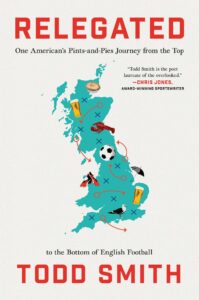
Excepted from Relegated: One American’s Pints-and-Pies Journey from the Top to the Bottom of English Football by Todd Smith. Copyright @ 2026 by Todd Smith. Reprinted by permission of Gallery Books, an Imprint of Simon & Schuster, LLC.

Todd Smith
Todd Smith is the director of a landscaping supply yard in south Minneapolis, the author of Hockey Strong: Stories of Sacrifice from Inside the NHL, and the cowriter of Brave Enough with Olympian Jessie Diggins. He has been a longtime contributing writer for the website of the Minnesota Wild. His work has also appeared in The Rake magazine, Minnesota Monthly, and Twin Cities METRO Magazine, where he penned a print column and a blog covering modern manhood and fatherhood. Smith runs the Donkey Soccer League, a Sunday morning game for assorted nitwits and out-of-shape, middle-aged scalawags in Minneapolis, where Smith lives with his wife and son.