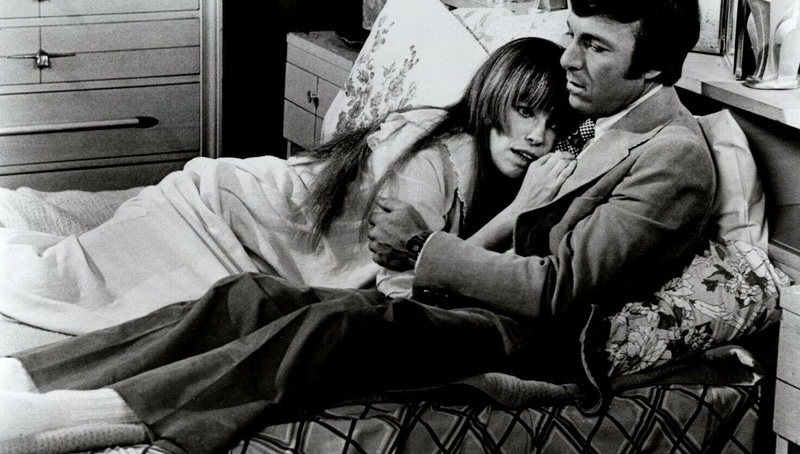
How Mary Hartman, Mary Hartman Redefined Daytime Television
Mayukh Sen on the Subversive Power of a 1970s Soap Opera
It was a breakdown unlike any the soaps had seen. A housewife named Mary Hartman had accepted an invitation to appear on The David Susskind Show, a decision that she likely did not anticipate would end in disaster. A resident of the fictional town of Fernwood, Ohio, Mary—who wore her auburn hair in two cascading, braided pigtails; dressed in frocks that resembled picnic blankets; and sat with her hands underneath her thighs, like a kindergartener—was out of her depth.
A panel of esteemed scholars had just seen a portion of her bizarro suburban life condensed into film form, a greatest-hits montage that documented her growing fixation on a waxy yellow buildup congealing on her floor, a mass murderer who’d killed a neighboring family (plus their pet chickens and goats), and the drowning of a local sports coach in a vat of chicken soup. The intellectual heavyweights beside her grilled her with sociological concern. Was she aware that she was being manipulated by everyone around her, one asked. Another inquired about the quality of her orgasms.
Mary, face frozen with incredulity, felt invaded and exposed, though she did not have the vocabulary to express her unease. She answered with garbled soliloquies about feminine hygiene sprays, vitamin E, and Del Monte fruit cups. Her voice, a cool and smoky baritone, made her seem rooted in reality’s soil, even if her expressions suggested a mind that was far removed from this planet. As the segment went on, she fidgeted. She put her hands to the sides of her head as if battling a migraine, stumbling and stuttering. “I am not a victim!” Mary screamed in one of her rare points of lucidity. She mentioned her factory worker husband’s infidelity, and suddenly her performance of suburban docility began to feel unsustainable. “Everything…is…too…much!” she said, each word like toothpaste from a wrung-out tube. “It’s just too much. It’s just television. Cameras. People. And the sponsors.”
Mary Hartman, Mary Hartman had the trappings of any other daytime soap with its hairpin plot turns, yet it could, in the same breath, reject—even mock—the genre’s implicit commercial demands.
Mary Hartman was cracking before America’s eyes.
This thirty-minute episode of Mary Hartman, Mary Hartman, which aired on July 2, 1976, would close with Mary awaiting psychiatric evaluation as she muttered her name over and over again in the vein of the show’s title. Developed by Norman Lear, Mary Hartman, Mary Hartman—or MH², as some soap fans call it—had begun airing earlier that year in syndication every weekday. The show’s thematic subversions separated it from safer network-sanctioned daytime soaps like ABC’s All My Children, CBS’s The Young and the Restless, or NBC’s Days of Our Lives.
It had, in fact, been rejected by all three major networks despite Lear’s handsome pedigree (his previous shows included the unequivocal successes All in the Family and Maude). CBS had dished out $100,000 to Lear for the two pilot episodes, only to respond with horror at the finished product. The NBC executive Lin Bolen felt that the show was directly insulting the intelligence of daytime’s primarily female audience: “I couldn’t commit to a show that depicted my women as fools.”
Lear conceived Mary Hartman, the woman, as a metaphor for the condition of America itself. The country was consumerist by design, and its attendant ennui could spiral into chaos if left unremedied. Mary Hartman thus became the avatar of this national illness. Lear would provide comment through this portrait of a neurotic, frayed woman and the people who surround her. She registered happenings in her life, even its terrors, passively, as if removed from her own body. In delivering this critique against the state of the country, Lear spared few targets, and even soap operas were fair game. Its title had the feel of a punchline: Lear wanted the repetition of Mary’s name to mimic the way a mother might call out for her child who’s out playing, but it resembled the daytime soap’s tendency to repeat salient bits of information for maximum effect—to treat its viewers like harried idiots. The show’s characters idled away their time watching programs like Years of Our Days to Live.
Soaps had become Mary’s panacea, inuring her to her everyday hardships. “Mary, aren’t there enough real-life problems around you without you having to surround yourself with soap opera problems?” Mary’s sister would ask her in frustration one episode as she sees Mary rotting away in her kitchen, watching one of her shows again. Pissed, Mary switches the set off. “Real-life problems?” Mary asks, incredulously. “Name one.” The power of soaps, Lear seemed to understand, was that they could sometimes make you forget what ailed you. He both relied on and inverted this foundational truth. Mary Hartman, Mary Hartman had the trappings of any other daytime soap with its hairpin plot turns, yet it could, in the same breath, reject—even mock—the genre’s implicit commercial demands.
Poor Mary Hartman, Mary Hartman, a show that has lived in the gutter of popular memory after its mercilessly short life (it aired from 1976 to 1977). It is now what some might charitably refer to as a cult favorite despite the wide cultural relevance it had while on air.* Its star, Louise Lasser, graced the covers of People, Newsweek, and TV Guide, back when those distinctions really meant something. The New York Times Magazine called it “a cultural signpost.” It became the subject of college seminars. Yet it has long had to play second fiddle to its more palatable kid sister, ABC’s prime-time megahit Soap, which premiered a year after Mary Hartman, Mary Hartman and would remain on television until 1981 while enjoying a healthy afterlife in reruns.
But the freaks among us may, if prompted to choose one or the other, share our preference for Mary Hartman, Mary Hartman as the defining soap satire of the 1970s. The elder show’s rough-hewn edges and imperfections were central to its appeal. Where Soap was straightforwardly in the realm of sitcom—leaning toward broad humor, underlined stylistically by the presence of a laugh track—Mary Hartman, Mary Hartman knew just how to strike that sweet spot between screw-loose absurdity and genuine pathos. Soap invited its viewers to take jabs at the genre in a time when the soap opera’s reputation had already been sullied in the American mind. Mary Hartman, Mary Hartman was—like David Lynch’s Twin Peaks, one of its tonal descendants—unsettling, both homage to and pastiche of the soap opera. It challenged viewers, possessing faith in their intelligence to make up their own minds about what they saw on screen, rather than condescending to them by telling them when and at whom to laugh.
Daytime soap operas had not quite developed the capacity to poke fun at themselves by the time Mary Hartman, Mary Hartman premiered in 1976. Though soaps were not without their occasional levity, the earnest self-seriousness of their proceedings often prevented them from engaging in self-reflexive critique. The culture at large, however, was already in the habit of playfully lampooning the genre: As far back as 1968, the comedian Carol Burnett had introduced a recurring segment, “As the Stomach Turns,” on her eponymous sketch comedy show that aired on CBS. The skit’s title was a direct reference to that same network’s ratings juggernaut, As the World Turns (which, at that point, was the highest-rated daytime soap opera on television, and thus the darling of CBS’s daytime lineup).
Predicated on the life of one Marian Clayton (Burnett) of Canoga Falls, “As the Stomach Turns” showed the mundanities of suburban life fringed with occasional oddities: Strangers Marian didn’t recognize would ring her doorbell, only to remind Marian they were her own children. She would reunite with estranged family members dying of malaria. Her friends would deal with maladies as diverse as pill addiction and demonic possession. Throughout, Burnett would break the fourth wall, speaking directly to the audience in exposition-heavy monologues to explain a character’s backstory. Pregnant pauses were in abundance. The honk of strident organ music would punctuate moments of tension. But something was intentionally amiss: The musicians may have missed their cues. Marian—or, rather, the woman playing her—may have forgotten her lines, veering off script.
Spoofs like “As the Stomach Turns” laid the groundwork for a show like Mary Hartman, Mary Hartman to pillory the genre with even greater precision, stretching that gonzo format to thirty minutes and turning the template of the soap opera inside-out. When Lear recruited the longtime soap writer Ann Marcus to write for the show, he sold it to her as “a soap on two levels,” as she would write in her 1998 memoir: “One level would satirize the medium, the other would hook the audience with characters and stories on a realistic level.” Marcus enlisted her coworkers from the earlier soaps she’d written for, like Search for Tomorrow and Love Is a Many Splendored Thing, to serialize this thinly sketched concept.
Early in Mary Hartman, Mary Hartman’s run, Marcus and her colleagues tackled taboos many Americans considered vulgar, be they homosexuality, impotence, or adultery. Its candor incited a small-scale moral panic. Scandalized members of the soap-watching public maintained that Mary Hartman, Mary Hartman didn’t deserve to breathe the same air as their other, proper soaps, just as network executives had predicted when they passed on Lear’s show. Some local stations in Richmond and Salt Lake City dropped the show following viewer outcry. A petition to end the show gained upward of 1,200 signatures in Little Rock. There were reports of people slamming the TV Guide issue featuring Lasser on its cover into the trash. Other stations issued statements prior to the airing of each episode claiming that the show did not reflect the channel’s opinions. Sponsors—Colgate-Palmolive among them—demanded advertisements for their products not air on Mary Hartman, Mary Hartman.
Mary was a vacuum—conceived as little more than an American everywoman—and Lasser rushed to fill that void with her own experience.
The decision of the soap press to even cover the show proved contentious for the genre’s devotees, who just couldn’t fathom that publications were giving credence to a program that held the form in such contempt. A handful of newspapers included the show in their rotation of daytime soap recaps: You could open up a copy of the Elmira, NY, Star-Gazette in 1977 and learn that it was Liz, not Snapper, who yanked Bill’s life support system on The Young and the Restless; that Karen on One Life to Live thought she might be pregnant with the child of a man other than her husband; and that a Fernwood resident named Martha feared she might be a kleptomaniac on Mary Hartman, Mary Hartman. Similar summaries of the show in the magazine Soap Opera Digest provoked outrage within the fledgling magazine’s readership. “What is our country coming to?” one pearl-clutching party wrote to the magazine, bemoaning the fact that, in her market, the show aired at 3:30 PM, just as schoolchildren were returning home. “My goodness, let’s clean this filth up. I’m a grandma and this show makes me sick.”
Other soap publications outright refused to put Mary Hartman, Mary Hartman on the same playing field as those shows it was so gently, though astutely, satirizing. Bryna Laub, editor of Daytime Serial Newsletter, felt the show besmirched the sanctity of soaps and contributed to the broader currents of shame surrounding the genre. The conservatism that would eventually hobble the daytime soap had its roots in this era, when soap viewers with especially fragile sensibilities had specific conceptions of what topics a soap should cover and made no bones about airing their protests.
But Mary Hartman, Mary Hartman, unlike its successors in the soap world, would not cower in the face of such agitation, and was all the better for it. A rhapsodic response from a vocal contingent of viewers drowned out the grievances. For every grousing old-timer who felt that Mary Hartman, Mary Hartman was contaminating the genre came another who expressed sheer joy that such a show even existed. Housewives across America saw themselves in Mary, the show’s anxious center of gravity: “You must have planted a microphone under my kitchen table,” one viewer would write to the showrunners. Another said Mary Hartman reminded them of a woman they knew who washed her lettuce with detergent. Some viewers even felt its liberal use of absurdity in fact grounded the show in the real world compared to the high-minded weepies on daytime, achieving honesty through nontraditional means.
Lasser, in particular, was an unlikely but ideal soap heroine. Her blank-canvas stare allowed viewers to more easily project their experiences onto her, and perhaps even exorcise their frustrations through Mary’s problems. At its core, the show concerned the tribulations of “a person who gets up and dresses in pink and blue, thinking it’s all going to be fine—and it just falls down on her every single day,” Lasser said when the show was airing, using the language one might ascribe to the female characters found on an Agnes Nixon or Bill Bell show.
Indeed, Mary Hartman was a confused—and confusing—protagonist for a country in the midst of second-wave feminism. Where Mary Hartman, Mary Hartman’s loudest critics complained that the show portrayed the American housewife as a fundamentally dumb creature, others saw her as beholden to a ruthlessly misogynistic American system and trying her best to smile her way through it. Mary was “a total victim,” Lasser said. “But what’s sweet and sad about her is that she’s a survivor. She survives in a world that may not be worth surviving for.”
By the start of Mary Hartman, Mary Hartman second season in the fall of 1976, the show had expanded to 125 independent markets, now putting it in front of a potential fifty-five million households. But the task of bringing this twisted character to life every day on screen proved to be taxing for Lasser. She was on every episode at her own request, which didn’t happen on your usual daytime soap opera, where a leading lady might appear three times a week at most. Lasser would often provide input into story directions, drawing from her offscreen dramas—such as a much publicized arrest in the spring of 1976 for drug possession that had made headlines.
With time, she started to wonder where the character ended and the actress began. “Mary Hartman cries my tears and laughs my laughs,” she would tell the Times of her connection to the role. (Not everyone was moved by such porousness; “If Louise was the chicken and Mary was the egg, we now knew which came first,” Ann Marcus, the show’s writer, observed in her memoir after dealing with one too many of Lasser’s creative interferences.) Lasser’s ordeals began to infect what Americans saw on screen. Her character’s mental unraveling was mirrored in real life when Lasser, at the height of her celebrity and just weeks after Mary’s breakdown episode aired, hosted Saturday Night Live. In her opening monologue, she laid it all bare: She told viewers about her cocaine bust, prattled on about her character’s disintegration, and eventually locked herself in her dressing room. (This incident led to the sprouting of an unsubstantiated urban legend that Lasser was banned from Saturday Night Live henceforward. Lasser has denied this claim passionately.)
Lasser decided to leave the show in 1977, signaling its end. “I was gradually morphing into her,” Lasser would say of Mary in a rare late-career interview conducted in 2013. “There was no her without me. I don’t think acting helped me deal with it.” To her, Mary was a vacuum—conceived as little more than an American everywoman—and Lasser rushed to fill that void with her own experience. The power of that breakdown episode, buffeted by Lasser’s elliptical performance, matched that of the best daytime soap operas: Viewers who had been following Mary’s moves every day were witnessing something terrible happening to someone they had come to know.
____________________________
Excerpted from Love in the Afternoon, and Evening: Essays and Conversations on Soap Operas by by Charlotte Druckman and Mayukh Sen. Copyright © 2026 by Charlotte Druckman and Mayukh Sen. Used with permission of the publisher, W. W. Norton & Company, Inc. All rights reserved.

Mayukh Sen
Mayukh Sen is the author of Love, Queenie: Merle Oberon, Hollywood's First South Asian Star (2025), a finalist for the National Book Critics Circle Award for Biography. He is a 2026 United States Artists Fellow. He teaches film and television reporting and criticism at New York University and lives in Brooklyn.