







Bajirao knew Gayatri was giving him her wordless approval. All she had to do was brush her fingers over her nose ring and clear her throat. How many years had it been since she first thought of this way of nudging him down the right path? And she did it now, almost imperceptibly, to indicate her excitement over the possibility of finding a groom for their daughter here, in the pages of a book at the Dhanpur Tehsil Post Office.
This was unusual, they knew. Finding grooms for their two older daughters had been harder and had required more favors, more travel, and more money than he could ever make again in his lifetime. More money than he could ever repay to the moneylenders.
The post office wasn’t the way he remembered it. It was still stuffy and dusty, and the walls were still stained with paan spittle. But now, someone had put a marigold garland on the postmaster’s big desk and thus, between 2 and 4 p.m. once a week, this room had been turned into an informal marriage bureau, and a handful of government logbooks had been converted into registers thick with profiles of potential brides and grooms in the taluka who would participate in the mass wedding. The postal employee who offered this service in his after-hours was sitting there at his table, flipping pages at the rate of two minutes per profile. The people in line had two minutes to identify the groom or bride they were interested in, and then they could meet the parents.
Bajirao had to struggle to use his wiry frame to create a few inches of space within which Gayatri, too, could stand with him in this long line. He strained each muscle in his body to maintain his footing among the huddle of other parents. The room grew more crowded and the lines were moving slowly. The electricity had been gone for hours and the summer heat wrung sweat out of everyone in the room. If breathing hadn’t been so hard, someone would have fainted from the stench of the farmers’ perspiration.
“Aadnav?” the man asked Bajirao when they finally made it to the front of the line. Surname?
“Andhale,” Bajirao said, enunciating his surname, almost breathless.
The man with the register looked up slowly and his lips curled outward like a bow with an unseen arrow. Bajirao understood his mistake instantly.
“You bloody fool!” the man said, in English. Then, reverting to Marathi, he said, “What are you doing in this line? This is for Brahmins only. You want a Brahmin groom for your daughter? Then tell her to trap one in a love marriage!”
The men in line behind him laughed.
Bajirao held his wife’s shoulders and started to usher her out of the line. Someone pushed him. Another man joined and pushed him harder. He was used to this. But Gayatri should
not have to see this. He was relieved to see her head turned away. He caught his step so he wouldn’t stumble against her.
How could he have been so stupid? He avoided Gayatri’s gaze. Now his carelessness had tainted her memory of this auspicious day. He removed her inquiring hand from his arm and led her to the other line. It was much longer. They would have to start their wait all over again, and this time it would be a few hours. But, at the end of it, they would find a young man who would take their lovely daughter away from the hell that was their life.
They spent the hours standing in silence among people who were designated Other Backward Classes, Scheduled Castes, and Scheduled Tribes. There were no written signs indicating the divisions, just experience and common sense, which seemed to be eluding him more and more these days. The line was longer, the stench of sweat more intense, but at least they could stand easier.
And now it was their turn. Another man with another register beckoned them. The man flipped the pages of profiles of grooms. Bajirao exhaled in relief when he saw Gayatri’s fingers on her nose ring even in this crowded line with people growing impatient behind them. She had spotted the picture and profile of the young man who seemed a suitable match for their daughter. He heard the faint but decisive vibration in the cough in her throat. He could never miss it or mistake it, not even under the loud dance beat of the song playing on the postal official’s transistor radio: zaraa zaraa touch me, touch me, touch me, zaraa zaraa kiss me, kiss me, kiss me . . . zaraa zaraa hold me, hold me, hold me . . . bin tere sanam iss jahaan mein. . . .
“Father or guardian of Dinesh Deshmukh!” the postal employee called out in a monotone, in response to the feeble tap-tap-tap of Bajirao’s finger over the black-and-white photograph that Gayatri had indicated as her choice. A stocky man with a well-groomed mustache, dressed in a clean kurta and dhoti and cap, stepped out from the crowd.
“Please meet the father or guardian of Meera Andhale!” the postal official shouted, pointing at Bajirao. Gayatri fumbled in her cloth bag and hurriedly handed Bajirao his white topi, his cap. The postal employee pointed his chin at the couple of stools behind him, indicating to the men that they may sit down and conduct their conversation there.
THE RIVER DRAWS CLOSER TO THE MAN AND WOMAN SITTING ON her northern bank, the spot where she exhales her coolest breath. The man is speaking softly, as if aware that, given the way the wind is today, voices could carry over the water. Voices, or smells, for his breath is heavy with alcohol.
The river knows this man and woman. The man has grown up on this shore and the woman first visited here as a girl. Her thin, dark legs had waded in, and the water had met her at the knee. Unlike most children, this one stood quite still until someone shouted to her—Gayatri, it is time to leave.
Then, a few years later, the child had returned as a bride to live here, married to this man from this shore. They came here on their wedding day, strangers to each other, a boy and a girl throwing flowers and colors into the water on the instructions of a pundit chanting prayers. From then on, the woman came to the river every few days, to pray with other women or to wash clothes.
Each year, the river would help her clean four white cotton kurtas, four white dhotis, and three cotton saris—green, yellow, and pink. Every few months, there would be a white polyester shirt, brown pants, and a red silk sari, and these the woman would not beat with a stick like the women did with their cotton clothes. The year after her wedding, the woman started to bring the clothes of a baby and then of three others. For some years, she brought four school uniforms, one of a boy and three of girls—white shirts and blue shorts, and white blouses and blue tunics. White ribbons. Then one day, the boy’s clothes came no more, and instead his ashes were strewn into the river—ashes with none of the smells that the river remembered on the boy’s collars. The woman returned a few days later and for years brought her girls’ clothes until they turned into saris and the woman was joined at the wash by her three grown daughters. The woman’s hair grayed quickly, especially around her face, which grew browner in the sun of three successive droughts.
The river has helped this woman clean her family’s hard work out of their clothes, readying the garments for more toil. The woman used very little soap. Sometimes, the woman came here, the way she had done as a child, to stand in the river, never deeper than her knees, always more still than the water itself.
So, today, the river draws closer, to listen. The man is drawing lines into the wet earth, finger-strokes on the river’s head. The woman is smiling, looking only at the man, not at the lines or the numbers he is writing into the riverbank. The man sometimes joins her in her smile and slows down his explanations. But his smile never lingers, for he is telling her about a loan and a mortgage and the expenses for a daughter’s wedding, and the low price offered for their cotton crop in the market. He is telling her about a man from the government and a loan officer at the bank and another man who is a moneylender who doesn’t work at a bank and has rules of his own.
His voice falls when talking about these things, but it rises again as he talks about a man he trusts, a man who is working to help the farmers be heard across the country. The woman, too, speaks about this wise, educated man who is going to get the farmers together and make the world listen to the stories of deaths in these parts.
The woman laughs every now and then and the man begins to almost sing between his puffs on his beedi. He speaks about how the world would raise its voice, the government would listen, and the farmers would get subsidies. They would be pardoned their crushing loans. And then this family could buy back its lost land. They would once again grow food from their own seeds instead of the foreign seeds that demand too much water, too much fertilizer, too costly a maintenance. He would dig her the well she has always wanted for their crop. He would have his woman grow old like a queen, the man says.
At this, the woman laughs a little louder, and her laugh turns into a cough, through which she says something about these days of the haldi-kunku being a good time for the arrival of fortune in the guise of a kindly stranger.
Neither the river nor its beloved woman hears the storm of thoughts in the man’s head. The father of Dinesh Deshmukh had approved of Meera’s photograph and nodded with deep interest at Bajirao’s quick listing of Meera’s accomplishments during her nine years of schooling and her subsequent years of housework. Your daughter will be a perfect wife for my son and a beloved daughter-in-law in my family, he said. He had joined in Bajirao’s excitement over the government’s benevolence in organizing the mass wedding.
And then, the father of Dinesh Deshmukh had asked for a dowry. A very small dowry, he said. It should come as a relief to you, he said to Bajirao. You must have been setting money aside for years, to pave the way for your daughter’s path to matrimonial bliss. The mass wedding was a wonderful thing, but age-old customs should not be tampered with. Tradition is tradition, especially in these troubled times.
The father of Dinesh Deshmukh had offered to be a kind man and wait as long as the morning of the wedding for the payment of the very reasonable dowry of 50,000 rupees. Of course, the father of Meera Andhale was free to refuse the alliance and look elsewhere. And, of course, the father of such a fine girl would not shame the two families by talking about this delicate matter, this revered tradition, to anyone.
So, the river hears no such thing. And neither does the mother of Meera Andhale, who is the most beautiful thing inthis man’s life. This woman shouldn’t know any of this as long as he lives. And he hopes with all his heart that she wouldn’t have to find out in the event he is forced to die.
The father of Meera Andhale reaches into the damp cloth bag that he carries around with him. Among the mundane things in the bag—his beedis, a cloth to wipe the sweat from his face, and a small transistor radio on which to listen to broadcasts of the market price of cotton or the old Marathi film songs he loves—is the sachet of pesticide that he had begun to keep close to him. It isn’t merely for the purpose of keeping his crop alive. It is also for keeping the promise of death alive. It is meant for use in the event that he has to pour it down his throat, shut his eyes, and lie down on a stretch of land, land he still owned, anticipating the peaceful sensation of life oozing out of his pores, freeing his soul from the
indignity of debt.
His wife asks him something, coyly, and he forces his attention back to her. What did you say, he asks her.
She repeats her question, “Will we have shrikhand and poori at Meera’s wedding?”
He laughs softly. “Yes, we will,” he says. “I know it has been a long time since you enjoyed your favorite sweet delights. You just wait and see how delicious that shrikhand will be—it will be made from the thickest curd and it will be rich with saffron and cardamom, maybe even pista. You can eat my share, and I will watch you eat. You can get fat. I have always wanted a fat wife.”
She pushes him and he pretends to fall over, his hands steadying himself upon the river’s shoulder as they laugh together. Something shifts on the far corner of the river’s shore, an acre away from the woman’s cough. The river rushes her waters closer, gathering up her skirts to take a look as the woman rises and then the man.
A strange step falls upon the river’s head. Not just strange but also foreign. He moves in a different way. He walks from his knees and his stride is uncertain. The woman quickens her step, urging her man to follow. And so, they come upon a boy who stands before them and asks, in the strangest lilt of voice that has ever carried itself upon the air of this river, “Ammar Chaudhry?”
__________________________________
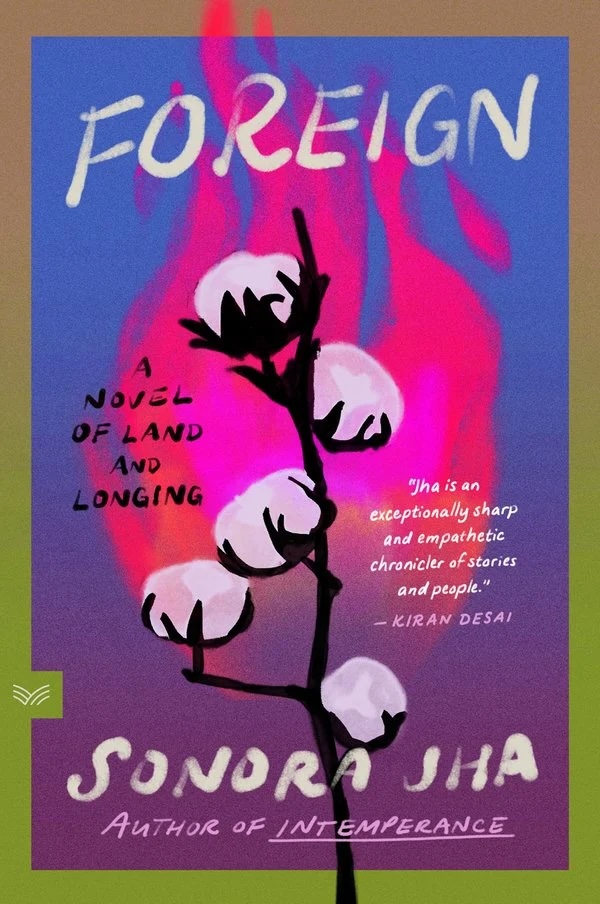
From Foreign: A Novel of Land and Longing by Sonora Jha. Reprinted with the permission of the publisher HarperVia, an imprint of HarperCollins. Copyright © 2026 by Sonora Jha.