







How to Make the Ink Used to Write Hamlet, the Declaration of Independence, and Beethoven’s Fifth
Simon Garfield on the History of Henry Stephens’ Iconic “Indelible Writing Fluid,”
This is how to make the ink that wrote Magna Carta, Hamlet, Samuel Pepys’s Diary, Robinson Crusoe, Gulliver’s Travels, Candide, the Declaration of Independence, A Vindication of the Rights of Woman, Beethoven’s Fifth, Les Misérables, and everything in between. The recipe comes from the UK National Archives, written circa 1483:
To make hynke. Take gall & coporos & or vitrial quartryn & gumme of eueryche a quartryn oþer helf quartryn & a halfe quartryn of gall more & breke þe gall a ij oþer a iij & put ham togedere eueryche one in a pot & stere hyt ofte & wyƷt wythinne ij wykys after Ʒe mow wryte þer wyþ. & yf Ʒe have a quartryn of eueryche take a quarte of watyr yf halfe a quartryn of eueryche þan take half a quartre of watyr.
If that isn’t entirely clear, there are other ways. First, sit under an oak tree. Second, look for the oak galls, also known as oak apples, the hazelnut-size balls that grow when a gall wasp lays an egg within the underside of a leaf and the tree secretes tannic and gallic acids. Remove two ounces of galls, and once dried, grind them with mortar and pestle. Add a pint of water and leave for a day or two (in medieval manuals, wine and vinegar are frequent alternatives to water, being less likely to make you sick). Then strain through fine linen or gauze, and add an ounce of ferrous sulphate (the “coporos” mentioned in 1483). Now add three flakes of the fixative gum arabic (a golden-colored sap collected from acacia trees) which will also increase gloss and flow, and leave in a cool place—a windowsill is ideal—for a fortnight, stirring daily. Your rich purplish-black ink is now ready to use. (When applied, the drying of the ink can be speeded up by dusting your writing paper with a fine powder known as pounce, made from pumice stone or salt, or sometimes grated dried cuttlefish bone. A letter would then be regarded as “done and dusted.”)
This “iron gall” ink was more popular than the earlier carbon inks produced from soot and animal glue, or the smoke of pines mixed with oil, not least because it was less fugitive. But its permanence was overrated, as those examining century-old documents have discovered. Not only did the rich dark ink turn to lighter brown over time, but the ink could be highly corrosive, particularly on parchment, and especially if a manuscript was exposed to extreme temperatures. So you are advised to use gloves while working with it, and maybe even a thin mask over your mouth and nose if you’re sensitive to volatile substances, and obviously don’t let it go anywhere near your eyes. And for God’s sake use it only with a quill or dip pen, and never a fountain pen, unless you want the metal or resin barrel to corrode and clog the feeder. Apart from that, enjoy your writing.
The selling point was permanence, an ink that began as a clear blue turning to an intense black when dry.
The sudden success of the Birmingham steel-nib trade coincided—although it wasn’t coincidence at all—with the birth of England’s leading ink company. The bottles on display at the Pen Museum carry many familiar names—Pelikan, Sheaffer, Parker—but the most prominent in the nineteenth and early twentieth century is today largely forgotten, the London family firm of Stephens, a generational story that begins in late 1815 with a trainee doctor sharing digs with John Keats.
Henry Stephens was born in Holborn in 1796, and grew up near St. Albans, where his parents ran a busy coaching inn. His medical training at Guy’s and St. Thomas’s hospitals in Southwark necessitated cheap lodgings nearby, and for about a year he shared his rooms with the twenty-year-old fellow student and yet-unpublished poet, a friendship that endured beyond their training. According to Stephens’s daughter Martha Walsh, her father also wrote verse himself, and was instrumental in one of John Keats’s most famous works.
My mother told me [that] during their evening walks [they] quoted verses to each other. They were not satisfied with a line in the Endymion, Keats’ poem—“A thing of beauty is a constant joy.” Each thought, and almost together burst out “a joy for ever,” and so it was written, with mutual approval.
Highly regarded as a family doctor, Stephens’s medical reputation rests largely on his advances in hernia surgery; a treatise published in 1829, when he was thirty-three (and Keats had been dead already four years), remained the widely accepted method of correction for decades. But Stephens also had a sideline. Dissatisfied with the consistency and fugitive nature of ink for steel dip pens, he established a makeshift laboratory near his home to produce “an indelible writing fluid,” and his precise scientific training led to a formula that might be scaled up for mass production. With industrial chemistry in its infancy, his endeavours were revolutionary. The Stephens Ink Co. was registered in Southwark in 1832, with its first patent granted five years later.
By the time of the 1851 Great Exhibition in Hyde Park, the ink fluid had been joined by Stephens’s wood stains, with both winning royal approval from Prince Albert. The selling point was permanence, an ink that began as a clear blue turning to an intense black when dry. “It is smooth and pleasant to write with,” an early label claimed, “and preserves its fluidity in a remarkable manner under exposure.” Soon, all government and other official documents, including great amounts of banking and legal agreements, would only be considered final if they had been signed with Stephens Blue-Black.
It also had an excellent logo, or brand mark: a large ink blot created in 1891 when its advertising manager dropped a large ink-soaked sponge on a papered floor and drew round its splashy results.
The earliest recipes for what Stephens called his “carbonaceous black writing fluid” were closely guarded, and they remain a mystery. His patent cited only “certain improvements in manufacturing colouring matter,” while the listing of various acids and solvents suggested the process was highly flammable. By the 1870s, Henry Beasley’s The Druggist’s General Receipt Book had worked out the key ingredients for the most common carbon-based ink: commercial soda mixed in equal parts with shellac or resin, and then oxalic or tannic acid and water. The solution was boiled and cooled, and combined in a large pestle and mortar with fine lamp-black and other colourants.
The company moved to new premises in Aldersgate Street, now the Barbican, in 1860, and opened a New York office the following year. It faced two problems: a shortage of glass bottles led to the selling of its ink in stoneware designed for beer; and a growth in competition resulted in many legal disputes. With each edition of Henry Beasley’s manual, new but similar ink recipes appeared from a longer list of rival companies: Runge’s Black Writing Fluid competed with Coathupe’s Writing Fluid, and they were both up against Puscher’s Indelible Ink and Dr. Normandy’s Blue. Stephens’s superior product continued to dominate the market until the 1920s, aided by bold advertising.
“Stephens’ Ink—Blue-Black But Unbeaten,” declared the signs in shop windows, while tall enamel mercury thermometers were placed on railway platforms showing “Freezing,” “Temperate,” or “Blood Heat,” assuring travellers that its product worked in all climates. It also had an excellent logo, or brand mark: a large ink blot created in 1891 when its advertising manager dropped a large ink-soaked sponge on a papered floor and drew round its splashy results.
After Henry Stephens’s death in 1864, the business was taken over by his son, Henry Charles Stephens, who had learned his chemistry at the Royal School of Mines and was soon so committed to the family business that everyone called him “Inky.” Inky found the business lucrative, and fully exploited the advent of the fountain pen. The purity required for this new implement was far more demanding than that for a dip pen, but a Stephens advertisement boasted it had risen to the challenge. Its lack of sediment promised to “cure a bad circulation” and ensure “it cannot clog the feed channels, cannot corrode the nib, cannot harm rubber containers or moving parts.”
The opening of a large factory in Islington was accompanied by the development of a ten-acre home and research laboratory in Finchley, where Stephens served constituents for thirteen years as a Conservative MP and longer still as a local philanthropist. His huge garden is now open to the public, and its former conservatory serves as a small, charming, and rather forlorn museum. Keats, who knew nothing but a quill and homemade iron gall, realised his lasting fame in less than a decade, yet Stephens’s ink lasted more than a century and achieved no such thing. I live nearby, and have passed the house perhaps fifty times without knowing anything about the industry that had financed it; it felt good to discover a Victorian empire not founded on slavery.
The appointment-only museum (“The Stephens Collection”) contains a vivid gathering of ink bottles, advertisements and writing materials, and a solid history of the Stephens dynasty, which effectively ended in 1967 when the firm was bought by the Royal Sovereign Pencil Company. When I stopped by in early 2025, the visitor manager Melanie Wynyard was sifting through old patents and trade contracts, and regretting the economic downturn. “We’re clinging to the rock face now,” she says.
Her goal is just to keep the place open; with government cuts to heritage funding, there is limited interest in an archive of inks and adhesives. I take a photo of the thermometers and other enamels that once stood proud on railway platforms as steam trains chuffed by. Wynyard says that people send her pictures of these from all over the world. “There’s one in Beijing in Chinese. We did have one in Syria, although I doubt it’s there any more.”
__________________________________
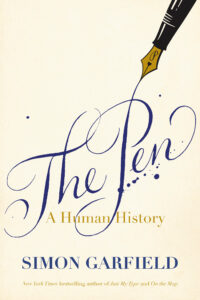
Excerpted from The Pen: A Human History by Simon Garfield. Copyright © 2026 by Simon Garfield. Published in the United States by Crown, an imprint of the Crown Publishing Group, a division of Penguin Random House LLC.

Simon Garfield
Simon Garfield is a feature writer at the Observer (London) and the author of nine works of nonfiction, including Mauve: How One Man Invented a Color That Changed the World, which was a New York Times Notable Book, and The End of Innocence, which won the Somerset Maugham Prize in 1995.