







Why I Had to Write My Memoir Under a Pseudonym
Azra Liaqat Khan on Her Choice to Use a Pen Name When Writing About Her Experience As a Sex Worker
“What’s your real name, not your stripper name?”
– Lil Wayne on Juicy J’s Bandz A Make Her Dance
*
Azra Liaqat Khan is not my name, but suppose it was:
My students might read my memoir and learn about the singularly unattractive customer who was nevertheless able to bring me to climax from the friction of a lap dance alone. They’d know that I once was trapped in a hotel room, taking a shower in front of a deranged customer in exchange for a bag of coke, and that even in my late-20’s, terrified of my parents, I spent a massive sum on trips to Charlotte, where Ammi and Abbu introduced me to the next in their line of lackluster bachelors. So much for my authoritative no-AI policy and my meticulous teaching notes.
If Azra Liaqat Khan was my real name, my university would waste no time in removing me from its list of speakers for local high school recruitment events, barred as sex workers are from contact with youth. Keynote invitations to universities would also dry up, as “Here’s the time I swindled a customer by letting him think my parents were slum dwellers in India” doesn’t quite scream Serious Political Scientist. (Despite all the handwringing about radical left professors in academia, higher ed remains a bastion of conservatism.) I’d become nothing other than Muslim-Stripper-Turned-Professor. So much for my professional reputation.
The question isn’t why I wrote Mona under a pseudonym. The question is, how else could I have written it?
If Azra Liaqat Khan was my real name, those I piss off in my book (the rightwing Indian nationalists and the religious zealots and the Islamophobes–a veritable who’s-who of internet trolls) would know just how to find me, dox me, and torment me for what I’ve written. So much for my peace of mind.
But the heaviest outcome of writing Mona under my real name would be the one understood by any South Asian daughter who believes her missteps will appear on the electrocardiogram of an elder. Back when Ammi-Abbu ruled through a reign of terror, I used to fear being caught, shipped away, and married off (the fate of so many women I knew whose boyfriends or wardrobe were enough to upend their lives). Decades later, I’m no longer worried they’ll ruin my life, but to know I could ruin theirs–that Mona could get a couple octogenarian Indian immigrants with walkers and home health aides kicked out of their mosque and disowned by their siblings–feels downright cruel.
The question isn’t why I wrote Mona under a pseudonym. The question is, how else could I have written it?
*
During Algeria’s war for independence, women were able to smuggle grenades and pistols past French checkpoints in their flowing haik. (The French, in all their Orientalism, never fathomed that a Muslim woman could have this sort of political agency.) I’d never claim that dodging marriage proposals from Lockheed Martin executives in my parents’ Charlotte dining room while secretly working as a New York City stripper was anywhere as revolutionary as the National Liberation Front’s tactics, but I too know that there’s something liberating in remaining hidden.
It’s a fact pseudonymous writers like the Bronte sisters and the queer Muslim author Lamya H have understood. Behind a fake identity, we can be ribald. We can command authority. We can remain “respectable” and retain the love of our husbands or parents.
Veiled, we can finally be taken seriously in our craft.
At its core, Mona is itself about false identities. For seven years, I played a character at the strip club, doe-eyed kewpie doll one moment, discount therapist the next. At the same time, I donned another fictive identity: a dutiful daughter for marriage-obsessed parents.
And I wasn’t the only one faking it. My customers, pretending to have work engagements so their wives would be none the wiser as they spent from their investment accounts at the club, did much of the same. Ammi-Abbu, seeing our extended family embrace a rigid Salafi Islam, performed increasing piety to keep up appearances, living double lives of their own. Everyone was playing a part.
As for me, I created one smokescreen after another, all to have a measure of autonomy away from Ammi and Abbu’s watchful gaze and delay the inevitability of marriage. Subterfuge became a survival skill, and it’s the very reason I had a memoir to write.
“Azra Liaqat Khan” is as much part of the story as it is the name of its author.
*
It might be the case that I (not Mona, not Azra, but the real me) have 20,000 TikTok followers or a friend who handles events at a major city library. I may have a professional contact at a major news outlet. I might even already have a public platform as an author. But that wouldn’t be anything I could leverage, would it, if I wish to remain anonymous? Nor can I tell the women’s studies department at my university that I’ve got a book coming out. In a marketplace built on moving units, where “author platform” is the sine qua non of a memoir’s viability, I must instead rely on word-of-mouth.
Perhaps, through the networks that have long connected us, Mona will find its own quiet channels to readers who have also lived more than a few lives underground.
I post occasionally on the instagram account I created for Mona. The algorithm ignores it.
Like the strip club stage, the algorithm is fed by cleavage, hair, and outfits. Since these are off limits to me, I share blurbs. I create a pink-and-purple snippet of my Kirkus review, set it to Ginuwine’s Pony, and post it to my Stories.
I’m not the only one navigating these limitations. My publicist, who doesn’t know my actual identity, sets up off-camera media interviews and coaches me on answering questions to reveal enough without revealing too much–a throughline in my life, it seems. My agent, editor, and I communicate using the same email address from back when I was stripping, the one I gave customers in lieu of a phone number. What was once a repository of unsolicited dick pics and desperate requests to meet outside the club has been resurrected for cover design and copy edits. Just like sneaking out to my senior prom (when teachers gave me fake field trip forms and a classmate made a phony website for the “leadership conference” I had concocted for the weekend), today’s fictions also require collaborators.
I considered posting an old photo I took in the dressing room mirror at Scandals, a now-defunct Queens strip club. From the earlier days of iPhone cameras, the picture is grainy. I’m surrounded by the midshift clutter of backstage: duffel bags and unplugged curling irons and a dirty ashtray. I’m wearing clear Pleasers heels and a tiny black tube dress with cutout sides. I look tacky and hot. Maybe I could place a cheeky “censored” banner over my face. I opened the app to make the post and noticed two messages.
“Sister,” one of them read, “you have lost your moral compass. You’ve gone astray.” It was from a man who had surely not read the book. He never will. He’ll never know how I agonized to ensure Mona didn’t become fodder for Islamophobes, how careful I was to present my people with complexity and care.
The other was from a guy with an American flag in his profile picture: “Jihadi communist. Your [sp] not fit to be near students.”
I deleted the messages and blocked the senders. Vindicated, I closed the app without posting my photo.
For me, there will be no author photo or bookstore event or “unboxing” video of my hardcovers. I’ll spend publication day teaching and grading quizzes, with colleagues and students none the wiser. I’m no stranger to this practice.
Perhaps, through the networks that have long connected us, Mona will find its own quiet channels to readers who have also lived more than a few lives underground.
___________________________
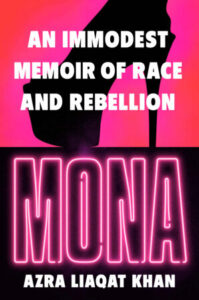
Mona: An Immodest Memoir of Race and Rebellion by Azra Liaqat Khan is available from Tiny Reparations Books, an imprint of Penguin Publishing Group, a division of Penguin Random House, LLC.

Azra Liaqat Khan
Azra Liaqat Khan is an award-winning professor, author, and labor organizer in the northeast writing under a pseudonym. She has written widely about the politics of race, immigration, and US empire.