“Clitter” is a Real World: And Other Discoveries Reading the First Draft of Stephen King’s Pet Sematary
Caroline Bicks Explores the Literary Legacy of an Undisputed Master of the Genre
It’s the night before my first trip to the archives, and I still haven’t decided where I’m going to start. I open the Doubleday hardcover copy of Pet Sematary I’ve just purchased at the Big Chicken Barn in Ellsworth, a vast consignment store full of creepy old dolls and spittoons—the perfect setting for a Stephen King story. It’s the same version I read in 1983, at age fifteen, when I took it out of the Witherle Memorial Library in Castine.
I’ve decided that to immerse myself fully in this project, I need to return to these originals. I want to re-create all of the sensory experiences that were a part of my first fearful encounters with King’s writing—to see the covers, smell the pages, and feel the unique heft of each book.
I burrow under my covers with Pet Sematary and begin. This edition has the face of a demonic, green-eyed cat on it: Church, the family pet that comes back to life after Louis Creed inters him in a Native American burial ground whose earth has gone sour. This Mi’kmaq land lies beyond the home in Maine into which Louis, his wife, Rachel, and their two children, Ellie and Gage, have just moved. After Church is killed in the road in front of their house, the Creeds’ neighbor, Jud Crandall, lets Louis in on the secret of the site’s power to revive the dead. The cat comes back—although he acts, feels, and smells a bit off. Then two-year-old Gage is killed by a speeding truck. Under cover of night, Louis digs his son up from his grave and relocates him to the Mi’kmaq site. The toddler returns in a monstrous form and murders Jud and Rachel. Louis, who continues to be pulled into the ground’s malevolent forcefield, buries his wife there as well.
Even Stephen King needs to hide from his books sometimes. Now we had something else in common.
The last scene in the book—with Rachel’s hand falling on her husband’s shoulder as her gravelly voice says Darling—has stuck with me for four decades. I don’t have time tonight to get to the end, but my stomach twists just imagining it.
Returning to Pet Sematary late at night, forty years after I first read it, I experience the first of what will become many eerie coincidences as I proceed with my work. I’d forgotten that Louis (just like me) had moved his family of four to rural Maine from a big city to take a job at the University in Orono. He’s the new head of University Medical Services. The student infirmary is where he’ll witness the first violent episode in the book, the death of Victor Pascow, a student who’s hit by a car. The campus may as well have been Oz for all I knew about it in 1983. But now, as a UMaine employee myself, I recognize the building and all of its surroundings as King describes them in the opening chapters.
Why was I being drawn to this story the night before I was starting my project? Did something want me to start with it? Because that can’t happen. Right?
It’s very late when I finally close the book and place it on my bedside table with the cover of Church the cat face down. So it can’t hurt me.
*
The next morning, I plug 47 West Broadway, Bangor into my Google Maps and it comes up as “The Stephen King House.” As I follow the directions, I realize that I’m being taken down the same road, Route 15, that the Creeds live and die on in the book. It’s also the same route along which Stephen and Tabitha had rented a home with their three children in 1978, when he worked for a year as a visiting writer and teacher at the University of Maine in Orono.
Now there were three UMaine employees living this story and traveling this road—two of us real, one fictional.
In his introduction to a 2001 edition of Pet Sematary, King explains that the book’s premise was inspired by real-life events that happened during that year:
My wife and I rented a house in Orrington, about twelve miles from the campus. It was a wonderful house in a wonderful rural Maine town. The only problem was the road we lived on. It was very busy, a lot of the traffic consisting of heavy tanker trucks from the chemical plant down the road.
The family cat, Smucky, had been hit by one of these trucks, and the Kings’ daughter, Naomi, had taken the news especially hard, yelling at God to take His own cat—an episode that King would recreate in Pet Sematary. (Ellie has a similar fit when it dawns on her that God will take Church someday.)
The Kings buried Smucky in an area behind the next-door house, identified by a hand-painted sign as a pet sematary. After that, they came very close to experiencing a major tragedy with their child Owen:
Our youngest son, then less than two years old, had only learned to walk, but already he was practicing his running skills. On a day not long after Smucky’s demise, while we were out fooling around with a kite, our toddler took it into his head to go running toward the road. I ran after him, and damned if I couldn’t hear one of those Cianbro trucks coming (Orinco, in the novel). Either I caught him and pulled him down, or he tripped on his own; to this day, I’m not entirely sure which. When you’re really scared, your memory often blanks out. All I know for sure is that he is still fine and well and in his young manhood. But a part of my mind has never escaped from that gruesome what if: Suppose I hadn’t caught him; or suppose he had fallen in the middle of the road instead of on the edge of it? I think you can see why I found the book which rose out of these incidents so distressing. I simply took existing elements and threw in that one terrible what if. Put another way, I found myself not just thinking the unthinkable, but writing it down.
He finished a draft of the book, let it rest for six weeks, read it over, and found it too “startling and gruesome” to pursue. Of all his books, this is the one that scares him the most, the one “I put away in a drawer, thinking I had finally gone too far….Put simply, I was horrified by what I had written, and the conclusions I’d drawn.”
Wow. Even Stephen King needs to hide from his books sometimes. Now we had something else in common.
I’m thinking about all of these stories—King’s, Louis Creed’s, and my own—as I drive down Route 15, past the house in Orrington that the Kings rented that year. I know which one it is because the night before, in addition to rereading the book’s opening, I’d watched a video made by a super-fan that identifies all of the locations associated with it. The Kings’ old rental looks an awful lot like the Amityville Horror house with its creepy quarter-moon windows staring out at you.
I drive nine more miles, take a left on Union Street, another left on West Broadway, and turn through the open gates of their iconic Bangor home, the one that they purchased in 1980. I feel like a movie star as I roll past the security cameras and down the long driveway to the right of the red Victorian mansion. When Stephen and Tabitha were looking for a secure location for the archives, they decided to renovate the back extension they’d built onto their house years earlier for an indoor swimming pool and turn it into a climate-controlled space. This back area is where I’ve been instructed to park. It’s a cheerful setting once you get past the spider gates. Bright-colored flowers line the brick walk that winds around the garage and leads to the archive door.
I knock, and the Kings’ assistant of many years, Julie, greets me with a friendly, matter-of-fact hello. The interior is modern and light. The tiles from the space’s swimming-pool days still line the walls, and I can see a big conference table through the glass walls of the reading area. Julie introduces me to the housekeeper who keeps all of the buildings on the property in order. Her name’s Carrie. Of course it is.
Then she shows me how the digital database works, and I start searching. I find records for the earliest draft of Pet Sematary, dated September 24, 1979, as well as the final draft, dated February 1979 to December 1982. I ask Julie if I can look at this last one first. She plugs in a code to unlock the door to the archives, then disappears behind it.
When she reemerges, she’s carrying a thick folder containing the manuscript, which turns out to be a treasure trove: The 536 double-spaced pages are filled with sticky notes that have questions to the author from the copyeditor and King’s responses to them. King’s humor comes through in many of the exchanges. In one example, the copyeditor asks: “Is the Ludlow in this novel a fictitious place? (maps show no Ludlow south of Bangor although there is a Ludlow in Aroostook County, west of Houlton),” and King replies: “Ludlow is pretend. It’s in the Twilight Zone—Steve.” At another point, the copyeditor notes an inconsistency in how Ellie addresses her father: “Dad or Daddy? Ellie usually says Daddy,” and King responds with a quote from Ralph Waldo Emerson: “yes, but ‘a foolish consistency is the hobgoblin of little minds.’ Not that your mind is little, copyed, but constant consistency is unlifelike. Can you dig it? —S.K.”
It’s fascinating to see King recognizing when he’s pushed the envelope too far with some of his more grotesque details and then editing them out, even at this late stage of the publication process. At one point, he crosses out a line and writes in a new description of one of the students who comes into the infirmary, a “woefully sick freshman boy with the terrible name of Peter Humperton, [careted in: “who went into convulsions shortly after being admitted”] Mr. Humperton puked while lying on his back in his infirmary bed and very nearly strangled.” In the margin, King explains the cut to his editor, Sam Vaughn: “SAM—I made this change because it’s begun to seem to me that there’s a little too much puking going on here. S.K.”
He’s also a stickler for his punctuation choices. At many points in the draft, the copyeditor replaces King’s colons with commas. When they leave one of them be, King quips in a margin note: “My God! A colon in this line copyedit didn’t attempt to change to a comma! Quick, somebody, I want a picture! S.K. (Just kidding, copyedit).” He often thanks the copyeditor as well for catching inconsistencies and errors at each stage. His respect for the people who (at this point in his career) are way below his pay grade is evident in all of these comments—early evidence that fame hasn’t gone to his head and turned him into a diva.
All of these exchanges are master classes in how words not only matter for the meanings they convey—they are matter….You see and hear them simultaneously as King’s horrible imaginings dance their way into your mind.
These editorial back-and-forths also reveal something about King’s writing process that I wouldn’t have appreciated otherwise: how much attention he pays to the sound effects of his word choices. In one scene, Gage has a high fever, and Louis is “trying not to let Rachel’s voice, which seemed almost accusatory, grate on him.” But he still snaps at her, and King crafts Rachel’s reaction to him: “ ‘You were,’ Rachel began, ‘you were shuh-shuh-shouting.’ ” The copyeditor whites out the uh in shuh so that it reads “sh-sh-shouting.” But in the margin, King writes “STET” (a proofreading term that means “let it stand”), and then elaborates: “the sound of that particular stutter really is ‘shuh.’ Say it out loud, you’ll see. S.K.”
King often explains his desire to keep a word based on its specific aural effect. There’s a scene where Louis thinks he’s dreaming that the ghost of Victor Pascow is leading him to the deadfall behind his house and warning him not to climb over it to reach the Mi’kmaq burial ground beyond. The dead-fall turns into a pile of moving bones: “Fingerbones clittered,” King writes. The copyeditor circles the word “clittered” and asks, “Word OK?”; King responds, “Word OK A clitter is a very soft, ghostly clatter.” I’m not familiar with this word, but as I say it out loud I can see (hear) why King would choose it over the harsher “clatter” to complement the eerie, dreamlike mood of the sequence.
This same attention to word sounds surfaces at another point when the copyeditor suggests King change the word “rattly” (a description of the sound sick Gage’s lungs are making) to “congested.” King rejects it: “ ‘rattly’ is certainly vernacular,” he writes, but he’s going to stick with it. He also STETs every time the copyeditor tries to change Gage’s shout of excitement—“Kite’s flyne, Daddy!”—to “flyin’.” The difference seems tiny, but King’s choice of flyne does so much work: It captures the sweet, nascent speech of a two-year-old, making his imminent death, when he flies that kite into the path of a truck, all the more horrible.
All of these exchanges are master classes in how words not only matter for the meanings they convey—they are matter. The way they look on the page and sound gives them a multi-sensory heft. You see and hear them simultaneously as King’s horrible imaginings dance their way into your mind.
At the end of this first day, there are all kinds of new words clittering and shuh-shuh-shouting in my head. I’m also starting to get familiar with King’s handwriting (he uses both cursive and lowercase print). And I’m learning new vocabulary, including deadfall, a word that sounds like something he invented. (For all you city mice out there, he didn’t: It’s a tangled mass of trees and brush.)
I’d never heard of it before, but the next morning, when I’m doing what I do every day before I get going, the New York Times Spelling Bee puzzle, this strange entity makes an unsettling appearance. The Bee is a game made for obsessive word nerds like me. You’re given a honeycomb cluster of seven letters and try to find every possible word you can make from them that includes the middle letter. The only one that I’m unable to find today is DEADFALL. Why did I not see it?
More importantly, what is it doing in my happy place? (For the record, it had never appeared in any other iteration of the Bee and hasn’t appeared since.) Is the deadfall insinuating its way into my world the same way it creeps into and ruins Louis Creed’s? Is King’s writing already messing with my head in new ways?
__________________________________
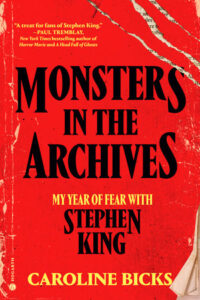
From the book Monsters in the Archives: My Year of Fear with Stephen King by Caroline Bicks. Copyright © 2026 by Caroline Bicks. Published by Hogarth, an imprint of Random House, a division of Penguin Random House LLC. Audio excerpted with permission of Penguin Random House Audio from MONSTERS IN THE ARCHIVES by Caroline Bicks, read by the author. All rights reserved.

Caroline Bicks
Caroline Bicks is the Stephen E. King Chair in Literature at the University of Maine, where she teaches courses in Shakespeare, early modern culture, and horror fiction. She is the author of Cognition and Girlhood in Shakespeare’s World and Midwiving Subjects in Shakespeare’s England; co-author of Shakespeare Not Stirred: Cocktails for Your Everyday Dramas; and co-host of the Everyday Shakespeare podcast. Her essays and humor pieces have appeared in the Modern Love column of the New York Times, McSweeney’s Internet Tendency, and the show Afterbirth. She lives in Blue Hill, Maine, with her family.