Christian B. Miller on The Honesty Crisis
In Conversation with Whitney Terrell and V.V. Ganeshananthan on Fiction/Non/Fiction
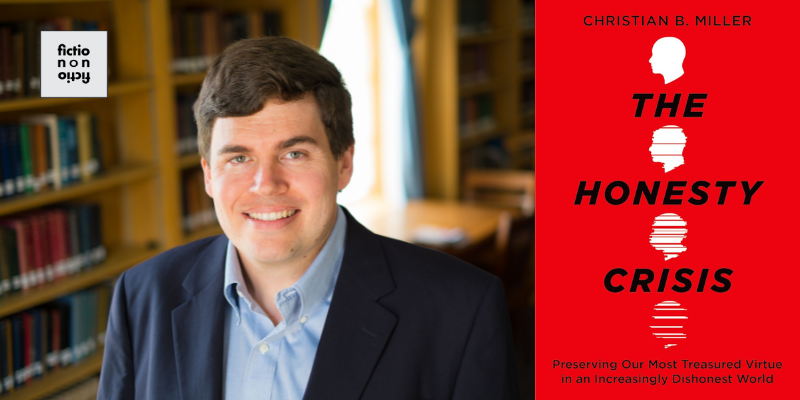
Wake Forest University Professor of Philosophy Christian B. Miller joins co-hosts Whitney Terrell and Jennifer Maritza McCauley to discuss his newest work of nonfiction, The Honesty Crisis: Preserving Our Most Treasured Virtue in an Increasingly Dishonest World. Miller argues that integrity and honesty are rapidly disintegrating and we are quickly losing social norms around truth-telling. He outlines five main categories that are contributing to this honesty crisis, gives his definition of honesty, and explains how we can diminish our reliance on self-interest. He explores how a loss of integrity can affect the academic, romantic, political and technological realms. Miller also addresses contemporary politics, the recent presidential election and how honesty is in flux in our country. He reads from The Honesty Crisis.
To hear the full episode, subscribe through iTunes, Google Play, Stitcher, Spotify, or your favorite podcast app (include the forward slashes when searching). You can also listen by streaming from the player below. Check out video versions of our interviews on the Fiction/Non/Fiction Instagram account, the Fiction/Non/Fiction YouTube Channel, and our show website: https://www.fnfpodcast.net/ This podcast is produced by Jennifer Maritza McCauley, V.V. Ganeshananthan and Whitney Terrell.
The Honesty Crisis: Preserving Our Most Treasured Virtue in an Increasingly Dishonest World • The Character Gap
Others
How The Washington Post Fact Checker Tracked Trump • The Rabbit Series • John Updike’s Rabbit Tetralogy
EXCERPT FROM A CONVERSATION WITH CHRISTIAN MILLER
Whitney Terrell: I wonder if you could give our listeners your definition of honesty and describe how it relies on interior motivation just as much as interior action.
Christian Miller: First of all, really honored to have this chance to talk about my views and ideas, but honestly, I’m thinking of honesty as a character trait, as part of who we are and how we see the world and how we interact with the world. It has an external side to it, so our behavioral focus, and then an internal side, which is what you’re asking about. But let’s start with the external. So if I’m an honest person, I’m going to be acting honestly in a variety of circumstances—on the podcast, at the party, at home, at work, in the courtroom, across the board—stably over time—so not just on Tuesdays or once a week or once a month—it’s going to be consistently over time with respect to large number of different types of behavior.
When we think of honesty, behavior that comes to mind right away is telling the truth. That’s part of honest behavior, but that’s not all there is to it. Honest behavior has to do with telling the truth, but also prevents cheating, stealing, misleading, promise-breaking, fraud, self-deception, hypocrisy, BS-ing. It covers a lot of moral ground as far as outwardly what it does and what it doesn’t let us do, and yet even that’s not the whole picture. You’re pointing us inward where I also want to go. It matters not just what I do if I’m an honest person, but why I do it. What’s my motivation? What’s my underlying reason for performing the action. I’ll come to the wallet example in a second, but take another one: why did I tell the truth? It could be because I didn’t want to get fired from my job, or because I wanted to advance the company, or because I want to get rewards in the afterlife, or because it’s the right thing to do. There are lots of different reasons for this very same behavior. Some of those reasons or motives are virtuous, and some are not. So, it doesn’t automatically count as virtuous just because you act well externally. In fact, I want to divide it up into three categories: I think there is motivation that’s concerned just with benefiting yourself. That’s self-interested motivation, egoistic motivation. I think that gets a thumbs down as far as virtue is concerned.
WT: I’m very sorry to hear that. I feel like I use that motivation occasionally.
CM: Well, we all do. If it leads you to behave well, even if it’s not the best motive, it’s better than the opposite, right? So it’s something of a win. But it’s not the best. We can do better. The other two categories are altruistic motivation where you’re concerned with benefiting the other person; so, I tell the truth, because they’re my friends, because I care about them, because I love them. And then the third category, dutiful motivation: because it’s the right thing to do, because it’s what an honest person would do, because I have a moral obligation, because I’ve been commanded to do it. Of these three categories, only one of them, I think, is off the table, and that’s self-interested. Altruistic, that’s fine. Dutiful, that’s fine. They get a thumbs up in my book.
JMM: So you cite five main categories where you believe we currently have a crisis of honesty? Could you outline those categories for our listeners and talk about why you think we’ve come to our crisis and all those areas?
CM: So, the book’s called The Honesty Crisis, but in all honesty, I probably should have titled The Honesty Crises, because I devote the heart of the book to a variety of different areas of society where I see honesty under attack, or I’m worried about the future of honesty. The five main ones that I highlight are as follows: deep fakes—AI-generated audio and video deep fake technology; AI student cheating, so when students are using AI to produce the papers or to do their problem sets or the coding assignments, for for graded work; internet infidelity, so when people are going on the internet and going to places like Ashley Madison to arrange affairs or looking at pornography when they’re in a sexually exclusive relationship that prohibits doing that kind of behavior; fame and dishonesty, so the rise of influencer culture and TikTok celebrity, and how that incentivizes increased dishonesty; and political misinformation.
It seems like a book on honesty these days has got to say something about politics, and so I devote a chapter not so much to talking about particular individuals and narrative honesty, which is low hanging fruit, but our general tendency, in light of social media, to be more inclined to distribute misinformation online. Those are the five I focus on. There’s definitely a technology thread running through all of them, and I own up to that. In all five cases, they’re all honesty crises because of two features: dishonesty in all these cases is becoming more tempting than it was before and harder to detect. So, it’s easier to get away with the dishonesty, and it’s becoming more tempting than it was before in all five areas.
WT: So, you mention this technology connection, and I want to focus in on that. All these things that you’re talking about existed before the internet— I’m assuming that’s like the beginning of this technology issue that you’re talking about. I mean, there were certainly lies in politics before then, and there were certainly affairs. So, why is technology so crucial to this?
CM: That’s a great question. It would be absurd of me to argue that these are areas where dishonesty is appearing for the first time. Let’s take education. Since there have been classrooms, there’s been student cheating. That’s nothing new. There was an honesty crisis that happened about twenty years ago, though, when the internet came along. What’s new is that there is a technology that provides capacities for users to be more dishonest than they were before, and makes it harder for them to be detected. It’s a new tool that facilitates dishonesty, rather than a new kind of dishonesty that’s never been around before. Twenty years ago, sticking with the education example, the internet ramped up dishonesty. Why? Well, students who are writing papers could go to the internet, they could find this material, they could incorporate it into their essay, they could not cite it, turn it in, they thought that they would get a better grade as a result and save themselves a lot of time and effort in writing the paper. It was probably true that in some cases that worked that way.
Now, of course, we all know about AI student cheating, so the next wave of the crisis is a new piece of technology that has advantages over the internet. You don’t have to spend time searching through the internet, you don’t have to worry about the professor coming afterwards and finding this website you used. So detection is very hard, ease of use is extremely high, and it increases efficiency many fold. Now, what do we have? We have an honesty crisis in education, where the majority of students are turning in work that’s not their own, and yet taking credit for it, and getting better grades than they probably would have otherwise. Generalizing from that example to all the other examples, in each case, the technologies increased capacities for dishonesty, rather than provided brand new forms of dishonesty that never existed.
Transcribed by Otter.ai. Condensed and edited by Rebecca Kilroy.

Fiction Non Fiction
Hosted by Whitney Terrell and V.V. Ganeshananthan, Fiction/Non/Fiction interprets current events through the lens of literature, and features conversations with writers of all stripes, from novelists and poets to journalists and essayists.