Mail Between Heaven and Earth: On Japan’s Post Office For Letters to the Dead
Sally Hayden Explores the Ways We Cope With Loss in Times of Crisis
It is called the drifting post, he explained, because the letters drift between heaven and earth. Set within a stretch of coastal woodland, in rural Japan, this post box receives letters written to the dead. Yuji Akagawa, a grandfather in his seventies, was the proprietor and key administrator.
“Yesterday was the tenth anniversary,” he told me in March 2024, the first day we met, about the drifting post’s founding.
Akagawa was smaller than me, I guessed less than five feet. He was wearing sandals with blue socks, a bowl haircut and a big smile, when I first saw him standing outside Mizusawa-Esashi Station in Iwate Prefecture, almost 500 kilometers north of Tokyo. Akagawa lived some of the time nearby, with his wife and their fifteen-year-old dog. Snowy peaks were visible in the distance, providing a contrast to the flat urban landscapes through which the car moved smoothly. This area felt more remote than most places I have been.
The spot of land by Rikuzentakata, a coastal town an hour’s drive away, was supposed to be Akagawa’s refuge. He’d longed for an isolated life in the countryside, far from the cities where he had earned his money. He was born in Yokohama, in Tokyo Bay, and built his career in the capital. It is unusual for Japanese people to move to rural communities without direct connections, he told me, and he was worried he would be excluded as a stranger. But at the same time, though he could not explain why, he had always felt a deep and yearning longing for solitude. After he and his wife first relocated to Mizusawa-Esashi, he decided he needed a retreat somewhere even more remote. He named his second home, in Rikuzentakata, Mori no Koya, or “the small house in the forest.”
When crisis hits, the factors that result in the difference between a life extinguished and one with decades more on this earth can be arbitrary and yet so permanent.
Akagawa retired two years before the Great East Japan Earthquake struck in 2011. He was in his second home, alone, when its violent shaking decreed that suddenly “everything was foreign.” He walked outside, only to realize that his small house—his refuge—was swaying from side to side. “I gave up the house in my heart. I decided to accept that the house would be destroyed.” He waited a while longer, and the building was still standing. Going inside, he saw splintered objects on the ground and considered vacuuming them up, but the electricity had been cut. His wife sent a worried message saying she, at least, was fine, but he did not immediately reply. Later, he would regret that, after the communications networks were completely cut off.
His home’s isolation meant Akagawa was not immediately aware of the tsunami risk that followed the earthquake. An older woman arrived through the trees and invited him to move over to her house, so he would not be alone any more.
There, passing fishermen began referring to the frightening state of the nearby sea.
Rikuzentakata had twenty-four thousand residents when the earthquake and tsunami struck. The waves that hit it reached thirteen meters—higher than many three-story buildings. “It’s not a town, not anymore,” emphasized an Al Jazeera reporter in the following days. “The everyday permanent fixtures of life have just gone in an instant, along with countless lives,” the reporter said, standing in front of brown debris, which included shattered walls and what appeared to be a roof attached to the top floor of a house. “The disaster didn’t discriminate…An iron railway bridge, twisted and broken like wire. Cars tossed and smashed.” The final death toll there was around 1,700.
*
A letter writer says this year will mark the thirteenth anniversary of the death of the person they are writing to, and they have begun to think of them again. They have not accepted the death yet and still reflect on the memories the two created together, including driving without any purpose, watching baseball games and playing soccer.
They wonder if it was the addressee’s serious side that made them try to complete their work, even after the tsunami warning was issued. The writer attempted to phone them the next day, before finding out about the body…
*
The day of the disaster is known as “3.11” in Japan, or San-ten-ichi-ichi. At 2:46 PM local time, on March 11, 2011, there was a magnitude 9.1 earthquake, the most powerful the country had experienced since records began. Shaking lasted around six minutes. The subsequent tsunami, which hit Japan at 3.20 PM, peaked at a height above 130 feet.
Survivors described watching buildings being consumed by the wave. A cloud of dust and debris rose above it, before that, too, was swallowed by the water. The wave broke through sea walls which were supposed to protect people. It destroyed everything in its path: roads, properties, family photo albums, laptops, phones, shrines to ancestors. Around 2,000 kilometers of Japan’s coastline was affected, and more than 400 square kilometers of land covered in water. The reactors at the Fukushima nuclear power plant were flooded, triggering a nuclear disaster which forced more than 150,000 people to evacuate. Some areas would remain deserted for over a decade, because of the risk of radiation poisoning.
More than twenty-two thousand people were declared dead or missing in the aftermath of the earthquake and tsunami, according to government figures. Over one million homes were fully or partially destroyed.
Some survivors described an uncannily quiet moment, an other-worldly pause, when the sea drew back from the shore before the big wave came. The sound of water, which normally underlay everyday life, had been momentarily eradicated. In videos showing the tsunami’s arrival there is a strange slowness, which can make it difficult to imagine the terror and jeopardy of impact. Victims were not only drowned, they were hit by trees, cars, pieces of buildings.
They were submerged, sucked under, tossed and propelled in divergent directions, according to which currents they fell to the mercy of. Some people remember seeing fires starting above the water, with no idea how this clash of elements was even scientifically possible. Despite any flames, the weather was bitterly cold. Survivors who fled to higher ground struggled as a result of the temperature, with some dying later on from exposure.
When crisis hits, the factors that result in the difference between a life extinguished and one with decades more on this earth can be arbitrary and yet so permanent. Like in a bombing, a tsunami or earthquake also makes the private suddenly, almost indecently, public. The insides of people’s homes were exposed, personal belongings floating in the water or spread out on the ground as it receded. Prized possessions were laid bare.
It took time to figure out who had lived and who had died. One sixty-year-old from Fukushima was discovered two days later, ten miles out at sea, floating on a piece of the roof of his home. His wife, who had been with him when the tsunami struck, was still missing. It would be months or even years before some bodies were recovered. Thousands never were.
*
A writer pens many letters over many months. She writes about a trip to an island in southern Japan where she danced to live music; it was so hot that she had to use an air conditioner and fan from early morning, for the first time in her life. She details the weather getting cooler and a cloudy sky. She notes the passing of their fifty-fourth wedding anniversary, and the transition into a new year: her seventh being alone. She says she knows he is most likely with both of their parents now. She does not want to worry him but she hopes to join them as soon as possible.
*
Three days after the tsunami, when Akagawa decided to return home to his wife, he found that the road which led to her no longer existed. He began driving anyway, though he struggled to surmount the gareki—the rubble or debris left by the tsunami. Maps had become useless; streets and landmarks washed away or hidden. At one point, he climbed a hill to scrutinise the area around him. “The city was all black, there was something moving like ants: that was the self-defense army’s helmets,” he realized.
Akagawa passed by lines of his countryfolk, now homeless, and he began to cry. He drove and drove, making it to the outskirts of the town where his wife lived. His phone began to buzz and ping with messages from worried friends and relatives—it was the first time he’d had phone reception in three days. When Akagawa finally saw his wife again, she was convinced he was a ghost. She slapped his legs, checking for a solid body and some proof that he was real.
Over the coming months, Akagawa experimented with ways to help the people affected. He negotiated with the owner of a hot spring, and began to drive the so-called “evacuees” to the spring so they could bathe. He realized that people living in the new evacuation centers—which were noisy, with little privacy—needed somewhere to relax. “The places were so crowded that you couldn’t take steps. People didn’t laugh at all, they just had torment in their hearts.” He invited them to visit his second home “to refresh their mind.”
When the initial shock wore off, “a certain period later,” he said, “people’s worlds changed. People began to say ‘please listen to me,’ they wanted to talk about the emotions that had been kept inside them since the earthquake. I tried. They talked about people who died or were still missing, the times when the bodies were found, that kind of thing. I asked: ‘Why are you talking to me, we only met today.'” For some reason, Akagawa realized, that made it easier. Talking to those close to them was hard; often the other person would shut conversation down—they too had problems. “I listened to people speaking for one and a half years,” Akagawa said. “The people who talked felt release, but I was tortured by listening.”
It was Akagawa’s struggle with how to cope with this responsibility that sparked the creation of the “drifting post.”
*
A writer notes that September is almost over, though the late summer heat continues. The passage of time has been a form of medicine for them, though they continue to write these missives and believe each one is being received. The writer also asks the letter recipient to thank Mr. Akagawa for providing delicious food during their visit.
*
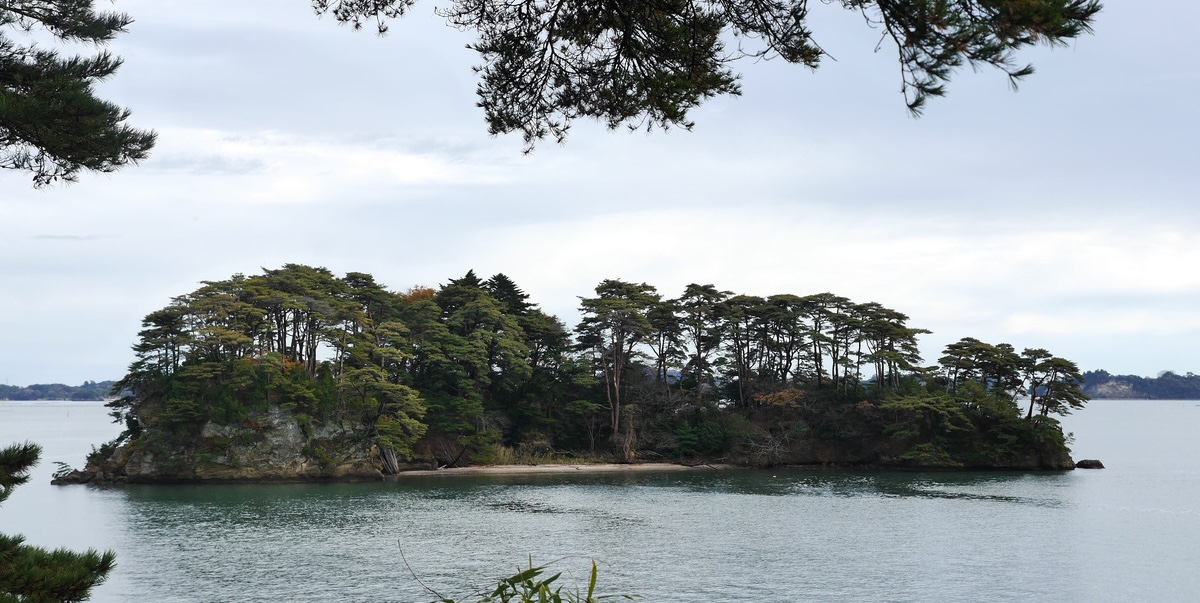
The next time I met Akagawa, it was in Rikuzentakata itself. Around us were rolling hills flecked with houses, dappled by the sun shining through the clouds. Old tourist guides reference pine trees—there reportedly used to be seventy thousand of them along two kilometers of coast. Just one survived the tsunami: a two- hundred-year-old that locals call the “miracle pine.” The road we were driving along had only reopened a year before: a huge concrete wall was first erected on the right, protecting it from the sea and blocking the water from our sight. It reminded Akagawa of Fuchū, one of Japan’s largest prisons, he said. Along our left flank was a line of bamboos.
The road wound upwards, past a sloping graveyard and cedar trees. We passed another hamlet of houses, and I started to spot various signs pointing towards the drifting post. Through a final flurry of trees, it at last became visible. There was a rectangular yellow post box—the “real” one, Akagawa said, and another upstanding coral-colored “ornamental” one. There were bicycles and benches, a big wooden house, and more trees all around. Further back from the structure of the main building was a DIY room—”my treasure box,” Akagawa smiled.
At the very end of the garden was another room, like a cabin, built by Akagawa himself. It housed sixteen binders of letters, six chairs and a desk, where people could relax or take a moment if they were “trying not to cry.” Sometimes multiple visitors turned up at once. Occasionally, they made friends with each other. Unless writers specified that they wanted their letter to remain private, Akagawa would place them in his binders so they could be read by other mourners; it might help them assemble their own thoughts. The writers were willing for their letters to be made public, he said: this made the mourning more collective. “Finding out that you are not alone is the most important thing, finding out that you are not the only person who is grieving.” As I leafed through the binders, the wind outside was so strong that it sounded like heavy rain.
In front of the cabin was a low wooden chair, where visitors could lean back and look at the sky; it was bright that day, despite the wind. “People think the dead person is in the sky above this building,” Akagawa explained. He built the room on naturally elevated ground, to honor the belief that the higher you are, the closer you are to heaven.
“I read all the letters,” he added, talking through his role. “People send the letters to be read.” There are common threads between them. “Many people assume that heaven exists, they ask ‘How’s the life there?’ And they say they know it’s hard, but they’d like to get a reply.” Some people came in person to deliver letters; others simply wrote “The Drifting Post, Iwate Prefecture” on the envelope. “The first six months were the most torturous because all the letters were so sad,” Akagawa remembered. “I saw the aftermath of 3.11 so I could clearly imagine the situation, I thought about quitting many times.”
Like in a bombing, a tsunami or earthquake also makes the private suddenly, almost indecently, public.
*
A writer misses the disappeared person who loved them like a little sister. They have moved and say they are happy, but on the eleventh day of each month they face the direction of the city where the pair spent so much time together and speak to them, their words projected into the air.
*
In the summer, Akagawa lives full time at his second home in the woods by Rikuzentakata, the drifting post visible from his windows. During winter, when snow is thick on the ground, Akagawa stays with his wife and visits the post box just once every ten days. She has little to do with his drifting post activities, he told me. “We have our own ways so we don’t interfere so much with each other.”
Akagawa imagined that the ten-year anniversary of the tsunami would mark “a kind of separation” from this work for him. But the letters never stopped arriving. Each year, the frequency increases around March 11. Letters or cards also turn up on dead people’s birthdays; birthday flowers have even been delivered. Some of the people writing have no connection to 3.11 at all; they lost loved ones due to health problems or other causes.
“The saddest letters are from mothers who lost their children, those are the hardest for me to read,” Akagawa said, as we sat in his cosy cabin, surrounded by artwork and photos given to him by supporters. “As time passed, the people who write these letters became so important to me, I realized that I could communicate with people at the lowest point in their life.”
Sometimes, people who write to the drifting post include an extra letter for him. Only then will he reply. (“People in Tohoku are very patient, but I think having a place where they can express their suffering and sadness reassures them a lot,” read one letter addressed to Akagawa, from a person who had learned about the drifting post from a newspaper. “My feelings were moved by you,” wrote another, sent from Sasebo city in southwest Japan.)
Akagawa has begun to talk about quitting, though he shook his head even as he expressed his desire to. “I communicated with the people who wrote the letters and they haven’t allowed me to quit,” he said. “I want to be released from this activity but I think it was so good starting this drifting post. I received a great gift from people who are grieving a lot. I’ve realized the relationship between people is much more than family connection. A relationship can exist when people are at the bottom.”
Once a year, Akagawa takes the letters to a nearby Buddhist temple, where a monk prays over them. Akagawa taught me about the Buddhist term kuyou, a ceremony held “to pray for people after death, to send the people to heaven.” The letters, he explained, now go through a similar process, transmitted “to heaven by the power of Buddha.” Following the annual ceremony, he packs them up and brings them home again, to his cabin in the woods.
Akagawa has never written a letter himself, “but I asked my wife to write to the drifting post after my death,” he told me. “The letter will go to heaven, so it doesn’t matter that I’m not there to read it in person. One of my consolations is, if I die, people will write these letters to me.”
_______________________________

Excerpted from This Is Also a Love Story: A Reporter’s Search for Goodness in a Cruel World by Sally Hayden. Copyright © 2026 by Sally Hayden. Reproduced by permission of Scribner, an imprint of Simon & Schuster. All rights reserved.

Sally Hayden
Sally Hayden is an Irish journalist focused on migration, conflict, and humanitarian crises. Sally’s work has been featured by The New York Times, the Irish TimesThe Washington Post, Financial Times, The Guardian, CNN International, Al Jazeera, Time, BBC, and other outlets across the world. Sally’s first book My Fourth Time, We Drowned was the winner of the Orwell Prize and the Irish Book of the Year, and was a finalist for the Baillie Gifford Prize and the New York Public Library’s Helene Bernstein Book Award for excellence in journalism.