How We All Became Little Blue Dots on a Digital Map
Katherine Dunn on the Intersection of Corporate and Military Power and That Created Modern GPS Systems
As Taiwanese manufacturers rushed to fabricate GPS chips in the early and mid-2000s and sat-nav companies rushed to install them in their receivers, Frank van Diggelen and his colleagues at Global Locate were finessing another technical challenge. Making mobile phones trackable when they called 911 was one thing. But what if GPS chips in mobile phones could actually be useful outside of emergencies, for directions, in the same way as TomTom receivers in cars? This was a great idea in theory. But the chips were still too slow, and too power-hungry, to be much use as an everyday tool.
There was another concern, one very much based on human impatience: if it took too long for a receiver to “lock on” to GPS and determine its location—which was highly likely, since the GPS antenna in a phone is very tiny, the signal is very weak and the user is often inside a building—people tended to just give up. Van Diggelen figured he had about a couple of seconds to make a human stay.
Global Locate was a fabless chip maker, which meant it designed the chips that would go in all kinds of GPS-hungry products. It was in the middle of the supply chain, between the companies that made the chips—many of them in Taiwan—and the companies that needed the chips, like TomTom. And this was a design challenge.
The system van Diggelen and Global Locate designed to solve these problems is called “assisted GPS,” and it’s basically a shortcut. To find its location, a phone’s chip first jumps back to the location of a landmark it most recently interacted with: a mobile phone mast, for example, or a Wi-Fi hotspot. The chip then cross-references the longitude and latitude of that location with the “ephemeris data,” the precise guide produced by the US government on where all the GPS satellites are expected to be, and when.
The interlocking puzzle of the iPhone, GPS and Google Maps was a moment when multiple strands of technological development…converged into a single life-changing package.
If predicting a satellite’s orbit sounds familiar, it should. This is a more advanced version of what the Transit engineers were doing in the 1950s and 1960s with the orbits of the early satellites: predicting where they would go next, based on their understanding of time and the earth’s gravitational field. These orbits are produced at the GPS Control Center near Colorado Springs and are typically valid for four hours.
This head start meant the chip in the phone already knows exactly where to look. Instead of going “wide” to scan the sky for the satellites, it can “go deep,” van Diggelen says, honing in on where the satellite is expected to be so the tiny antenna in the phone can pick up its whisper and magnify it to more than a hundred times its usual strength, all while minimizing the impact on data and battery life. It’s the equivalent of arriving in a new city, pulling out of the car park in a rental car, and using a Post-it note left on the dashboard to tune in to the exact radio station you’re looking for.
This jump-start meant a mobile phone could theoretically lock on to the GPS signal within milliseconds. And because the US had turned off selective availability, van Diggelen and his colleagues realized that Global Locate could produce their own ephemeris data for days into the future, not just four hours—so a mobile phone wouldn’t be reliant on constant connectivity. This is why, if you open Google Maps on your phone right after you arrive in a new location, you can see your general location (usually on a mostly blank map) even before you have local data coverage.
These are the first two pillars of assisted GPS: first, knowing where to look for the signal in advance, and second, having ephemeris data that is valid for a week into the future.
The third and most profound pillar deals with time. The ephemeris tells you precisely where a satellite is at a specific time, but usually this process takes around six seconds. As you’ll know if you’ve opened Google Maps looking for your location, the blue dot usually appears in only a second or two—a whole six seconds would probably feel like an eternity.
This quick response is because van Diggelen realized it was possible to work out the time much faster by adding the motion of the GPS satellites to the standard GPS equations. Standard GPS uses four satellites to solve four unknown variables: the longitude, the latitude, the altitude and the receiver’s clock offset. Assisted GPS adds one more satellite and does a fifth equation that further refines the timing calculation. Counterintuitively, this also helps the receiver calculate your position much faster, within one or two seconds.
One of the most persistent misunderstandings about GPS, especially its use in mobile phones, is that it makes you trackable. On its own, GPS is built not to track you, because of its wartime origins. This system has no idea where or who its users are, which is also why it’s impossible to say how many people are using the system at any one time, or from where. If anything, the receivers are tracking the satellites.
In the context of a smartphone, this distinction can feel a little pedantic. But it’s the way that GPS location is knitted into the broader system, particularly telecoms networks and, later, all manner of food-delivery and dating apps (themselves dependent on GPS), that turns phones into two-way tracking devices.
In the early 2000s, the emphasis on not just using location and time, but also transmitting it out, was becoming embedded across human travel and supply chains: commercial planes, container ships and shipping containers were all becoming trackable. In some industries, including international shipping, this trackability was even becoming a legal requirement.
*
It’s a moment that has gone down in tech history. On 9 January 2007, Apple CEO Steve Jobs, in his uniform of black turtleneck and jeans, stepped out onto a half-darkened stage at the Macworld Convention in San Francisco to announce the launch of the very first iPhone. The announcement of Apple’s own smartphone had been hotly, even breathlessly, anticipated. The arrival of this sleek black rectangle of metal and glass was the moment the convergence of telephone and computer went mainstream.
But the launch of the iPhone also marked the start of another revolution, albeit one that took a couple more years for the scale of its impact to become obvious. In a last-minute collaboration for the ages, the iPhone included mobile Google Maps, previously only available on computer browsers.
“I want to show you something truly remarkable, which is Google Maps on iPhone,” Jobs said. The enormous screen that engulfed the stage behind him showed his live iPhone screen as he clicked on the Maps icon on the home screen, taking the audience on a tour to their location—the Moscone Convention Center West on the corner of Howard Street and 3rd Street in downtown San Francisco.
Then he looked up a local Starbucks, and dialed the number, live.
“Yes, I’d like to order 4,000 lattes to go, please,” Jobs continued, once someone picked up. The crowd burst into laughter. “No, just kidding, wrong number. Thank you.”
Jobs proceeded to use Satellite View to tour around world-famous landmarks: the Washington Monument, the Eiffel Tower, the Colosseum—all rendered as if from a bird’s eye view.
“Isn’t it incredible?” Jobs asked the audience.
But that moment came with an important caveat: the first iPhone may have had Google Maps, but it didn’t actually have a GPS chip. Instead, it used mobile phone masts and other hotspots to find rough locations. To find a particular spot, a user had to search their location, as Jobs had done with the Starbucks onstage.
The jump to automatic, precise GPS location on the iPhone came a year later, in 2008, with the second iPhone, the iPhone 3G, which included a Global Locate GPS chip.
The iPhone quickly became a sensation: in 2007, 1.4 million iPhones were sold, even though the model was only launched in June that year, and until November it was only sold in the US. It hardly mattered that the iPhone was not even the first smartphone to tie a GPS chip to a mapping function.
The launch of the iPhone was also a period that marked a fleeting but powerful alliance between Google and Apple, before the relationship soured over Google’s decision to pursue its own line of smartphones. Right from the start, that relatively brief partnership was transformative, producing a near-compulsive Google Maps habit for early users that still persists in much of the world.
Google Maps had been available in browser form on desktop computers for nearly two years by then; even at its launch in February 2005 it was effectively a new and improved version of websites that already existed, like MapQuest, with satellite views subsequently built in.
That had already made it hugely popular. But before the iPhone, users might have pulled up Google Maps on their desktops once or twice a week, according to Bill Kilday, a Google alumnus who wrote a history of Google Maps called Never Lost Again. Almost immediately after the iPhone’s launch, traffic to the site skyrocketed, he recalled, with users now appearing to pull up Maps on their phones once or twice a day.
Eighteen months after the launch of the iPhone—and with the GPS-equipped iPhone now on the market—Google Maps was being used more on the iPhone than on all other smartphones and computers combined.
Like GPS, both Google Maps and the iPhone were what is sometimes called “confluence” technology: a convergence of multiple inventions and forms of technology into one package.
Google Maps, too, was a vast and complex collaboration, built on the back of publicly available US government reference maps, and often using satellite imagery taken by US government satellites. The product was largely the fusion of two startups Google acquired in 2004: the mapping company Where 2 Technologies and Keyhole Technologies, which stitched together aerial and satellite imagery into what was clearly the forerunner to “satellite view” and Google Earth.
Keyhole was in fact named after a system of American spy satellites, and it received funding from the CIA and the National Geospatial Agency. During the Iraq War in 2003, CNN presenters developed an on-air obsession with using it to show the location of bombing strikes. Despite the intelligence link, however, its main pre-acquisition customers came from the commercial real-estate industry.
The iPhone, although intimately associated with the singular legend of Steve Jobs, wasn’t in fact a radically new bit of kit. “I really don’t see the iPhone as an invention so much as a compilation of technologies and a success in smart packaging,” Chris Garcia, the curator of San Francisco’s Computer History Museum, told the journalist Brian Merchant for his 2017 book about the creation of the iPhone, The One Device. Merchant himself describes the Apple product as a “deeply, almost incomprehensibly, collective achievement,” rather than a product invented by Steve Jobs.
Sitting at the center of a touchscreen like they were at the very centre of the world, streets or fields or mountains arrayed in neat, artificial colors around them, they looked different, too: like a little blue dot.
Although the lone-inventor theory feels simple, compelling and “morally right,” it is fundamentally never the whole truth, Merchant argues. Much like the tick tock of GPS time, the iPhone represented a convergence, a synchronized and coordinated dance of consumer tech perfection.
*
In the late 2000s, as the iPhone was reshaping the world, Frank van Diggelen started handing out business cards that included a three-dimensional feature: a real GPS chip, intended for a mobile phone. By then, van Diggelen was working for the chip maker Broadcom in Silicon Valley—the company bought Global Locate in the summer of 2007—where he continued to develop GPS chips.
The business card chip was a “teeny weeny little thing,” he recalls, just two millimeters across, lodged under a thin layer of plastic lamination, like a rare insect on display in a glass case. Even still, most of its diminutive size was just plastic packaging, encasing the far tinier, unfathomably dense network of billions of transistors embedded in silicon. Here were decades of human invention and competition, and staggering quantities of money, all distilled down to something smaller than the size of a newborn’s pinkie finger.
Not much later, van Diggelen began teaching the basics of GPS to graduate students at Stanford University in Palo Alto. It was a role that clearly suited him. With his shock of white-blond hair, South African accent and the perma-tan of the adopted Californian, he possessed the energy of an enthusiastic high school teacher. Handing out the business card was yet another of his teaching moments.
This, it seemed to be saying, is what Moore’s Law looks like.
“Just play time backwards,” van Diggelen suggests, to describe the years that led up to GPS in smartphones. The minuscule chip becomes the size of an adult pinkie, then a postage stamp, a matchbox, a postcard: exploding in bulk and size every two years, back towards the first commercial GPS receivers in the early 1980s, as large as a microwave with an external receiver attached, too heavy to carry and worth more than $100,000.
It wasn’t just GPS chips, of course, that were shaped by the former IBM CEO’s “law” that the number of transistors on a computer chip would double every year. It was every kind of chip, and every facet of digital life. Picture the iPhone itself, ballooning backwards through time until it is a room-sized assemblage of wires and circuit boards and screens, a “giant brain” requiring teams of elite mathematicians and physicists, holed up in military labs in Dahlgren and Los Alamos.
The interlocking puzzle of the iPhone, GPS and Google Maps was a moment when multiple strands of technological development, some of them obscure and many with deep links to the US military, converged into a single life-changing package. It was the very first time that many people saw their own physical location, via the intermediary of a block of glass, metal and computer chips, US government satellites and Silicon Valley, reflected back at them in such a visceral way.
Sitting at the center of a touchscreen like they were at the very centre of the world, streets or fields or mountains arrayed in neat, artificial colors around them, they looked different, too: like a little blue dot.
_______________________________
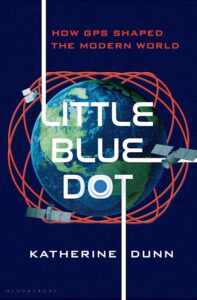
From Little Blue Dot: How GPS Shaped the Modern World by Katherine Dunn. Copyright © 2026. Available from Bloomsbury Publishing.

Katherine Dunn
Katherine Dunn is a business reporter and editor based in London. She has worked at Fortune magazine, S&P Global, The Wall Street Journal/Dow Jones and the Reuters Institute at Oxford University, where she contributed to the Oxford Climate Journalism Network, an international network to help improve climate journalism worldwide. This is her first book.