A Ghost of One’s Own: On Collaboration and Creative Ownership in Mother Mary
Katie Yee Considers the Film as an Artistic Cautionary Tale
Contains spoilers
David Lowery’s Mother Mary has been described as musical/drama, a thriller, and a psychological horror. The main character has drawn comparisons to Taylor Swift and Lady Gaga—is it then a cautionary story about fame? “Friend breakup” is another label that’s been assigned to it. (Or perhaps breakup story full-stop, though we don’t really get into it, sadly.) Many early critics have disparaged the film for being a confusing, melodramatic, metaphysical mess. And we haven’t even gotten to the ghost!
The A24 trailer defines the film in negatives first: “This is not a ghost story. This is not a love story.” It goes on to say, “This is a prayer, a song, a dress, a communion, a betrayal, a sacrifice, a rebirth.” That it defies definition, lets boundaries bleed, is sort of the point.
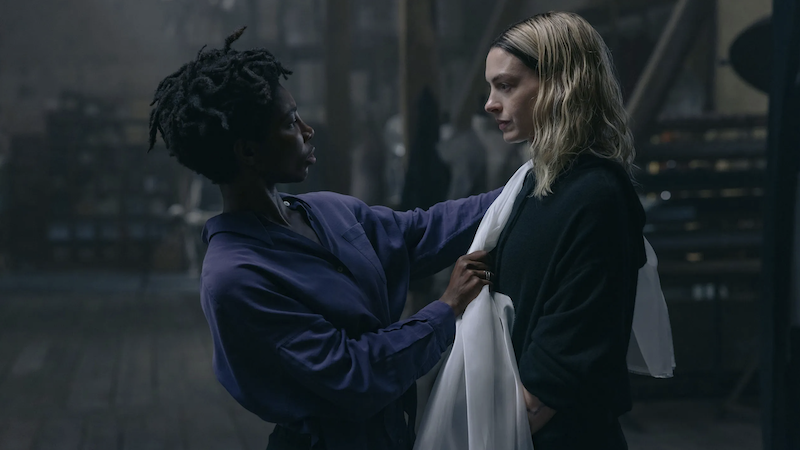
The bare-bones premise is this: an iconic pop star, the eponymous Mother Mary (Anne Hathaway), needs a dress for her return to the stage, so she flies to London to reunite with her ex-friend and ex-collaborator, a dressmaker named Sam Anselm, a self-described Miss Havisham (Michaela Coel). On a rainy night, they enter Sam’s drafty, secluded workshop/converted barn. This is where we’ll stay for the rest of the movie; it’s a locked-room kind of story that feels almost like a play.
They start talking about the dress, about their different visions for it. Mother Mary says she wants—and then she can’t quite finish her thought out loud. She makes a series of gestures with her hands, from which Sam gleans “clarity.”
Early on, Mother Mary tries to apologize for whatever it was that went down between them, but Sam stops her. She tells her old friend to apologize two more times, later, so she knows she means it. At some point, Mother Mary finds an old photograph of the two of them, smiling, tacked to the wall behind some other sketches. Think of any old sun-drenched photo you took in your twenties, with people who are no longer so prominently in your life. It’s that kind of ache. In the photo, Sam is the one wearing the halo that will eventually become synonymous with the pop star Mother Mary. This is the only glimpse we get of them happy, together.
In flashbacks and cryptic conversations, we are to understand that Mother Mary has gone through many eras of her career (not unlike Taylor Swift), versions of herself that have brought her far from where she started. The halos that the costumers adorn her with grow larger and larger—painfully so, she says. This seems to be the cautionary tale, the flip side of fame. She’s lost control of the narrative. She’s lost some key sense of herself. She’s desperately trying to return. Not just a comeback, but a homecoming.
Then Mother Mary asks if she can play Sam her new song. She says it “might be the best song ever written in the history of songs.” We know it’s called “Spooky Action,” a nod to Einstein’s theory of quantum entanglement that observes a confounding connection between particles that cannot be explained. Is it about these two old friends/potential past lovers? Is it really the best song ever written in the history of songs? Who’s to say! We are never allowed to hear this song. Sam instead proposes that the performer dance to it without music, a prompt that is followed by Anne Hathaway flinging herself across the room, dragging her body across the floor in a hypnotic spectacle that seems to convey struggle, possession, and loss of control.
What happens when your art spirals so far outside of yourself? (It should be noted that we never discover the name of Anne Hathaway’s character. Her old friend never calls her by her given name, an indication of the loss of intimacy between them. We know her only by her stage moniker “Mother Mary.” Another woman whose creation was more for the world than it was for herself.) Mother Mary is a warning: This is what happens when you lose control over your own narrative. This is what happens when you let your creation balloon up and come down like a wall between you and your loved ones.
It’s clear that there are some wounds still too fresh to touch. They dance (sometimes literally) around the hurt. One criticism I’ve heard of the movie is that it keeps the audience frustratingly at bay; why the coy allusions? Why can’t we just talk about what happened?
Mother Mary is a warning: This is what happens when you lose control over your own narrative. This is what happens when you let your creation balloon up and come down like a wall between you and your loved ones.
To me, this is the point of the movie. Mother Mary seems to be about the ways we fail to communicate with those we love, about the impossibility of expressing the pain we feel over one another. It’s about the ineffable magic of collaboration—and the indescribable despair when that link is severed. Think of any band, dance group, or art collective that you and your beloveds dreamed up once: the way it felt to sit in a room and make your art together, the way it felt to sit around and tell each other stories of your collective future success. If you’re still making art in tandem like this, with your original cast, kudos to you. The rest of us have something like one theater group (now defunct; members scattered) and one literary journal (still going, just with different names on the masthead) under our belts. Making art alone is hard because what’s in your mind hardly ever comes out right on the page; making art with other people is usually even more difficult because it feels like each of your individual visions have to be translated across different mediums and minds before they can be realized. When it clicks, it’s like sorcery—like spooky action. When it falls apart, it’s tricky to talk about.
Time and time again, the characters can’t tell it straight. They launch into memory, into metaphor (their friendship like a rotting tooth that needs to be pulled from the mouth).
And then this story tips wildly into the surreal. Sam admits that the last time she saw Mother Mary perform, she also saw something otherworldly: a bloody mass appears in her bedroom in the dead of night, then transforms into a red gossamer ghost and floats out the door. When Mother Mary echoes that she’s seen that same ghost, too, Sam is exasperated: “I can’t even have my own ghost.”
First the halo, now the haunting—this is a story about what happens when someone you love co-opts your creativity. A bad art friend. Sam has been able to let the whole friendship go, while it struggles for acknowledgement within the body of Mother Mary. What is a ghost if not a story looking to be told?
The film culminates in an exorcism, with the two women in a circle of candles, literally cutting themselves open so that the ghost may exit. They’ve reached the end of the line; they’re all out of ways to convey the hurt they feel, the pain they’ve caused one another. Much easier then to show the wound fresh.
Mother Mary is a story about why we make art, about how the same sentiment can struggle to be expressed in dance and design, in science (quantum entanglement) and song (“Spooky Action”). At the end of the day, it’s a movie about two women sitting in a room telling each other stories, sharing what haunts them, trying to cut to the heart of it.
Mother Mary’s posse shows up to this horrific scene; they drag their star out of the workshop. The last thing Mother Mary says to Sam is, “I’m sorry. I’m sorry.” The apology like Chekov’s gun at last. What is an apology if not ownership over this side of the story?
In the final scene, Sam is finishing the dress with her assistant, Hilda (Hunter Schafer). She asks Hilda to tell her what’s happening with Mother Mary at the concert, to tell her a story. Hilda looks wistfully into the distance and says that, right about now, Mother Mary will be getting on stage. We cut to some imagined narration of this scene, presumably playing out in real time, at the same time. Mother Mary is tearing off her clothes, removing her halo. In Hilda’s telling, Mother Mary sings “not her song, but your song.”
In Hilda’s telling, Mother Mary is obviously not wearing the dress that they are still working on in the barn. This is the devastating final blow: Sam will never hear the song, and Mother Mary will never see the dress. Another miss, another way they have failed to fully express themselves to one another in their final, composed form. Why even finish the dress, then? Tangled up before the credits, we see Sam Anselm’s signature label. Her name on her art. Something that is hers, at last.

Katie Yee
Katie Yee is a Brooklyn-based writer.