Our mishmash of magnificent reviews this week includes Junot Díaz on Jane Schoenbrun’s Public Access Afterworld, Kevin Power on Yiyun Li’s Music Against the Night, Sarah Chihaya on Deborah Lutz’s This Dark Night, Anna Louie Sussman on Sarah Anderson’s Fallow, and Kathryn Schulz on Nathaniel Philbrick’s The Rush.
Brought to you by Book Marks, Lit Hub’s home for book reviews.
*
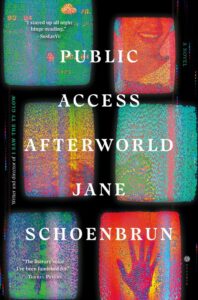
“Best known for a trinity of extraordinary movies (if you ain’t caught I Saw the TV Glow, you really should), Schoenbrun has written a doozy of a debut that reimagines the Orpheus myth for our hypermediated age. A purveyor of cinematic opacities, Schoenbrun is far more accessible here, though they haven’t abandoned their propensity for the uncanny.
Schoenbrun draws upon a cosmos of influences and genres: Public Access Afterworld is not just an Orphic epic, but also a political conspiracy, an urban fantasy and a neo-slave narrative that recalls Videodrome, The Matrix and even Neal Stephenson’s Snow Crash.
But for all this generic prolixity, Schoenbrun keeps the narrative planted in the everyday lives of their marginalized characters. By refusing the temptation to escape into the fantastic, they resist the very trap that the novel sets for its heroes.
Schoenbrun has an almost preternatural talent for rendering characters—for excavating strange channels buried underneath regular ones—whether it be the self-hating and substance-rattled Jules; David, who cannot see the harm he perpetuates; or anxious Willa, who, in a separate plotline set in 1940s Los Alamos, lives with her scientist husband and finds herself drawn to a newcomer named Rachel. Even when Schoenbrun inhabits a monstrous creature caught between dimensions, the effect is devastating.
…
Profoundly realized and profoundly human, Bethany is an emphatic rebuttal to the vile cruelties that our conjuncture has heaped on trans people. In a novel where young women are stalked and eliminated, Bethany is an exceptional ‘final girl,’ in Carol Clover’s phrasing, a tormented sole survivor who is part of a community that is itself always ‘scheduled for destruction.’ She’s alert, trusts her scars and knows better than most what it is to be trapped.
…
“But if the world has learned anything from the horrors of history, it is that even in days of chains there is much more to us than our manacles. Creativity, solidarity, laughter and, barely visible through the static of our agonies, something that might just be love. Public Access Afterworld is proof of these hard-earned sureties.
‘Find the receiver. Make it real,’ the novel urges.
An entire generation may have found a receiver in this revelation of a book. Schoenbrun has called together the dreams and tribulations of a dimension of peoples—long erased, long maligned, too often brutalized, heroically resisting—and made them real.”
–Junot Díaz on Jane Schoenbrun’s Public Access Afterworld (The New York Times Book Review)
“In his recently published A History of the Novel in Britain, Philip Hensher makes a bold claim. Historical novels, he tells us, don’t last. However popular and prestigious a historical novel might be in its day, it will almost always get thrown overboard as the ship of literary culture sails on, piled high with novels of contemporary life. He might be on to something. Who now prefers Walter Scott to Jane Austen? The historical novel risks a double obsolescence, courting a future in which it has become an old-fashioned vision of an old-fashioned time.
However much this news might dismay writers of historical novels, Hensher is untroubled: ‘As readers enjoying our contemporaries, we should not let our readerly pleasures be affected by the probability of ultimate oblivion.’ Will the future, what there is of it, rate Wolf Hall as highly as we do? It doesn’t matter. Posterity, as Gore Vidal once wrote, is ‘a permanent darkness where no whistle sounds.’ What matters is us, now, what we make of history and of our lives—in our novels and elsewhere.
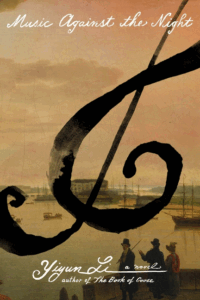
Posterity and its ironies form a central theme of Yiyun Li’s new historical novel. In several senses Music Against the Night isn’t, in fact, ‘a historical novel’—certainly not in the supermarket-own-brand sense of a cosplay adventure in which affable protagonists find themselves chatting with Byron or whoever. Readers of Li will already know that she soars far above the well-meant strivings of lesser writers, occupying a luminous realm of her own. She has the craft that makes craft invisible, and the art that makes art itself her obsessive subject.
…
“Late in the novel there is a brief reflection on the loss of a child. Li herself, of course, has written about the loss of her two sons, Vincent and James, to suicide. The subject is not dwelt on at length in Music Against the Night. It forms merely part of a piercing argument about the passions of life versus the austere and indifferent values of art. The aphoristic narrator remarks: ‘Death is a subject that rewards minor artists.’ But ‘Life? It requires major talent to convey that.’ Li conveys life without apparent effort. Major is the word.”
–Kevin Power on Yiyun Li’s Music Against the Night (The Guardian)
“At first, I felt resistant to the idea of reading an Emily Brontë biography. After all, Brontë did not make herself the most approachable author—or person, for that matter. If you take Elizabeth Gaskell’s word for it, she was “never happy nor well but on the sweeping moors that gathered round her home—that hater of strangers, doomed to live amongst them.” Nobody knows what endowed her with such fierceness and strangeness or made her do what she did or write what she wrote. As someone who has read nearly everything she wrote that survives, I must confess that I didn’t really want to know. Brontë herself, after all, seems to have wanted her readers to know nothing about her, not even her real name.
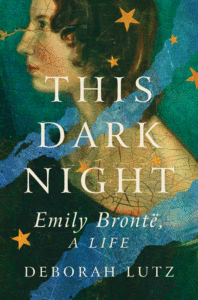
In her new biography of the unknowable Emily, This Dark Night, Deborah Lutz doesn’t commit the prime biographical sin of trying to make Brontë too easy to understand or relate to. Instead, she asks more questions than she answers. For this reason, while some readers may be frustrated by the paucity of new facts or explanations for why Emily was the way she was, for others (including this reader) this vagueness is the very reason for the book’s success.
…
“The mythology of Emily as a free-range ‘moor nymph’ was partly started by Charlotte in her editor’s preface to the posthumous second edition of Wuthering Heights. In her grief, and perhaps also because of an inability to communicate what Emily was really like, Charlotte depicted her genius sister as a kind of feral savant—a ‘native and nursling of the moors,” as she put it—who was somehow otherworldly.
…
“The point is not to bring Emily Brontë down to earth by claiming (as the 2019 show Dickinson did to that later Emily) that she was just like us, all anachronistic feelings and hidden Sapphic longings, but to bring her down to an earth that was uniquely hers. Lutz’s book does just that. Her Emily is a thrillingly earthbound creature, as individual and ultimately as inaccessible as we all are. To think we know her or understand her would be reductive. But to realize that we don’t fully know or understand her is to realize that she is just like us.
After reading This Dark Night, I don’t feel like I really know Emily Brontë any better, but I do think I understand her world a bit better—her terroir, the environment she was steeped in and that infuses her verse and prose. Lutz does not try to explain Emily—rather, she leaves her where she wanted to be, on her own.”
–Sarah Chihaya on Deborah Lutz’s This Dark Night: Emily Brontë, A Life (The Nation)
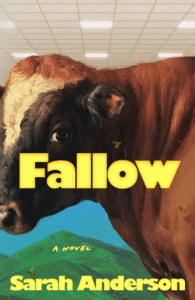
“There’s a certain kind of novel that’s not quite apocalyptic enough to be science fiction, but just far-fetched enough to be speculative. No one is from outer space; society has not yet been carved up into a hierarchy of groups with their own capitalized names. It is set in a recognizable present day—our already surreal moment of technology-driven surveillance capitalism. Its premise is plausible enough that reading it induces a specific kind of queasiness, along with an earnest prayer that Elon Musk hasn’t yet seen it and gotten any ideas.
This genre is fertile ground for feminist writers, perhaps because it doesn’t take much more than checking out the latest proposals coming out of, say, the Texas Statehouse, to send the imagination spiraling into worst-case scenarios. For women who have benefited most from centuries of progress—the college-educated women writing in rooms of their own—and feel viscerally how much they have to lose, the not-quite-sci-fi novel is a place to work out those fears.
…
“By doing away with some of the disparities that traditionally loom over both fictional and real-life surrogacy narratives, Anderson heads off common criticisms of surrogacy and the skewed power dynamics between gestational carriers and intended parents. Instead she focuses on surrogacy as just one type of job in America’s already exploitative labor market, and poses a stark question: If surrogacy exploits women, then who, exactly, is doing the exploiting?
…
“There is a reason that forced gestation is a feature of many feminist dystopian novels; for many women, this job would be nothing less than a nightmare come true. But Natalie is the kind of exception that undoes attempts at making rules. In a 2022 paper in the International Journal of Comparative Sociology, four scholars argued for the plural term ‘surrogacies,’ rather than surrogacy in the singular, to acknowledge the many versions of surrogacy and the wide variation in circumstances around each pregnancy and family. Fallow’s plot twists and turns, and the relationships and friendships Natalie eventually develops, demonstrate how the ethics of surrogacy are not reducible to any one of these narratives, but depend instead on the power relations that define each case. Natalie’s relationship to surrogacy itself evolves as the power dynamic evolves, from one of exploitation to one of respect and consent. Moreover, her entire approach to work shifts as her relationship to other people shifts: She learns to take pleasure in work when it becomes an act of interdependence rather than a mode of capitalist accumulation.
Feminists have long argued for wages for housework. They were asking for compensation for the unpaid work of social reproduction, or what one scholar calls ‘life-making’: birthing and raising and caring for generations new and old, cooking and cleaning and mending and all-around sustaining that has been, and overwhelmingly still is, done by women, ostensibly for love and not money. In its withering critique of work in all its more banal forms, Fallow suggests that unscrupulous bosses and our economy’s callous disregard for workers, not Natalie’s choice of labor, are the far more pressing problems.”
–Anna Louie Sussman on Sarah Anderson’s Fallow (The New Republic)
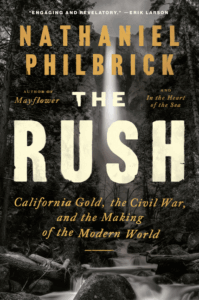
“The Rush is a sprawling book, characters and stories spilling out everywhere, as dense with claims as the goldfields it describes. Of these, two emerge as dominant. The first, which is woven throughout the book—albeit in the strict sense that it keeps appearing and disappearing—is that the discovery of gold in California set off a mad scramble for wealth, land, labor, and power that contributed to the onset of the Civil War and then helped determine its outcome. The second is that what mattered most about the gold rush was not the gold but the rush. The headlong haste with which those Nantucket whalers picked up their lives and went West was representative, Philbrick argues, of a new and distinctly American appetite for speed, novelty, and transformation, one that has defined our character and shaped our future from the time of the forty-niners to the planned Anthropic I.P.O.
The Rush is not particularly convincing about either of these claims. This is partly because both are a little rickety and partly because they are too different to comfortably coexist in a single book: one is about history and causality, the other is about psychology and culture. Mostly, though, it is because Philbrick keeps veering off into a larger, messier, less instrumentalized account of the gold rush and its aftermath. A better title for his book would be ‘A History of California, 1848-1878.’ Lest that strike you as dull, consider that those are three of the most thrilling, harrowing, and action-packed decades since the founding of our nation. In a sense, then, the tacit question The Rush asks is not about the history it covers but about history in general: Does the past need to explain the present to be worthy of our attention?
…
“It is a pleasure to meet these people in The Rush, but not every character makes an equally strong case for belonging there. Primary sources are a necessary and wonderful tool for historians, but they can have a fun-house-mirror effect, making some aspects of the past bulge and others narrow. To his credit, Philbrick is sensitive to those parts which we usually see inaccurately or not at all. He tells us, for example, that, although more than ten thousand Chinese workers helped build the transcontinental railroad, not a single diary or letter from one of them has ever been found, leaving a vast lacuna where their own California story should be. Still, The Rush is ultimately more hamstrung by what it contains than by what it does not.
…
“In Philbrick’s framing, the root cause of this crisis was the discovery of gold in California nearly two centuries ago. ‘This is the world in which we live today,’ he writes earlier in the book, ‘jammed into jets on our frantic way to the next new thing—a world created in 1849 by the California Gold Rush.’ But did the gold rush create our contemporary world, or do the two just resemble each other? It’s true that many features of eighteen-fifties California are also visible in the current A.I. boom, from the benefits of arriving early and the outlandish profit to be made in infrastructure—whether picks and shovels or microchips and data centers—to political instability, environmental destruction, and wild inequality. But resemblance is just a surface relationship, and nothing in Philbrick’s book makes the gold rush seem like a motive force behind the breakneck, and maybe break-everything, boom of today. Nor does anything in it make avaricious urgency seem specifically American; how could it be, when all those Aussies and Frenchmen and Chinese and Chileans likewise dropped everything and sped to California?
The more plausible explanation is this: put any group of people within striking distance of a potential source of spectacular wealth, and many of them will behave in similar ways, including moving toward it, competing for it, cheating over it, exaggerating about it, inventing new ways to extract it, creating rules to manage access to it, breaking those rules, and generally using all available means, legal and otherwise, to dominate and profit from it. The Rush is at its best when it simply shows us this mayhem as it unfolded in a specific place and period, instigated, abetted, opposed, documented, and occasionally averted by marvellously specific human beings. One sympathizes, in these dark and confusing times, with the desire for the past to illuminate the present. But the past is its own kind of gold—abundant, difficult to access, inordinately valuable—and sometimes it is enough to let it shine.”
–Kathryn Schulz on Nathaniel Philbrick’s The Rush: California Gold, the Civil War, and the Making of the Modern World (The New Yorker)