5 Book Reviews You Need to Read This Week
“A rigorous, self-assured, propulsive, at times terrifying portrait of a dweebocracy that sets the agenda for the planet.”
Our favorite criticism of the week includes Anand Giridharadas on Theo Baker’s How to Rule the World, Hamilton Cain on Ali Smith’s Glyph, Thomas Mallon on Lois Romano’s An Inconvenient Widow, Kate Preziosi on Paige Lewis’s Canon, and Alex Tan on Lisa Robertson’s Riverwork.
Brought to you by Book Marks, Lit Hub’s home for book reviews.
*
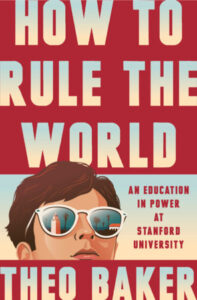
“If America is the most powerful country on earth, and Silicon Valley the most powerful place in that country, and Stanford the most powerful institution in that place, and a secretive network of students and adult hangers-on there the hub of influence on campus (I know that’s a lot of ifs, but let me finish), then here lies the rapacious, awkward center of the world. Theo Baker, a reluctant journalist still not old enough to rent a car, nonetheless drives us, Jules Verne-like, into the molten core of our troubled time … Baker’s first book, How to Rule the World, is a rigorous, self-assured, propulsive, at times terrifying portrait of a dweebocracy that ‘sets the agenda for the planet.’ In every age, there is some place that epitomizes how power works. Baker’s Stanford is a strong candidate, and his book follows in the tradition of Michael Lewis’s Wall Street chronicle Liar’s Poker, but with more pimples and less eye contact.
…
The Stanford-within-Stanford Baker exposes matters to you even if this exclusive core feels impossibly distant. The university has let technology firms and venture capitalists worm so deeply into it that it now functions, in Baker’s telling, as a talent-scouting system for future unicorns. Everyone else is window dressing. And this campus elite betrays attitudes — captured by Baker — so contemptuous of non-Übermenschen, not to mention those far outside this world, that one gets a feel for the kinds of mentalities designing A.I. and presuming to rewire our societies.
…
Baker pursues the story like a campus reincarnation of Woodward and Bernstein. But for a time he continues trying to be an insider, even as he lobs grenades from without. He organizes hackathons and files stories, takes coffees with talent brokers and stakes out Tessier-Lavigne. It’s as if Woodward and Bernstein were also trying to win a couple of House seats.
This dual-track approach would probably discredit an established journalist. For a college freshman who is still figuring himself out, it is understandable — and makes him harder to dismiss. Baker still admires much of the tech world. He still believes it does good and wants its approval. But he confronts his dreamland and concludes, painfully, that it is rotten, indifferent, built on lies, craving power for its own sake.”
–Anand Giridharadas on Theo Baker’s How to Rule the World (The New York Times Book Review)
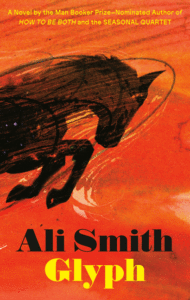
“In her feisty, graceful Glyph, Ali Smith mulls writing and language among other themes: it’s her best work since the lauded Seasonal Trilogy. Written language shape-shifts, from glyphs and runes to schematic sonnets to today’s emojis and texts; Smith’s experimentation links this notion with the political upheavals and moral betrayals of our moment. No Anglophone author channels molten rage with her level of skill.
…
Glyph brims with whimsy, but it’s more than a game … Who is seen amid global atrocities — more importantly, who isn’t seen, entombed beneath collapsed hospitals and apartments — remains Smith’s focus, a theme from earlier books. Innocents, she reminds us, bear the brutal costs of empires … Glyph is about war, but there are no heated battle scenes; the author sifts meaning from collateral damage, a flattened human, a wounded horse, a bomb-scarred city. And while the novel flirts with allegory, it never tips into abstraction, but stays rooted in the concerns of our most vulnerable.
…
This equipoise of spontaneity and control define Smith’s singular fiction. As Glyph rounds into the homestretch the narrative broadens, a flash of transcendence for the soldier and horse, a ray of hope for Petra and Patch. I won’t spoil the conclusion except to note the final three pages alone are worth the price of a hardcover. Once again Smith makes her case beautifully: art points the way forward, enduring across millennia, like those Sumerian tablets, yet transforming itself and us each day.”
–Hamilton Cain on Ali Smith’s Glyph (The Boston Globe)
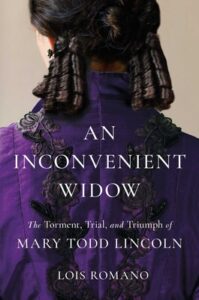
“Romano admits to Mary’s long-standing ‘histrionics,’ ‘eruptions,’ ‘temper,’ ‘mood swings,’ and ’emotional immaturity,’ but recognizes how Willie’s death started a more serious ‘mental decline’ that today’s medications might have helped forestall. Lincoln himself would likely have benefitted from modern prescription drugs for what was then thought to be his ‘melancholia’ … Romano’s sturdy book may not stint on examples of Mary’s bad behavior—including a ferociously jealous verbal assault, near the end of the war, on the wife of a prominent Union general—but the biographer keeps tilting against those who slighted Mary in even the most superficial ways.
…
Romano puts herself in the curious position of fighting a battle that has already been won on facts but not yet in legend. The cruel cartoon of a constantly shrewish, venal, and disloyal Mary began cementing itself in the public mind when William Herndon, Lincoln’s Springfield law partner, started lecturing about his reminiscences within months of the President’s murder. Having loathed Mary for decades (the feeling was entirely mutual), Herndon moved beyond personal animus into outright fabrication by promoting the fairy tale that the real love of Lincoln’s life had been a young woman named Ann Rutledge, whom he knew in Illinois, in the eighteen-thirties, before her death from typhoid fever. Romano writes that ‘it would be sixty years’ before the story was publicly contested, though attempts at refutation actually began almost immediately.
…
Our need to meditate upon Lincoln as a savior and a saint—especially in times as rotten as the present—gives us a motivation, perhaps subconscious, to vilify Mary. If the assassination made the President a Christlike figure, his forbearance in the face of a wife’s unreasonableness provides him with an extra measure of purity. Romano is aware of the thumb on the scale, and she blames ‘early historians’ for it: ‘The more Lincoln’s legend soared, the more Mary’s reputation declined.’ But the fault lies more with the citizenry than with scholarship. Each reiteration and exaggeration of Mary’s bad behavior is another civic stroke of the chisel that perfects the monumental Lincoln in our collective imagination. The task is advanced by our malice toward one, and that one is Mary.”
–Thomas Mallon on Lois Romano’s An Inconvenient Widow (The New Yorker)
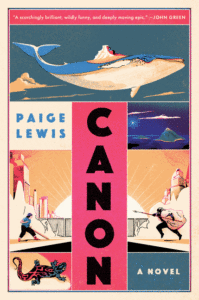
“Stop me if you’ve heard this before. In Paige Lewis’s brilliant debut novel, Canon, the beautiful wife of an army general is abducted. War breaks out. A mercurial God pulls all of the strings. A hero journeys far from home, and meets powerful mentors along the way that prepare them to face the ultimate villain before they can return home again. Except, this isn’t Ancient Greece. It’s mainly taking place sometime in the nineties.
…
For millennia, God has been recycling the same tropes that we all know from Homer, Virgil, Dante, and the Bible. By the time we get to the action in Canon, the schtick is getting stale. The novel’s omniscient narrator can barely conceal their exasperation, relaying key details like place and time with a winking mix of hostility and resignation.
…
In choosing the title for Canon, Lewis is both nodding to the Western texts that serve as the novel’s foundation, and offering an audacious mission statement: that something original can indeed be made from used parts. It can also be funny, chaotic, warm, and impossible to put down.”
–Kate Preziosi on Paige Lewis’ Canon (Brooklyn Rail)
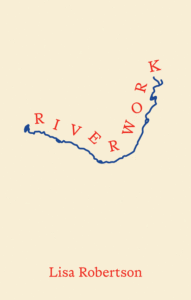
Unlike the living river, available to myth, the dead river paved over with asphalt is far less common and useful as a trope. But precisely from the smoothed-over ruin of one such forgotten river—the Bièvre in Paris—the Canadian-born writer Lisa Robertson stitches together a lost world. Riverwork, only her second novel after a lifetime of ludic, elliptical poetry, assigns itself an essentially recuperative and archival undertaking. Its unlikely heroine is the self-described ‘hag’ Lucy Frost, descended from a line of petty thieves and ‘small-time scammers’ … Having unearthed the notebooks containing the hydrological research of her mysterious great-aunt Em—who herself vanished years ago, never to be found—Lucy sets out to retrace her ancestor’s errant footsteps.
…
Riverwork’s apparent arc is one of oblivion—like pressing an ear to the murmur and purl of an undercurrent. But its narrative premise is almost an alibi, for the textual disjecta that accrete around it are seemingly endless, aleatory digressions into everything from film criticism and medical trivia to literary biography and leftist history. Call it hybrid, genre-bending, unclassifiable—those totemic labels of the contemporary literary zeitgeist fall short. There is no story, Lucy Frost protests repeatedly—part lament, part apology, part political statement—in case we should expect otherwise.
…
Robertson’s oeuvre demands to be situated in such a feminist lineage; she has called herself a ‘she-dandy.’ Her sentences are as sculpted and baroque as Djuna Barnes’s. They are resistant to paraphrase, for abstracted out of context, they seem gnomic. I have often described her to others as a more difficult and intractable Anne Carson … For her, form is everything—form is the problem, and style can be as serious as life and death.
…
Robertson’s work is precisely about the negative space around authorship. Or, to state it otherwise, all that we might find when we renounce our attachment to that individual construct of genius. Aren’t we all, in some fundamental acute way, antenna vibrating to the frequency of voices not our own? … Might that not be fiction by another name? The kind that lurches and makes as if to supersede itself?”
–Alex Tan on Lisa Robertson’s Riverwork (The Baffler)
Book Marks
Visit Book Marks, Lit Hub's home for book reviews, at https://bookmarks.reviews/ or on social media at @bookmarksreads.