5 Book Reviews You Need to Read This Week
“Musk is many things: entrepreneur, far-right troll, cautionary tale about the negative effects of completely lacking a good sense of humor.”
Our favorite criticism of the week includes Matt McManus on Quinn Slobodian and Ben Tarnoff’s Muskism, Katie Kitamura on Sophie Mackintosh’s Permanence, Chris Vognar on Craig Fehrman’s This Vast Enterprise, Barbara Spindel on Mary Lisa Gavenas’s Selling Opportunity, and Hua Hsu on Karen Tei Yamashita’s Questions 27 & 28.
Brought to you by Book Marks, Lit Hub’s home for book reviews.
*
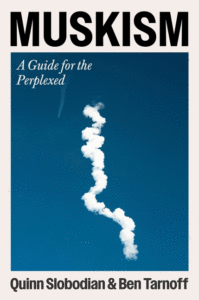
“Elon Musk is many things: entrepreneur, far-right troll, cautionary tale about the negative effects of completely lacking a good sense of humor. This mercurial figure is the main subject of Muskism: A Guide for the Perplexed by Quinn Slobodian and Ben Tarnoff. Both come well equipped for a deep dive into the life and thought of the tech entrepreneur.
…
Ror all its strengths, Muskism’s account of the rise and influence of its protagonist is one squarely focused on ideology, obscuring the broader political and economic forces working behind the scenes. This makes the book enlightening but ultimately limited in its approach to understanding the pathologies of the present. It would benefit from situating Musk in the broader nest of institutions and practices that have allowed him to flourish and discussing his relationship to the broader right. Given all that, I found Muskism more suggestive than revelatory and was left feeling the definitive left-wing critique has yet to be written.
…
The deeper reasons for Musk’s attraction to the Right lay in the realm of ideology rather than political economy. Musk routinely invokes right-wing influencer Gad Saad’s notion of “suicidal empathy” to describe fellow feeling for the weak and suffering as a bug holding back Western civilization. This bug directs excess attention toward the needs and empowerment of the lower orders, which in turn undermines the ability of figures like Musk to build the future in their own image.
…
Slobodian and Tarnoff’s analysis of Musk’s worldview is fascinating and informative, but the book is a lost opportunity to say something more historically resonant about how the tech mogul’s outlook connects to that of the broader right … Muskism is very much about Musk’s worldview, right down to the book’s chilling coda in which the authors describe the potential dystopian futures that the tech billionaire would like to impose on us. This is all well and good, but the focus on a singular figure has the effect at points of obscuring as much as it reveals. What social structures enabled Musk and his peers to acquire so much power, such that their messianic techno-reactionary futurism is a real threat rather than just fodder for b-rate science fiction? How and where does Musk fit into the broader history of the political right?”
–Matt McManus on Quinn Slobodian and Ben Tarnoff’s Muskism (Jacobin)
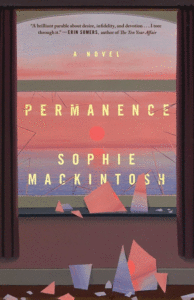
“Sophie Mackintosh’s novels are always speculative in some way, with either the author or her characters forging a world governed by its own logic and rules. In their boldness and their ability to convey the violence of patriarchy, they recall the work of Jacqueline Harpman … Like Harpman, Mackintosh has a spare and confident hand. Her work is sometimes described as dreamlike; certainly, its contours are sketched with rapidity and confidence and relatively little detail … When Mackintosh writes about masculine power, she does so in a way that articulates both its seductions and its terrors. Her newest novel, Permanence, is less explicitly concerned with the structure of patriarchy, but it has the same erotic charge as her earlier work, the same preoccupation with social prohibitions and the thrill that comes from breaking them.
…
Might seem like an outlier in the current array of articles and books about open marriages and polyamory, and at first glance the line of distinction between the two worlds, much like the division between blue and white tickets, seems almost old-fashioned. But as Mackintosh persuasively illustrates, the familiar emotions of jealousy, infatuation and eventually indifference — these persist and can flourish in any relationship, however free of prohibition.
…
In her work, Mackintosh devises scenarios that are bold and almost aggressively simplified. But her terrain is complexity and contradiction, and in her hands these oppositions twist and turn in on themselves … What is more disquieting is the surreptitious ease with which Mackintosh’s speculative worlds start to align with our own, allowing the reader to see how so many of the old prohibitions and conventions — around choice, around marriage — remain, somehow, firmly in place.
That moment of recognition, in a landscape that is startlingly alien, is the source of Mackintosh’s power as a writer.”
–Katie Kitamura on Sophie Mackintosh’s Permanence (The New York Times Book Review)
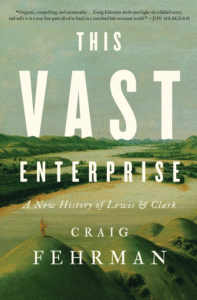
“History, as they say, is written by the victors. It’s also written by those with ready access to pen, paper, and, in many cases, patronage. Meriwether Lewis and William Clark certainly fit this bill; they’ve gone down in national lore as the heroes who led the Corps of Discovery on a treacherous 8,000-mile trek to find a route to the Pacific Ocean in the early 19th century. The expedition, along with the Louisiana Purchase, opened up the country to new possibilities of expansion, empire, and exploitation.
But Lewis and Clark had a lot of help, as Craig Fehrman argues persuasively and poetically in his new book This Vast Enterprise: A New History of Lewis & Clark. Without minimizing the contributions of the two complicated men known (at least casually) to school children far and wide, Fehrman makes room for a supporting cast that was really much more than that. As Fehrman writes, “The success of Lewis and Clark depended on more than Lewis and Clark.” This is vivid, character-based history with a dramatis personae that includes figures familiar and relatively obscure — those celebrated by the official record, those lost to it, and those who fall somewhere in between.
…
This character-based approach pays enormous dividends, as Fehrman weaves a tale that uses human stories to go beyond hard facts and calcified myths. You get a real sense of what it might have felt like to tow the Corps’ barge over an endless series of sandbars, or engage in a tense, multi-day standoff between Corps members and the Lakota, led by the proud, patient, and strategically adept Black Buffalo.
…
This Vast Enterprise moves Lewis, Clark, and their crew out of the realm of myth and into a world not just of blood and sweat but also negotiation: with the land, with Native peoples, and with each other. Fehrman’s approach to this well-trodden historical chapter is fresh and inclusive. It also makes for a ripping good read.”
–Chris Vognar on Craig Fehrman’s This Vast Enterprise (The Boston Globe)
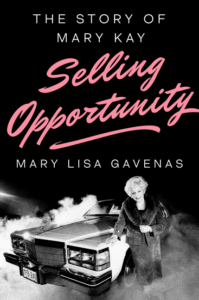
“The cosmetics company Mary Kay is known for the pink Cadillacs awarded to its top earners, but the luxury vehicle is only one of the so-called Cinderella gifts conceived by its founder. Mary Kay Ash (1918-2001) reveled in presenting mink coats, diamond rings, dream vacations and other extravagances at her company’s pomp-filled annual convention in Dallas. The gifts were lavished upon an elite tier of the company’s “beauty consultants.” In Selling Opportunity, her enthralling biography of the self-made magnate, Mary Lisa Gavenas observes that Mary Kay (as she calls her subject throughout) saw such prizes as the rewards “that we wait around for that guy on the white horse who never shows up to bring us.”
They were also, the canny saleswoman believed, things that women were not likely to buy for themselves. Ms. Gavenas observes that Mary Kay made a point of avoiding cash bonuses, convinced that women would feel they needed to use the money to pay bills or replace appliances. She chose pink Cadillacs precisely because they were impractical, the furthest thing from a family car that she could imagine.
…
Ms. Gavenas is a stylish writer with a knack for spotting telling details. The bewigged and bejeweled Mary Kay, forever spouting aphorisms…is a vivid presence in these pages, even if her inner life can be difficult to fathom. She maintained a punishing schedule into her late 70s, until a debilitating stroke left her confined to her home, with Rogers running the company.
Mary Kay Inc. today claims a global sales force of 3.5 million; its stated mission is enriching women’s lives. Multilevel marketing has been subject to increasing scrutiny in recent years, but Ms. Gavenas devotes more space to Mary Kay’s funding of cancer research and women’s shelters than to critics’ complaints that the company she founded deploys high-pressure tactics to convince women to shell out for expensive products that they’re likely to have trouble selling. While the author acknowledges the distinction between the accounts of a few high-flying sellers and the reality of what most consultants earn, her generous account prefers to see the story of Mary Kay through pink-colored glasses.”
–Barbara Spindel on Mary Lisa Gavenas’s Selling Opportunity (The Wall Street Journal)
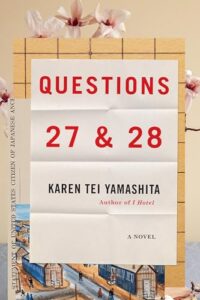
“In 1943, the United States government administered a questionnaire to people of Japanese descent who had been confined to wartime concentration camps in California, Idaho, Arizona, Colorado, Utah, Wyoming, and Arkansas. The forced imprisonment of some hundred and twenty thousand residents, a majority of whom were U.S. citizens, rested on dubious evidence that they posed any meaningful threat to American safety. The removal orders seemed cruel and arbitrary, given that they applied only to people living on the West Coast. Still, the government sought to measure their loyalty. The title of Karen Tei Yamashita’s fifth novel, “Questions 27 & 28” (Graywolf), refers to the survey’s last two questions:
Question 27: Are you willing to serve in the armed forces of the United States on combat duty, wherever ordered?
Question 28: Will you swear unqualified allegiance to the United States of America and faithfully defend the United States from any or all attack by foreign or domestic forces, and forswear any form of allegiance or obedience to the Japanese emperor, or any other foreign government, power, or organization?
…
Some young men, eager to assert their Americanness, answered yes to both questions and volunteered for military service; members of the all-Japanese 442nd Regimental Combat Team quickly became war heroes. Others feared that these were trick questions; there was a rumor that everyone would be sent to Japan anyway as part of a P.O.W. exchange. Those who answered no to the questions were, in most cases, imprisoned for the remainder of the war or beyond. They became pariahs referred to as “no-no boys.”
Questions 27 & 28 is about what preceded and followed this episode. At first, the novel’s conceit seems familiar: a series of scattered, representative lives cohering into a kind of collective story. In the opening pages, the real-life Japanese writer Yone Noguchi…sets sail, in the eighteen-nineties, for San Francisco.
…
As we encounter more people, Yamashita’s approach to narrating their stories grows strange. Life in the camps is told largely through collaged fragments of latter-day writings, testimonies, and oral histories; footnotes remind us that we are accessing these voices at a distance. Other experiences are recounted through dramatic dialogue, or from the perspective of an inanimate object; some chapters adopt the pulpy tone of a spy thriller, breaking from any sense that Questions 27 & 28 is meant to be a straightforward account of the past.
…
Questions 27 & 28 is a work of fiction about the nature of history, and about the mechanics by which we come to know anything reliable about the past in the first place. It is a sprawling and overwhelming volume, encompassing about a hundred real lives and spanning more than a hundred years, so that the reader experiences the process through which the accumulated occurrences of the past get shaped into historical fact … A novel about writers writing or researchers digging through archives runs the risk of tedium. But Yamashita is at her best when she zooms out of such small moments and meditates on the greater stakes of these scattered lives.”
–Hua Hsu on Karen Tei Yamashita’s Questions 27 & 28 (The New Yorker)

Book Marks
Visit Book Marks, Lit Hub's home for book reviews, at https://bookmarks.reviews/ or on social media at @bookmarksreads.