Why Everyone is Talking About Salome These Days
Leslie Baird on Exploring Enduring Questions of Patriarchy and Feminine Agency Through Fiction
The couple at the table next to me at the restaurant in rural Tuscany were fighting over their dinner. Arms flew around in exasperation, and the woman left the table for such a long time that the large dog lying at their feet sat up and whimpered in the direction of her departure. The couple had ordered an enormous rack of meat—ribs of some kind, arching off the plate like a detached flying buttress. I tend to notice these things as a Not Animal Eater, and a generally distractible person. But I didn’t notice any of this yet, because at this moment, I was locked in rapt attention as across the table from me, my colleague described her experience of seeing Salome performed at the Metropolitan Opera some months before.
Jaime described how the production had included young actors to symbolize Salome at different ages, drawing a clear image of sexual abuse at the hands of her stepfather. This is hinted at in Oscar Wilde’s play, Salomé, which premiered in Paris in 1896, after initially being banned in London. The opera by Richard Strauss features a German translation of Wilde’s play as the libretto. The director of the 2025 Met Opera performance, Claus Guth, chose to bring Salome’s history of sexual abuse by her stepfather to the fore, giving the character a tangible motivation for her infamous rage.
The realization that there is a punishment for women who align themselves with men, as well as for those who don’t, is rightfully maddening.
The spectacle Jaime detailed included projections onto the set’s back wall, frenzied choreography involving animal masks, and, most interestingly to me, an anticlimactic, psycho-analytic take on the “dance of the seven veils,” which is typically portrayed as a strip tease. It wasn’t until after Jaime’s impressive recall was over that the other people at our table directed our attention to the drama that unfolded just one table over.
The former theater major in me was interested in the well executed interpretation of this classic play, but I was, of course, mostly curious because my own novel of the same name was set to be published one year later. (Note: in English, the name is often spelled “Salome,” while the French is “Salomé.”) Starting in early 2024 with the announcement of Silvia Moreno-Garcia’s The Seventh Veil of Salome, I’d noticed a sudden resurgence of the character sometimes described as the “original femme fatale.” When I’d started working on my novel back in 2017, I’d rarely, if ever, heard the story referenced.
So why this woman, and why now?
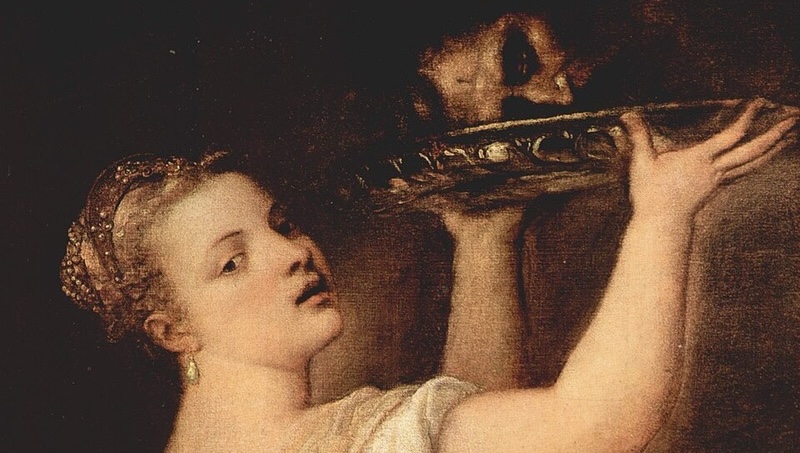
The first thing to establish is that the word “woman” is a loose interpretation. If you consider that in the Biblical story, Salome was a teenager. (The Bible does not expressly name her, so the name “Salome” comes from other records of the daughter of Herodias, wife of King Herod in ancient Judea.) The gist of the story is that Herod begs Salome to dance for his guests at his birthday banquet, and he promises her anything she wants in return. In both Wilde’s play and Strauss’s opera, Salome is obsessed with Jokanaan (John the Baptist), who is being held as a political prisoner in a cistern, his disembodied voice floating around the stage. When Salome propositions Jokanaan, he immediately rejects her. Her mother, tired of Jokanaan’s accusations that her marriage is unlawful (she had been married to Herod’s late brother before, who was Salome’s father), suggests that Salome should ask for Jokanaan’s head in return for the dance. Salome, spurned by Jokanaan’s rejection, agrees. Salome performs a sexually-charged “dance of the seven veils,” and Herod reluctantly orders an executioner to behead Jokanaan.
It isn’t until Salome lifts the severed head and kisses Jokanaan’s dead lips that Herod is so repulsed by her that he (spoiler alert for a one hundred and thirty-year-old play) orders his soldiers to kill her on the spot.
At first glance, a young girl being sexualized by her creepy stepfather and subsequently killed for her own desires may sound like a story badly told by a man (even a famously queer one). But the more I thought about it, the more I realized that Oscar Wilde’s tragedy is more evergreen than I wanted to admit, and touches on a key, though nuanced, element of patriarchy—female complicity.
“The Patriarchal Bargain” is a term first coined by the Turkish author Denise Kandiyoti in her 1988 article, “Bargaining with Patriarchy.” Kandiyoti describes the paradox of being female in a male-dominated world, and the means by which some women align with men, often at the expense of other women, essentially bargaining for their own safety. In 2026 internet parlance, we might see this described as a “Pick Me,” the consequences of which are: “I didn’t know the face-eating leopard would eat my face.”
While the patriarchal bargain can and does exist throughout different cultures worldwide, the particular brand on full display in the United States at present is inextricably linked to white supremacy, as white women uphold patriarchal structures in a misguided attempt to exempt themselves from misogyny by distancing themselves from women of other races. In the first few months of 2026 alone, we watched as multiple women in Trump’s inner circle lost their jobs in rapid succession, after aligning themselves with the ideals set forth in Project 2025, the policy plan created by The Heritage Foundation, a right-wing think tank.
Among other societal setbacks, Project 2025 dismantles reproductive rights, rolls back legislation protecting women in the workplace, creates barriers to divorce, and threatens to erode the foundation of same-sex marriage. The face-eating leopard memes soared on the day that Caitlyn Jenner, an avid Trump supporter, had the audacity to be surprised when she was misgendered on her new passport, even though the State Department was very clear on its new policy. The thing about the patriarchal bargain is that it’s always a losing bet.
Be that as it may, it stands to reason why the patriarchal bargain endures, as women are sure to be punished even more promptly for noncompliance. Throughout the late 2010s and early 2020s, we watched woman after woman essentially have their lives ruined as they accused powerful men (Harvey Weinstein, Donald Trump, Brett Kavanaugh, Bill Cosby, Johnny Depp—to name a very few) of abusing them. The window of time during which we thought that these men may be held accountable for their actions not only swiftly closed, but created a vacuum that seemingly hurtled our progress back in time. The new fad of tradwife influencers idealizing a time before women had the right to vote is evidence enough. (See: Yesteryear.)
The tragedy of Oscar Wilde’s play, for me, was in realizing that the author wasn’t going for shock value when he had Herod immediately dispatch of Salome after sexually exploiting her. As the New York Times classical music critic, Zachary Woolfe, wrote of the Met Opera rendition: “Well over a century after its premiere, Salome has lost its onetime ability to shock. At its best, perhaps, it can sadden.”
Although many modern women have opportunities that our own grandmothers barely knew, living within a patriarchal system means that the majority of us are still raised to center men.
Indeed, Salome’s lascivious dance of the seven veils was once more shocking for audiences than her execution. Now, one hundred and thirty years later—although we’ve been able to see the strings of patriarchy for generations—we still aren’t shocked to see a woman brazenly acting outside of societal norms be publicly punished. We also aren’t surprised that Salome’s own mother might’ve encouraged the behavior that ended in her demise, as one element of the patriarchal bargain involves older women subjecting younger ones to the same rules they endured in order to swim along in the currents of patriarchy—sometimes unconsciously, sometimes under coercion, and sometimes willfully. Perhaps this audience evolution, as astutely observed by Woolfe, is exactly why we keep coming back to Salome.
The realization that there is a punishment for women who align themselves with men, as well as for those who don’t, is rightfully maddening. Spanning genres and satisfyingly cathartic to read, “feminine rage” is a recently-coined subgenre that has exploded in popularity. These stories usually involve a woman shucking societal norms of being nice, pretty, and obedient. Even more niche subgenres include “weird girl lit” and “good for her” narratives. A very successful recent interpretation of feminine rage, Rachel Yoder’s Nightbitch, depicts a new mother physically morphing into a dog at night, sprouting fur all over her body and running feral. It’s worth noting that many feminine rage books, including my own, take on a supernatural element. Perhaps because it seems easier to reinvent the laws of physics than to write a woman unburdened by patriarchy.
While it was certainly less symbolic than morphing into a dog, I enjoyed the opportunity to explore the theoretical side of feminine rage. Although many modern women have opportunities that our own grandmothers barely knew, living within a patriarchal system means that the majority of us are still raised to center men. In my own interpretation of Salome, I wanted to explore how decentering men could be the first step a woman takes to grapple with the extent to which she perpetuates the patriarchal bargain.
Sometimes, these first steps are small, such as learning to accept her aging body without forcing it to fit a patriarchal, and frankly prepubescent, beauty standard. (Women scramble after eternal youth while the ever-growing longevity/immortality movement is dominated by men.) While these first steps into dismantling the patriarchy may not appear radical at face-value, I enjoyed exploring how severing those ties could lead a woman to the rational conclusion that there’s no way out other than to burn it all down.
____________________________
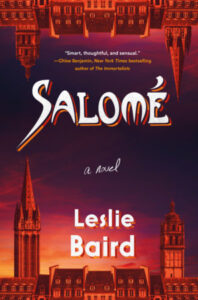
Salomé by Leslie Baird is available from Putnam, an imprint of Penguin Publishing Group, a division of Penguin Random House, LLC.

Leslie Baird
Leslie Baird is an author and ghostwriter. She holds an MFA in fiction from Sewanee, the University of the South, and lives in Europe. Salomé is her debut novel.