Writing a Novel and Hiking a Mountain Are Pretty Similar, Actually
Leila Renee on Climbing a Mountain with Her Sister
In July 2020 my twin sister Madelynn and I had decided we were tired of being apart, of quarantining alone in our homes—mine in Syracuse, NY, where I was an MFA student drafting my first “novel” and hers in East London—rightfully cowering from a deadly pandemic whose end then seemed unfathomable. We decided we would overcome confinement by becoming hikers. Those were the kind of people we were. Not the kind who cowered from viruses and obsessed over death.
We had never summited anything beyond a modest hill, but we just knew hiking Big Slide Mountain would be easy. Yes, Big Slide’s imposing height meant it had a place on the list of the Adirondack 46 High Peaks, a set of peaks in the Adirondack Mountains of New York. True, it had an elevation of 4,420 feet. And, sure, the AllTrails website alleged that the 9.4 mile ascent and descent would last eight hours, but we were pretty fast walkers. How hard could it be?
We bought hiking boots, rented a Corolla, and drove four hours east from Syracuse, NY to Lake Placid, NY. We drove to the trailhead at dawn and parked, the day’s impending heat foreshadowed by mosquitos and humidity. I left the big water jug I had brought in the car because there was no way I would need it.
And I know writing a creative nonfiction essay like this one means mining life experiences and packaging them into meaningful lessons but truthfully, like mountains, I’ve got little clue exactly how essays should be navigated.
Instead, I put a small water bottle in my backpack. Madelynn took pictures of me standing beside a sign nailed to a scaly tree. In yellow letters: TRAIL TO BIG SLIDE MT. 3.9 miles (Total ascent 2800 ft.). The July sun swung high above our heads, casting an orange glow around the canopy of trees. I smiled into Madelynn’s iPhone. Behind her sat the cramped parking lot where weathered hikers limped to their cars. Pussies, I thought. It’s a two hour hike up a measly “mountain.” How hard could it be? After all, Madelynn and I had already survived homebound months, an ocean apart, consumed by insulating fear.
“Ready?” Madelynn asked, steadying herself on the soggy woodchips of the path.
I knew hiking a mountain meant walking upward, but I didn’t know how much water to bring, nor how to navigate moss-slickened rocks. And I know writing a creative nonfiction essay like this one means mining life experiences and packaging them into meaningful lessons but truthfully, like mountains, I’ve got little clue exactly how essays should be navigated. I am a fiction writer, after all. And I was a fiction writer in July 2020, when we set out to conquer Big Slide. I was drafting a novel that at 200 pages in I still wasn’t sure if I should just preemptively incinerate.
Unlike my poor knowledge of hiking, I was aware of how much I didn’t know when it came to writing novels. I even felt the angst of writing in Lake Placid, hours from my laptop. Each day that I did not write that summer, I felt like a finger plugging an exploding tap. The novel seemed impossible to surmount, yet I could not kill the magnetic impulse to continue. It was a coming-of-age story about family dysfunction that I felt called to tell because I had so intimately lived it. Perhaps a similarly magnetic impulse lured Madelynn and me to Big Slide. After all, hiking felt like the thing we had the most control over; the thing that made us feel—despite the prevalence of death—like we could stay alive.
I clutched my damp backpack straps as Madelynn and I hiked up a woodchipped path. The air was sweet with tree bark and mosquito repellent and the leaves around us rustled like they were whispering secrets. For the first time in months, my eyes were not strained by pixels and my fingers were not cramped from typing. I felt a gentle breeze caress my cheeks and the dull crunch of foliage beneath my boots.
After twenty minutes of ascent, we heard voices and footsteps. Descending hikers approached us wearing grins caked with dirt and sweat, and offered dumbstruck proclamations, “Get to the top,” they playfully insisted. “It’s so worth the view.” We smiled at them and I noticed both the exhaustion on their faces and the light in their eyes. We waved and they passed by us. They were so nice! This was so nice. Hiking was amazing! Yes, I had already grown slightly winded, and the pathway seemed to steepen, but it was nice. Whatever struggles they had endured to reach the top had been worth the view. I listened to the whispering leaves.
Madelynn and I traded glances, our eyes flashing with a twin cocktail of apprehension and terror. Could we conquer this impenetrable wall?
Beneath the shade of crooked trees, and buoyed by the passing hikers, Madelynn and I hiked twenty more minutes up the wooded trail, our eyes pointed down into the rocks and dirt of the path as we did the silent, tricky math of navigating which step to take next. The goal was not to fall. As I navigated each slippery rock, I could not help but think about the arithmetic of writing a novel. Every sentence felt like a floundering leap of faith; I could either stick the landing or crash onto the ground. Much like hiking, writing was unpredictable. But as the pandemic raged, writing was the only thing anchoring me to life. It felt silly to be obsessing over writing while hiking, but as I stepped on each new rock without falling, I wondered if there was something intoxicating about navigating puzzling terrains.
Little by little, the shade waned and the sun glowed brighter. Madelynn followed behind as I stepped onto a flat rock and I briefly looked up, aiming to see further down the path. But the instant I glanced up from the ground, a massive wall of boulders blocked my view.
“Are we going the right way,” I asked Madelynn, whose dismayed face rivaled that of the passersby from earlier.
I studied the taupe surfaces of the imposing boulders mere inches from my face. I saw white dash markings of paint that curved upward over each boulder. Upon closer inspection, I noticed how the boulder contained grooves meant for gripping. Were we meant to climb these things? Shakily, I craned my neck and up ahead saw the tiny, distant bodies of scrambling hikers.
“Is there another way around?” asked Madelynn.
We were hikers, not rock climbers. We were barely an hour into the hike, nowhere near the mountaintop, and already faced with such a daunting obstacle. I felt my heart erupt in my chest, consumed with the sun and the altitude. I suddenly wished I was back in Syracuse, writing. Instead, my trembling body was confronted by an impenetrable wall of rock. Madelynn and I traded glances, our eyes flashing with a twin cocktail of apprehension and terror. Could we conquer this impenetrable wall?
During the first COVID lockdown it was impossible to think beyond walls of uncertainty—towering walls inscribed with infinite questions: How much longer would it last? Would the death toll climb infinitely? And as I felt entombed within the walls of my bedroom, writing my so-called novel, I mourned what I had lost. I moved to Syracuse to be in community with writers, not to write alone in a bedroom as the world disintegrated beyond its walls, which I could only study in futile attempts to decode its floral scrawls of wallpaper. But every time the blurry roses started to come into focus, my mind went blank.
Madelynn and I cowered before that insurmountable wall of rock. Frozen, we stood, backpacks heavy, breaths pumping, our minds blank.
“Should we just go back?” I asked.
We stood in silence. My heart plunged into my stomach.
“Let’s just try,” said Madelynn.
I approached the first boulder, twice my height, and stuck my slippery hands inside two grooves then lifted one foot, then another. I could see the top of the boulder a few feet ahead. I just needed to climb a bit more, then hoist my legs over the horizon halving rock and sky, then I’d be at the top. I gripped as hard as I could and lifted my body. My legs dangled and reality bulldozed me; I was dangling from a boulder hundreds of feet in the air.
I swung my leg up, using all my might, and crash-landed on top of the boulder, totally winded. I leaned over the edge and gave Madelynn a hand, pulling her arm as she hoisted her body. We collapsed shuddering on the boulder, both dazed and astonished.
Knees wobbling, we stood and got a new point of view. We shielded our eyes from the sun and studied the sweeping vistas of forests and mountains. We saw birds fly coolly past us, appearing right at home in the sky. The trees we had seen while driving to the trailhead looked like blades of grass. We could see narrow roads bisecting plots of farmland and ant-sized cars speeding in the distance. I adjusted my hat and felt a fiery blend of pride and a churning sense of fear. What else would we have to surmount to reach that splendid, promised view at the top?
As we stood silently atop the boulders, still catching our breaths, my ears attuned to the sounds of whistling wind and periodic birdsong. I inhaled and studied the mountains and forests far in the distance. Then, a gust of wind floated past my ear, and I swore I heard two, sudden words: Keep going. I jerked my head back, and eyed Madelynn, who didn’t seem to hear what I’d heard. It was a low, mystical whisper that seemed to come out of nowhere. It was a voice that did not seem real but was still undeniable. I had never heard voices or seen visions, just had the odd paranormal experience or two. I do not know where those two words came from—if they were only flowing into my ears because even while hiking I was consumed with doubts about writing. Or if they originated from a fictional voice that I hallucinated thanks to thirst or disorientation. I just know that they settled like heavy seeds in my gut.
I did not know what lay ahead, but I kept going.
A great teacher of mine, writer Dana Spiotta, once said that writing a novel is like driving down a darkened highway with your headlights on. On Big Slide, I was driving, but my headlights were dim. After the boulders, I spent dim, monotonous hours stumbling through rocks, mud, streams, flies, and branches. When writing my book, the headlights were even dimmer. The Word document was like a trail swamped with mud after torrential rain. Another great teacher of mine, writer Chanelle Benz, said that editing a novel is like a sculptor chipping away at a slab of stone. As Madelynn and I trekked the forest trail, cautiously persisting with the hike, I recalled the boulders and thought: We are chipping away at stones, alright.
“I just hope there aren’t any more boulders,” I said into Madelynn’s back as she charged ahead. Or anything worse, I thought. My little water bottle sloshed in my backpack, now half empty. We were not even close to the summit. I felt the panic of dwindling water, my throat already desiccated. We could not see the summit from where we stood but knew, among the trees, that we were in the thick of things.
“Come on,” said Madelynn. She continued into the winding forest.
I did not know what lay ahead, but I kept going.
After nine daunting hours of climbing and descending, as shadows replaced the sun, we finally exited the darkening trail and dizzily stumbled to our Corolla in the parking lot. For the final three waterless hours of the hike, I was so profoundly thirsty that I had resolved to drink my spit. I ripped open the car door and guzzled from the water jug I’d left on my seat. Six years later, I can still taste the relief of that water, chugged in the car, scorching yet sublime. I collapsed in the driver’s seat and mentally prepared to drive the 20 minutes to our motel. I opened the vanity mirror and saw my face, tanned and streaked with dirt. My eyes contained the same, shell-shocked look as the passersby. I shut the mirror, closed my eyes, and recalled the smiling photo Madelynn had snapped of me at the trailhead. While that version of me was cuter and smelled a whole lot better than this current one, I thought that I preferred this new version.
When we drove back to Syracuse days later, I knew the next time I climbed a mountain I would do a little more research, probably bring a map, and bring some more goddamned water. I knew that if I could climb that godforsaken mountain, then I could finish that novel. Whenever I wanted to throw my laptop out of my bedroom window, I thought of the excruciating thirst, and the orgasmic relief of that jug of water. When I rewrote the book for the eleventh time, I thought of sitting on the summit, beside my sister, soaking in the glorious view. For the subsequent six years of writing, rewriting, and editing I always came back to those two, mystical words. I always came back to Big Slide.
What does it mean to persist despite the murkiness of the future, to continue a daunting writing project or climb a mountain even as our world seemed and still seems to crumble under the weight of illness and death? We often endure hard things and navigate unknowns just because we have to. But sometimes we endure and navigate hard things, like write books or climb mountains, because we want to—because there is a reward at the end, like an arresting view or a sense of having crafted a story. Remember, I am a fiction writer, after all—a lover of stories—which means I’m still not 100% sure if that message from the wind was just some story my mind made up because I was so uncertain about telling stories. Being a fiction writer also means that I live for drama, so I have left the best part of this story for the end.
Five hours into the hike, Madelynn and I finally reached the summit:
“TRAIL TO —> BIG SLIDE Mtn —> 0.3 Miles”
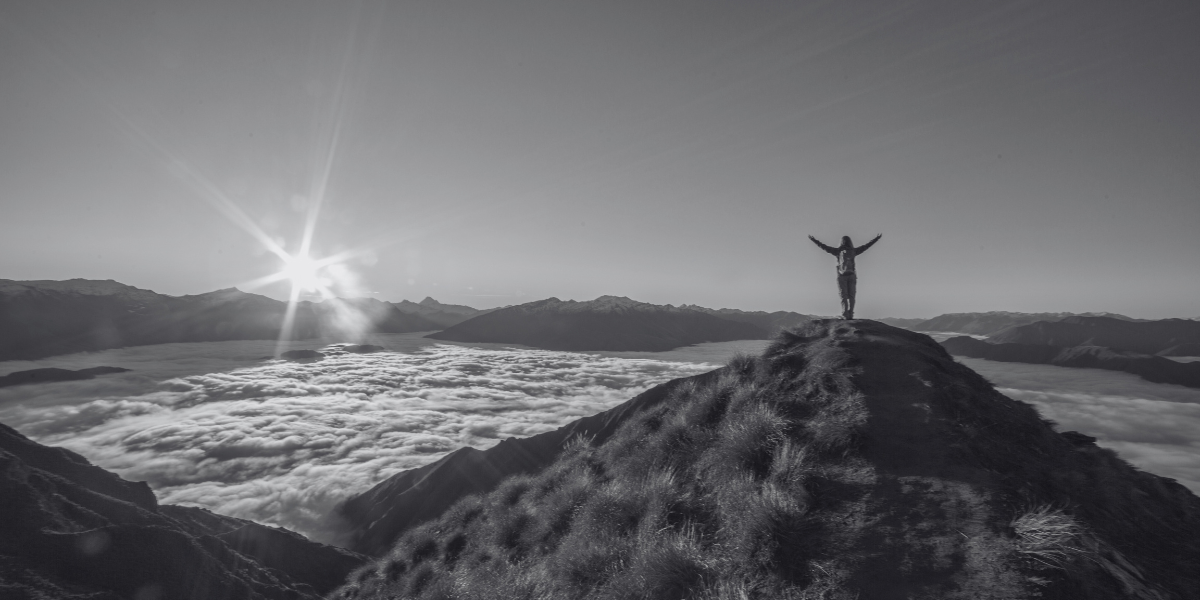
We were dazed with thirst but perked up once we saw this sign. Would the passersby’s promise of a glorious view be realized? Would this challenge be worth it? Several people crowded the mountaintop. It was windy and few clouds painted the sky. We waited our turn to have a seat on a rock and drink it all in. We received a panoramic view of Keene Valley, known as the “Home of the High Peaks.” We saw an expanse of mountains that comprised the Adirondacks’ Great Range. We sat side by side on the top, overlooking a green forest, and studied the distant, towering slopes. So, this is what the passersby wanted us to see. More mountains. We took photos and embraced the pin-drop stillness of high altitude. We saw birds soaring and felt so divorced from the ground, over 4,000 feet below, where sat all our fears and obstacles and that terrible virus.
I had initially felt so guilty for hiking when I should have been writing but, I thought, as I studied the curves of distant green mountains, a break from writing—this venturing out into the world—is the thing I needed in order to keep writing. After all, writing is living. You must experience life in order to write about it. I didn’t think I would have the experience of making it to the top, I thought the boulders and thirst would kill me. I thought random voices meant I was going insane.
Maybe, I thought at the top, the wind was right. I could really do this thing. Sometimes there are signs that you should persist: either nailed to trees or whispered in the wind. There is always uncertainty but there is often blind faith—a profound belief in a view that you cannot quite yet see but just know will be worth it. I’d say the summit view was worth it. We got to rest our bodies, and it was so serenely quiet. We got to trace each distant mountain from wide base to jagged peak. I got to see how far I had come and where else I might go.
__________________________________
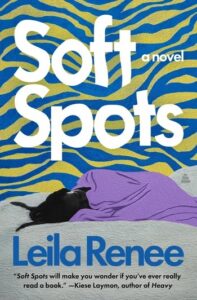
Soft Spots by Leila Renee is available from Amistad.

Leila Renee
Leila Renee is originally from Milwaukee. She earned her MFA from Syracuse University and her stories have appeared in McSweeney’s, The Kenyon Review, and more. She has received the Gulf Coast Prize in Fiction and a Fulbright Award. She teaches at the University of St. Thomas and lives in Minneapolis.