5 Book Reviews You Need to Read This Week
“You can love Riley’s work, you can certainly admire it, but I don’t think you can fangirl over it.”
Our mixum gatherum of marvelous reviews this week includes Rachel Vorona Cote on Paul Yoon’s Etna, Anahid Nersessian on Jorie Graham’s Killing Spree, Daniel Felsenthal on Molly Crabapple’s Here Where We Live Is Our Country, Walton Muyumba on on Claudia Rankine’s Triage, and Hermione Hoby on Gwendoline Reilly’s The Palm House.
Brought to you by Book Marks, Lit Hub’s home for book reviews.
*
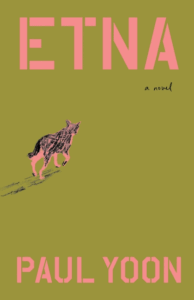
“Etna, Paul Yoon’s third novel, is the latest addition to the modern animal-in-peril narrative: the story of a military dog named Etna who is snatched up and discarded in the course of a human war. Like Open Throat, Etna excels as a keenly wrought hypothesis about not only how its chosen creature would perceive the world and its dangers, but also how those perceptions can be adapted to fiction. Although Etna tempers the exacting moral judgments at the core of Open Throat with a plot that bends toward empathy, Yoon’s critiques of humanity are just as pointed as [Henry] Hoke’s, and they emerge from a similarly textured philosophy that acknowledges the fraught business of living, whether one walks on two feet or four. Like all weary, uprooted creatures, Etna longs for home, but unlike so many of the humans who commandeer his world, he possesses far less agency when it comes to finding his way back there. And yet there are compensations. Etna may lack the privilege of human sovereignty and the benefits of advanced intelligence, but he is free of the hubristic delusions that underwrite so much human-produced wreckage. As he observes to a fellow dog, ‘There’s no other place but here.’
…
“For all its compactness, Etna has the shape of an epic. The story draws explicit comparisons to Homer’s The Odyssey: Its titular character tries to return to the farm where he was born after surviving a ravaging war. (The book also features a minor Greek character named Achilles.) An animal story set in motion by the basest human impulses—though also distinguished by some of our best—the novel is tied deeply into both ancient literary tradition and tragically perennial concerns.
Etna prompts readers to imagine an experience of the world unbound from human social convention, but it is no less interested in the slippery distinctions between human and nonhuman desires for belonging, intimacy, and home. Yoon drew extensively on these themes in his earlier works—most recently in the novel Run Me to Earth and the Story Prize–winning collection The Hive and the Honey—and his oeuvre depicts war’s psychological and material calamities. He understands that one of the most violent disruptions a living being can sustain is sudden estrangement from their environment. And yet, in Yoon’s hands, a character’s suffering never overwhelms their capacity for tenderness. The author always insists on the enduring humanity of his displaced subject—even when they aren’t human.
…
“This is, at times, a wrenching novel, strewn with broken bodies, but its atrocities never overwhelm its faith in creaturely communion, and in grief and longing that clarify, rather than obscure, one’s desires and selfhood. ‘What do you know about creatures?’ Etna wonders to himself, about a group of missionaries he encounters on his journey. He might well ask his readers the same thing. In real life, our dogs cannot tell us what they make of the disasters we humans have wrought, nor can their fidelity absolve us. But we can see by their perked ears and wagging tails that they are waiting to see what happens next.”
–Rachel Vorona Cote on Paul Yoon’s Etna (The Atlantic)
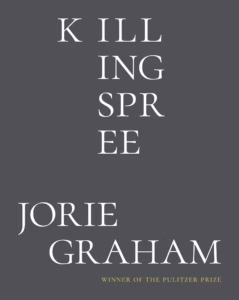
“In Killing Spree, her latest collection, Graham’s notes change to tragic. Her laments are now laced with fury, as genocidal wars and murderous technologies join global warming in the twenty-first century’s third decade. Most appalling to Graham is our collective inertia, not to say apathy. The world ‘didn’t change much/at first,’ she writes in the book’s first poem, and neither did we. ‘Where is everyone,’ she asks, before being met by a terrifying stillness, at once the silence of mass death (‘Only just heard/no one survived’) and the stupefaction or indifference of those who feel, for now, untouched by mounting crises. For all its characteristic restraint and formal diligence, Killing Spree is a book that wants to make noise, to cut through the dead air with cries of grief and rage, undoing our own savage torpor. Graham knows that it might make no difference; poetry, as we are often reminded, makes nothing happen. But she also knows that a difference—even just a minor variation in what we notice and how—is the only thing a poem can make.
All this is to say that Graham is a poet who consistently confounds her own self-representation, withdrawing from testimony even when she lays herself bare. Not for her the torrential unbosoming of so much contemporary lyric, with its mawkish self-regard and biographical appetites. Dramatizing the experience of one’s consciousness is only worthwhile (or, to use Wordsworth’s phrase, ‘really important’) if that consciousness is capable of understanding itself as operating within a shared historical condition, independent and idiosyncratic but nonetheless irreducibly in dialogue with other minds or essences. The broken line, the hard scar of the dash—these are gestures toward the uncertain and intractable distance between self and other, presence and absence, ‘awareness’ and its loss.
Graham’s language hovers at a breaking point. It is erudite and self-assured, but it has an underlying fragility that suggests someone trying to hold back a tide of chaos and disintegration. Like Paul Celan, Graham wants to know what it sounds like when meaning gives way to the malignant jabber of history, or when it is so overcome by its own futility that it sinks into silence.
…
“Graham’s poems grieve not from within the passivity of despair but with the intention of upholding the value both of lives lost and of lives that have not been lived so much as survived. Killing Spree puts into words what many of Graham’s fellow Americans have yet to understand, namely that the condition of being ungrievable—precarious, disposable—in the eyes of those who wield the drones and the jets and the hypersonic missiles might at any moment be shared by those who now feel well cushioned by privilege and security.”
–Anahid Nersessian on Jorie Graham’s Killing Spree (The New York Review of Books)
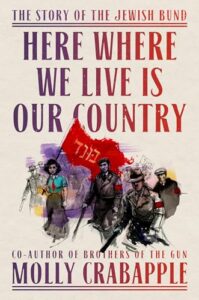
“Crabapple is perhaps best known as a visual artist, the creator of striking illustrations and lithographs from the Occupy Wall Street protests. She’s also a dogged reporter who has worked in combat zones. She sees a precedent for today’s progressive firebrands in the example of Jewish freedom fighters who opposed prejudice, tyranny, and class stratification in their home countries, without seeking solutions in nationalism and the colonization of distant lands. Anyone, anywhere, she suggests, can tune themselves to the wavelength of revolution.
…
Here Where We Live Is Our Country denies any narrative defined by victimhood, particularly one that suggests hopelessness as an essential theme of Jewish existence. This feels more surprising than it should. Crabapple proceeds from a refreshing assumption that Jews were agents of history and not mere casualties of its worst tendencies, that the footprint of anti-Zionists in the twentieth century was robust and central to Jewish history at large, and that exclusionary notions of Jewish identity were already outdated a century ago. In her book, Jewish forbears are models for anti-colonial fervor and action: staunch souls who, while fending off starvation, disease, overcrowding, and lethal violence in the Warsaw Ghetto, found space and energy to support Gandhi and the cause of Indian independence. Isolated from the world, the Bundists sent telegrams praising Gandhi’s Quit India campaign, a push for Indian self-determination that was sparked by the martial law that Britain instituted to maintain order while it fought the Nazis. No matter that the Brits, like the Bund, were battling Hitler—the Bundists knew that their allies were the colonized, marginal, and exploited.
…
“What she does astonishingly well is reframe a decisive, often misconstrued period of European Jewish life, restoring a sense of diversity and complexity to the conversation. Bundist Marek Edelman, a leader of the Warsaw Ghetto Uprising, wrote an invaluable book about the resistance in 1945, which was not sold in Israel or published in Hebrew until 2001. It’s no mystery why: The nation furnished a narrative that such a monumental insurrection was enacted nearly exclusively by Zionist youth militias. Crabapple reorients this tale toward the truth, gifting her readers a compass for their exploration of the past, and a rallying cry for battling the oppressors of now.”
–Daniel Felsenthal on Molly Crabapple’s Here Where We Live Is Our Country: The Story of the Jewish Bund (The New Republic)
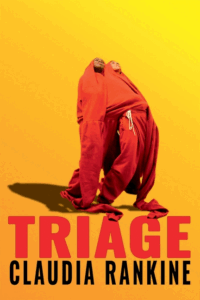
“What is Triage, novel, memoir, work of criticism, or every form all at once? In emergency medicine, triage prioritizes care for the mortally wounded and injured first. What are this book’s priorities? Outside of her published texts for stage, Triage is the first of Rankine’s books to arrive without a subtitle since her 2001 poetry collection, Plot. In a headnote, Rankine forewarns against reading Triage as strictly nonfiction: ‘Any resemblance to actual persons, living or dead, or actual events is purely coincidental. Unless it isn’t.’ Does generic category matter any longer when approaching Rankine’s books? As though borrowing from another Miles Davis aphorism, Rankine seems to say here, ‘I’ll play it and tell you what it is later.’ Or not.
…
“Like Don’t Let Me Be Lonely: An American Lyric, Citizen: An American Lyric, and Just Us: An American Conversation, Triage is colorfully, referentially, and intellectually dynamic. Citing 28 different theoretical, philosophical, and cinematic works, including Judith Butler’s Antigone’s Claim (2000), Omar El Akkad’s One Day, Everyone Will Have Always Been Against This (2025), the late Lauren Berlant’s Cruel Optimism‚ and John Akomfrah’s The Stuart Hall Project (2013), Rankine adds ballast to the narrative’s argumentative structure.
…
“Because she controls the text, the narrator relays more about herself than the theorist. We access the theorist tangentially, only through the narrator’s recollections and, perhaps, weak interpretations of their political philosophy. As the sexagenarian characters attempt reviving their faded connection, the narrator remarks, offhandedly, nearly surreptitiously, that she is Black and the theorist is from Ramallah.
Acknowledging this information, she deciphers her story newly. In her essay ‘Recognizing the Stranger,’ Palestinian British writer Isabella Hammad calls this re-cognition, or, following Socrates, anagnorisis. Triage may also incite re-cognition: Antigone becomes contemporary, the stakes of the counterpointed definitions collapse, as theory and practice, rise and Rankine’s new experimentation challenges and expands the focus of her recent works. Though the narrative’s ending verges on negative abstraction, Rankine clearly demands that we confront our failure to prioritize Gazans and reckon the massive resultant losses, personal, ethical, and human alike.”
–Walton Muyumba on on Claudia Rankine’s Triage (The Boston Globe)
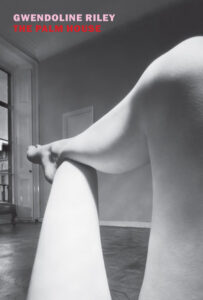
“Gwendoline Riley, the ferociously talented forty-seven-year-old British novelist, is deeply and rightly admired—by younger female readers in particular—for a body of work that now comprises eight increasingly sophisticated novels, all of them short and lacerating. Riley’s oeuvre, in other words, has become an object of widespread readerly love even as her books themselves can seem scoured of fondness. Fandom has been around since the advent of mass media, but with that old world dying and the new one (bluntly summarized, its main features are social media plus the tyranny of the algorithm) very much born, now is the time of fangirls. And fangirling—loving a stranger madly and blindly—essentially means voluntarily replacing your own vision with a pair of heart-eye emojis. The guarded, intelligent, and relentlessly scrutinizing female narrators of Riley’s novels see through whatever the opposite of heart-eye emojis are; the astringent pleasure of her work comes from a sense that its author is vigilantly undeceived and would rather die than swoon over anyone or anything. In both the precision of its prose and in the sometimes cruel, often sordid human realities it depicts, a Gwendoline Riley novel is phobic of sentimentality. You can love Riley’s work, you can certainly admire it, but I don’t think you can fangirl over it.
…
“Riley’s novels are preoccupied particularly with filial attachments and sexual relationships—but just as notable is that successful love, that is to say mutually salutary and rewarding commitment, barely exists in her fictional universe. Her work belongs to a lineage of doggedly anti-romantic and disenchanted British writing, which includes the dyspeptic verse of Philip Larkin (a Riley narrator would likely roll her eyes at the staggering obviousness of the truth that ‘they fuck you up, your mum and dad’), the sour swagger of Amis pater et filius, or the crafty, incidental wickedness of Muriel Spark.
…
“Throughout Riley’s work, specific archetypes recur, albeit differently shaded. In fact, while working on this essay, I found it necessary to write out a dramatis personae so as to distinguish each book’s personnel from the others. After a while, the many variations of feckless American musician boyfriends, bullying dads who abruptly die, and cowed, pathetic mums trailing a series of hopeless partners all start to blend into one another. This is not the gripe it might sound like. Doing pretty much the same thing over and over needn’t make for stultifying work, even if a shrink (rather than an admiring critic) might label it repetition compulsion. In the artist, unlike the neurotic personality, stuckness can be hard to distinguish from integrity. But now, with her eighth novel, Riley might finally have broken free of her phantoms. Or at least partially so. In the coolly observed and exquisitely controlled The Palm House, a new type of Riley character presents himself.
…
“I laughed when I read Riley quoted in a recent New York Times profile. She’s asked if she’s seen Hamnet. ‘I cannot imagine,’ she responds acidly, magnificently, ‘anything more ignominious than watching Hamnet.’ The implication being that Chloe Zhao’s acclaimed movie about the death of Shakespeare’s young son is a work of such irredeemable mawkishness as to be beneath contempt. But my laugh was kind of sad. Hamnet does indeed make one or two sentimental missteps, but it’s mostly, and more importantly, a moving work of real cinematic beauty. Not everything can be exclusively grand monsteras and glossy ferns; most artworks come muddled with the tat of mirrors and whirligigs, too. Loving something enthusiastically—a person, or an artist and their art—always risks embarrassment and the loss of dignity. To indulge in sentimentality or blind devotion is to be self-deceived, but to pathologically gird oneself against the threat of sentimentality is its own form of deception—it, too, can prevent a person from seeing properly. There are worse things in this world than lapses of taste. Isn’t it better to risk the ignominy of mirrors and whirligigs so you don’t miss out on the beauty of monsteras and ferns?”
–Hermione Hoby on Gwendoline Reilly’s The Palm House (Bookforum)
Book Marks
Visit Book Marks, Lit Hub's home for book reviews, at https://bookmarks.reviews/ or on social media at @bookmarksreads.