Why Writing Stories For Children is So Much Harder Than Writing Stories For Adults
Claire Swinarski on the Fulfilling Job of Creating Stories for Kids
A few years ago, my longtime children’s book editor rejected my idea for a new middle grade novel. The rejection hit me hard—the story, of the daughter of a celebrity chef who moves to a small town after being adopted by her older brother, was really tugging at my heartstrings. But the editor’s rejection was swift and brutal; there was no version of this manuscript she was going to accept.
Some stories plant deep in your creative brain and come out through songs heard on the radio and random daydreams in the shower. They will not, simply, leave you alone. It occurred to me that the story would actually be much more interesting from the perspectives of the daughter’s brother and one of the elderly women who lived in the town. I wrote the first chapter longhand on a boat and dashed it off to my agent, who confidently told me he could sell it. He did, and so began a brand-new chapter of my career.
Since the publication of that book (The Funeral Ladies of Ellerie County), I’ve written another novel for adults (The Supper Club Saints) and a handful of additional middle grade novels. I’ve continued to carve out a career path in both age groups by the skin of my teeth, somehow finding myself writing for two very different audiences.
The second question, however, I can answer easily: it’s harder to write good stories for children than it is to write good stories for adults.
Upon hearing this, I’m usually asked two questions by hopeful multi-age-group writers: Is it difficult to switch back and forth? And which group is harder to write for?
The first question offers a complicated, nuanced answer: it’s difficult, and it isn’t. Like any working writer, I wish I were beholden to the muse but in reality am beholden to deadlines I didn’t set. It’s difficult to switch back and forth but life is difficult, and I have to do it for my job, so I do it. There are hacks I can incorporate to make things easier, and I do—I have playlists associated with each book; I try to utilize block scheduling; I follow my creative energy as much as I can in any given week. But it isn’t, to quote one of my favorite SNL digital shorts, worse than working in a coal mine.
The second question, however, I can answer easily: it’s harder to write good stories for children than it is to write good stories for adults.
The reasoning is multi-faceted. First of all, children are incredibly harsh judges. They aren’t going to give you longer than a page. If you don’t have them hooked in the first couple of paragraphs, good luck getting them to stick it out when the sweet, sweet siren song of Dog Man is right there.
Secondly, my adult novels have all been contemporary, meaning that they’re very much written in my cadence and worldview. Children’s books require a massive shift of perspective, almost as if I’m writing in a different language. I was once a child, of course, and I remember many of the important feelings, wishes, and points of view—but to transcribe those in a way that resonates with a modern child, without talking down to them or tap-dancing some sort of morality lesson across a stage, can feel like a Herculean task.
But children do not like to be condescended to any more than you or I like it, and furthermore, they’re eagle-eyed in noticing condescension because they’re so used to it.
Thirdly, there’s simply more pressure on the writer of a children’s book to help shape and transform The Youths. We’re all, always, being shaped and transformed. But there’s a semi-true idea that children are doing so at an incredibly rapid pace, and stories can be conduits for emotional growth, wonder, and empathy. In other words: the children are the future, and you better whip up a story that helps us get to a bright one.
But children are not just the future; they are also, as the National Ambassador for Young People’s Literature Mac Barnett has said, the now. They are people within their own right here and now, who go through struggles and trials and need the gift of story to help them whether life’s storms the same as any of us do. Their perspectives are quite literally smaller, but that doesn’t make their needs any less necessary or demanding. There’s almost a stereotype that children’s writers should be either goofy clowns or some sort of modern Sarah, Plain and Tall: ready to dole out wisdom at any moment’s notice. But children do not like to be condescended to any more than you or I like it, and furthermore, they’re eagle-eyed in noticing condescension because they’re so used to it. I write seriously for children for the same reason I write seriously for adults—because they are actual people who deserve wonderful stories.
So, yes: writing for adults is very hard. Writing for children is very, very hard. Writing for both is very, very, very hard. But that’s also what makes it so fulfilling. Every day offers a new creative challenge, and a new chance to tell a story that has an impact, whether it’s for a seventh grader or that seventh grader’s grandmother.
There are hiccups when it comes to branding, and looking back, it might have been wise to use a pen name for one age group or the other. But I didn’t want to. I wrote these stories, me entire; not some filtered-down branded version of me. Is it frustrating when someone comments “I really liked Funeral Ladies but this feels like it was written for kids” on my latest children’s book? Of course. Are some people angry that a children’s book author would cuss in an adult novel? Bizarrely, yes. However, it’s also quite fun to go on a school visit and have a teacher tell me how much she enjoys my adult novels, or to hear about a mother/daughter book club where the mothers read Funeral Ladies and the daughters read Each and Every Spark.
I’m incredibly grateful to be able to tell stories for both kids and adults. It keeps my schedule varied and allows me to utilize different muscles. It also, helpfully, provides me with multiple income streams. But most importantly, it allows me to write for more people and use my creativity to connect and serve with a greater pool of readers. Because while there are stark differences between writing for children and writing for adults, the two tasks actually encompass the same goal: telling a story for a person who needs to hear it.
__________________________________
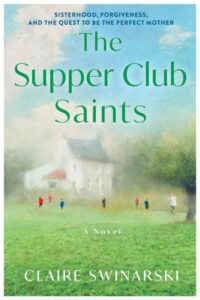
The Supper Club Saints by Claire Swinarski is available from Avon, an imprint of HarperCollins.

Claire Swinarski
Claire Swinarski was born and raised in Wisconsin, where she still lives with her family and writes stories for readers of all ages. What Happens Next was her debut middle grade novel and was followed by The Kate in Between and What Happened to Rachel Riley, which was an ALA Notable Children’s Book, a YALSA Best Fiction for Young Adults title, a Cybils Award nominee, and an Edgar Award nominee. These were followed by Take It from the Top and Each and Every Spark. Claire believes wandering around a library can solve 95 percent of life’s problems.