How Bees Came to the United States and Changed Our Landscape
Jennie Durant Explores the History of Beekeeping and Its Impact on American Agriculture
Over the past 150 years, honey bees have become the cornerstone of US agriculture. Beekeepers now crisscross the country in semi-trucks to pollinate our crops, towing thousands of bee colonies from one blooming pasture to the next like cattle ranchers on wheels.
But it wasn’t always this way. Like the colonists who brought them, Western honey bees (Apis mellifera) aren’t native to the Americas. Over centuries, a series of migrations and innovations transformed beekeeping from a backyard hobby to a nationwide enterprise. Honey bees were domesticated to serve farms, and the fates of beekeepers and US agriculture became tightly intertwined.
Humans have been hooked on honey for thousands of years. Long before sugar was widely available, honey was often the only sweetener around—and we’ve gone to great lengths to get it. An 8,000-year-old cave painting in Spain shows a honey hunter dangling from a cliff, one arm deep inside a hive cavity, bees swarming as they harvest their prize. Ancient Egyptians documented early beekeeping in their art. By the Middle Ages, monks across Europe tended hives in monasteries and abbeys, not just for honey but also for beeswax candles and mead, a honey-based alcoholic drink. Honey and wax became staples of European trade.
In a sense, bees went from wild foragers to shift workers, clocking in for bloom season as beekeepers hustled them from farm to farm.
Then these cravings crossed oceans. Colonists brought honey bees with them on their earliest voyages across the Atlantic. The first recorded shipment to what’s now the United States arrived in Virginia in 1622, just two years after the Mayflower landed at Plymouth Rock.
Settlers quickly wove honey bees into their daily lives. When managed colonies swarmed each spring, many escaped into surrounding forests and established feral nests. Honey hunting became a popular pastime, as colonists tracked down wild colonies to harvest wax and honey like their ancestors back in Europe. They used honey as a sweetener, crafted beeswax into candles, and fermented mead. Managed and feral honey bees also played critical roles in pollinating crops brought over by European settlers, including apple and cherry trees and clover, which provided food for livestock and their communities.
As settlers moved west, they brought their bees and crops with them. Honey bees soon became a symbol of colonization, and not always a welcome one. Thomas Jefferson wrote that Native Americans called honey bees the “white man’s fly,” because swarms from domesticated colonies often arrived before the settlers themselves. One settler described a day of mourning at an Osage village in Missouri after the tribe discovered a swarm. For many Native communities, it meant their way of life was about to change—or disappear.
The symbolism was both striking and unsettling. Like the settlers they traveled with, honey bees reshaped the land in Europe’s image, displacing native bees, changing plant communities, and mirroring the wider story of Indigenous loss.
Early beekeeping was as risky for bees as it was for their keepers. Settlers housed colonies in a variety of containers, including skeps (upside-down woven baskets), hollow logs, and pottery vessels that mimicked natural nests.
Yet most hives shared a fatal flaw: The colony had to be killed to harvest the wax and honey and then replaced with a captured feral swarm. The fixed, immovable combs also made colonies hard to inspect and monitor for pests and pathogens, so as bees and beekeepers spread across the United States, they inadvertently spread disease. Truly domesticating bees required a hive with movable frames, one that would allow beekeepers to examine their bees and harvest honey without destroying the colony.
In 1851, Lorenzo Langstroth revolutionized beekeeping with the invention of just such a hive. Building on European research, he discovered that bees needed a precise gap of 6.3 mm to 9.5 mm to move between frames, a range he termed “bee-space.” If frames were spaced too far apart, bees filled the gap with wax comb; if too close, they sealed it with a sticky resin called propolis. Langstroth’s design maintained an optimal 8 mm gap between frames to prevent bees from fusing them together. His patented hive, now known as the Langstroth hive, allowed beekeepers to inspect colonies, monitor health, and harvest honey with unprecedented ease.
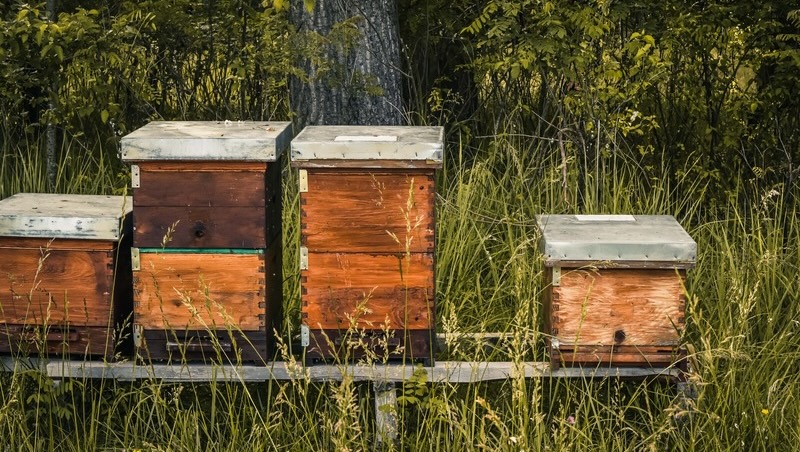
Langstroth’s hive is nearly identical to the ones commercial beekeepers use today. It’s a stack of wooden boxes, typically eight to ten in number, with removable frames inside. The lower two boxes serve as brood chambers, where the queen lays her eggs. The shallow boxes above, known as honey supers, store honey and pollen. To prevent the queen from moving upward, beekeepers often place a screen called an excluder between the brood chambers and honey supers. An inner cover allows moisture to condense without dampening the hive, and an outer cover protects the colony from inclement weather.
The hive’s sturdy, portable design allowed nineteenth-century beekeepers to manage and transport colonies over long distances. They could move stacked boxes to orchards for pollination and honey production and harvest enough honey to transform their backyard apiaries into commercial operations. The hive also facilitated swarm prevention: Beekeepers could transfer a portion of the bees and a new queen into an empty colony box, effectively doubling their hives.
Historians credit Langstroth’s hive with launching the golden age of American apiculture, which spurred innovations like Franz von Hruschka’s honey extractor in 1865 and Moses Quinby’s smoker in 1870, which uses controlled puffs of smoke to calm hives. These inventions transformed honey bees from a largely feral species into semi-domesticated livestock that could be managed year-round, expanded, and reproduced.
Finally, beekeepers had tamed some of the wildness of the hive.
But it wasn’t until the two World Wars that beekeeping turned into a major industry. During WWI, German U-boats cut off sugar supplies to Europe and the United States, making sugar scarce and expensive. Americans and Europeans turned to honey as a homegrown sweetener. Demand for honey and wax peaked again during WWII with a second round of U-boat attacks and strict rationing of paraffin wax. The military used beeswax to waterproof canvas tents and rucksacks, use in sunscreen and camouflage, and wax and coat planes to reduce drag and save money on fuel. Given the high demand for bee products, the US began a campaign to recruit beekeepers across the nation to help supply the war.
As automobiles replaced horse-drawn wagons, beekeepers could haul 20 to 40 colonies by wagon or move hundreds of colonies at a time in nearly any weather. By the 1920s, beekeepers were moving their bees across state lines by automobiles and trains.
Once WWII ended, demand for honey diminished. Honey had to compete with sugar and other cheap sweeteners on the shelves, like saccharin, glucose, and corn syrup. As research highlighted the benefits of bee pollination for certain crops in the early 1900s, many beekeepers began switching gears from a sole focus on honey production to providing pollination services to provide extra income.
Those semi-trucks crisscrossing the country aren’t just moving bees. They’re moving the infrastructure that modern agriculture has come to depend on.
By the 1950s, US agriculture had radically transformed. Synthetic fertilizers, pesticides, and mechanized farming shifted agriculture from a patchwork of diversified farms to large, monoculture landscapes.
These changes took a toll on pollinators. Habitat loss, widespread chemical use, and shrinking forage caused wild pollinator populations to plummet. Soon, farmers started needing honey bee pollination as an input. Beekeepers began hauling their hives cross-country to pollinate everything from orchard fruits and nuts, to berries, melons, squashes, sunflowers, cotton, clover, alfalfa, and seed crops.
This marked a major turning point, as pollination shifted from a natural benefit provided by wild pollinators to a paid service beekeepers had to deliver during crop bloom. In a sense, bees went from wild foragers to shift workers, clocking in for bloom season as beekeepers hustled them from farm to farm.
As this change happened, beekeepers adjusted their practices to meet the demands of Big Ag. Like other large-scale livestock operations, beekeepers began to prioritize productivity and efficiency above all else—even when it strained bees’ physical limitations.
The shift didn’t just transform beekeeping. It reshaped millions of acres across the United States as honey bees enabled the spread of crops that might have never succeeded otherwise.
Nowhere is this more evident than in California’s almond orchards, a crop that requires bee pollination to bloom. Over a matter of decades, beekeepers from across the country helped support the expansion of almonds across California’s Central Valley from 70,000 acres in the 1930s, to over 1.3 million acres today.
Now, beekeepers ship over 90% of the nation’s managed colonies west each year to pollinate almonds. Those semi-trucks crisscrossing the country aren’t just moving bees. They’re moving the infrastructure that modern agriculture has come to depend on.
______________________________

Bitter Honey: Big Ag’s Threat to Bees and the Fight to Save Them by Jennie Durant is available from Princeton University Press.

Jennie Durant
Jennie Durant is a writer and researcher focused on bees, agriculture, and the environment. She has spent more than a decade working with beekeepers, scientists, and policymakers, including time at the US Department of Agriculture and University of California, at both Davis and Berkeley. Her writing has appeared in Grist, Glamour, HuffPo, and the San Francisco Chronicle. She lives in the San Francisco Bay Area with her family.