Why Do We Keep Murdering Our Darlings?
Sarah Braunstein on Killing Off Main Characters
Why is everyone killing off their main characters? In the academic year 2021-2022 at the liberal arts college where I teach, I was startled by the trend. A plot contagion. Nothing is off limits, I said to my short story writing class, but let’s examine our impulses. Why so much death? That year, even major characters and first-person narrators wound up dead, killed by strangers or friends or family members, often by parents, or serial murderers, or in accidents, usually right at the end at the story, no warning. After a while, each death was like being flicked by a rubber band. When I cautioned against group-think, the phenomenon increased.
I don’t want to speak for these writers in the aggregate—each was in the process of discovering a singular universe. Plots often involved ecological disaster, war, corruption, corporate exploitation and extraction. But the stories had their own voices and aesthetics. Some were extraplanetary. Some local. Some took place in dormitories on campus, examining quiet moments between friends or lovers—even these inward-looking stories weren’t spared bloodshed that year. Family picnics ended in drownings; tender, bantering dates at Applebee’s concluded with car accidents.
During that year, Putin attacked Ukraine, Trump preened and plotted. We dealt with ongoing COVID-19 disinformation, creeping fascism, call it what you will. Was all the death in their stories a collective trauma response? I always tell my students to think about the world: what’s on television in the house? What’s playing on the radio in the car? Calm in the face of mass death is the moral crime of every era, ours included, but that’s hard to talk about straight on. Fictions may be sublimations, places to hide outrage or grief or guilt, or to talk about complicity, which by its nature cannot be spoken of. Plus, everyone was listening to true crime podcasts. Plus, what bleeds leads. Plus…it’s so hard to know how to end a short story! Much easier to write past an ending, or around it, or stall out before you get there, or kill those half-made people off. I have so many drafts languishing on my computer, two thirds done. Put them out of their misery.
I sensed they were afraid of so much freedom.
Lurking in every ending are questions of accountability. Do these characters experience the consequence of the action of the story? Relatedly, what accountability does writer owe reader? If the act of reading a story is the coming together of reader and writer, the creation of a delicate channel between subjectivities, what happens to that provisional bond when our proxy is knocked off? Not fair, I sometimes felt, reading that year’s drafts. My attention has been misused.
My students often note that no one is properly held to account these days. No one with power, they mean. That politicians and governments and banks and other far-reaching institutions do not face the consequences of their criminality. The wealthiest seem to just glide away. I don’t think accountability in our domestic spheres is any simpler. (Who among us has our own house entirely in order?)
Still, I have the romantic idea that fictional characters might contend with challenges of accountability that never get resolved in life. Sometimes, this means an actual death is rendered on the page, but not always. Sometimes, a character facing themself, living to deal with the burden of new knowledge, suspended in shame—or, conversely, reaping a long-deserved joy, their brightest moment preserved—feels to me better justice.
If “justice” is the goal. What is the point of the ending? I asked my class. In fact, what’s the point of a short story at all? I had no investment in their plots, I promised. Lots of stories and novels end with main characters dying. One is allowed to do anything, I kept saying. But also: Why does this story demand this outcome? What else could happen? Why have you foreclosed those possibilities? But this didn’t make it better. I sensed they were afraid of so much freedom.
During this same period, I was trying to finish writing a novel, the main character of which is a dreamy librarian, Maeve, who becomes entangled with a man she’s not married to, a novelist. I wasn’t sure how to end it. I’d been working on the book too long already. I could not imagine killing Maeve off. I hadn’t considered it until my students began to boldly murder their protagonists, and then I wondered if I could too.
No, it would be wrong, I decided. A cop-out, an evasion. But an evasion of what? What did I owe my reader? Was I willing to subject Maeve to the accountability she was due? What would that look like? Maeve could be selfish and self-deluding. (Should her husband forgive her? Should she run off with the famous novelist? Should she lose everything? Step in front of a train?) It was a period of high anxiety in my own life, for this and other reasons, and I couldn’t sleep. When I did sleep, I’d dream the ending, the right ending, finally! But I’d wake up with an empty head.
I asked my students, instead of killing your characters, what if they get what they want? Most replied they did not believe in happy endings. The ones who preferred romances sat quietly, for even they were killing their characters this year. Someone said an ending can be both happy and sad at the same time, which is surely correct. What does that really look like? What is lost by gaining and gained by losing? If a character in a story ends where they begin, a resumption of a status quo, something must be changed for the story to work, right?
We talked about the famous fatal endings, great moments of vengeance and grace, the murder of the book critic in Tobias Wolfe’s “Bullet in the Brain,” the grandmother in Flannery O’Connor’s “A Good Man is Hard to Find,” and the final image of Mrs. Bridge, Evan Connell’s classic novel: the gigantic out-of-date vehicle, stalled, stuck, night falling. More recently, Minor Detail by Adania Shibli, the first part of the book predicting and preparing us for the second, which follows a Palestinian researcher entering a space where she is not supposed to be. What happens? As O’Connor says, an inevitable shock.
Look at the “real” world, I told you all, as if the present wasn’t already inside our classroom.
An ending can be a start of a new life too. One of my favorites is Suzuki Beane (1961) written by Sandra Scoppettone and illustrated by Louise Fitzhugh, a parody of Eloise at the Plaza Hotel. Suzuki is a young beatnik of Greenwich Village, a moral, sharp-witted kid wanting a place where children can be taken seriously, free to manage their own affairs. (Children are people, she insists.) She and her friend Henry hatch a plan to run away. Before they go, Suzuki commits an act of meanness against Henry, because children are people, as capable of cruelty as adults, as hungry for control. We know the authorities are coming; two kids under ten no matter how committed and daring can’t hitchhike across America to start a commune. Given the same plot, my students that year might have hit her with a bus, or found a dozen other sneaky methods of extinguishing her lovely life force, but we get to pause with Suzuki as she takes her sip of freedom. She’s left to live, running but not yet caught.
I figured out an end to my novel, Bad Animals. Now that the book is out, readers share varying reactions to its ending. Some find the last scene ambiguous, multivalent; some dark; others comic. People read it differently, which makes sense to me. I myself can hardly articulate what I am getting at. Maeve lives. Spoiler alert: she lives to look back on the events of the whole book, to wonder what the hell happened.
But that’s no spoiler at all. It’s the plot of nearly everything, our own lives included, for as long as we narrate them. One critic said that the ending of my book was “predictable,” and I admit that stuck in my craw. Predictable how? What did that reader predict? I couldn’t for the life of me have predicted it. Even now, the psychological moves of the book’s last moments, how and what Maeve understands, feel to me provisional, blurry, to be co-created with the reader. What did that reviewer mean? And why couldn’t she have been there when I needed her, when it all was a blur to me?
All of this is to say, to the students of that year, if you’re reading, other people might understand our endings better than we do. Or tell us what they mean. Or fault them. We’re the ones who have to write them, and live with the consequences. In our time together, I cautioned against group-think, but I also said that You are the authorities on your stories. I meant it, even if I found so much death tedious.
I feel in retrospect a bit like a fuddy-dud, moralizing about a connection between reader and writer, shaking my Henry James. As if these were real people on the page. As if what happened to them matters, or had anything to do with the bodies we read about in the paper. Look at the “real” world, I told you all, as if the present wasn’t already inside our classroom. As if each of us isn’t a walking embodiment of our moment, clueless and attuned at once, screaming about one thing and in total denial about another. I don’t want to tell anyone what should happen in their stories. The best I can do is say what I see, ask some basic questions. To point out: Well, this is a high body count. Unusually high. Is this on purpose? What does it mean? Given these numbers, should we all be quite so calm?
__________________________________
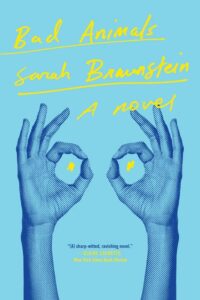
Bad Animals by Sarah Braunstein is available from W. W. Norton.

Sarah Braunstein
Sarah Braunstein is the author of Bad Animals and The Sweet Relief of Missing Children. Her writing has appeared in The New Yorker and The Best American Short Stories, among other publications, and she received a National Book Foundation 5 Under 35 prize. She lives in Maine and teaches at Colby College.