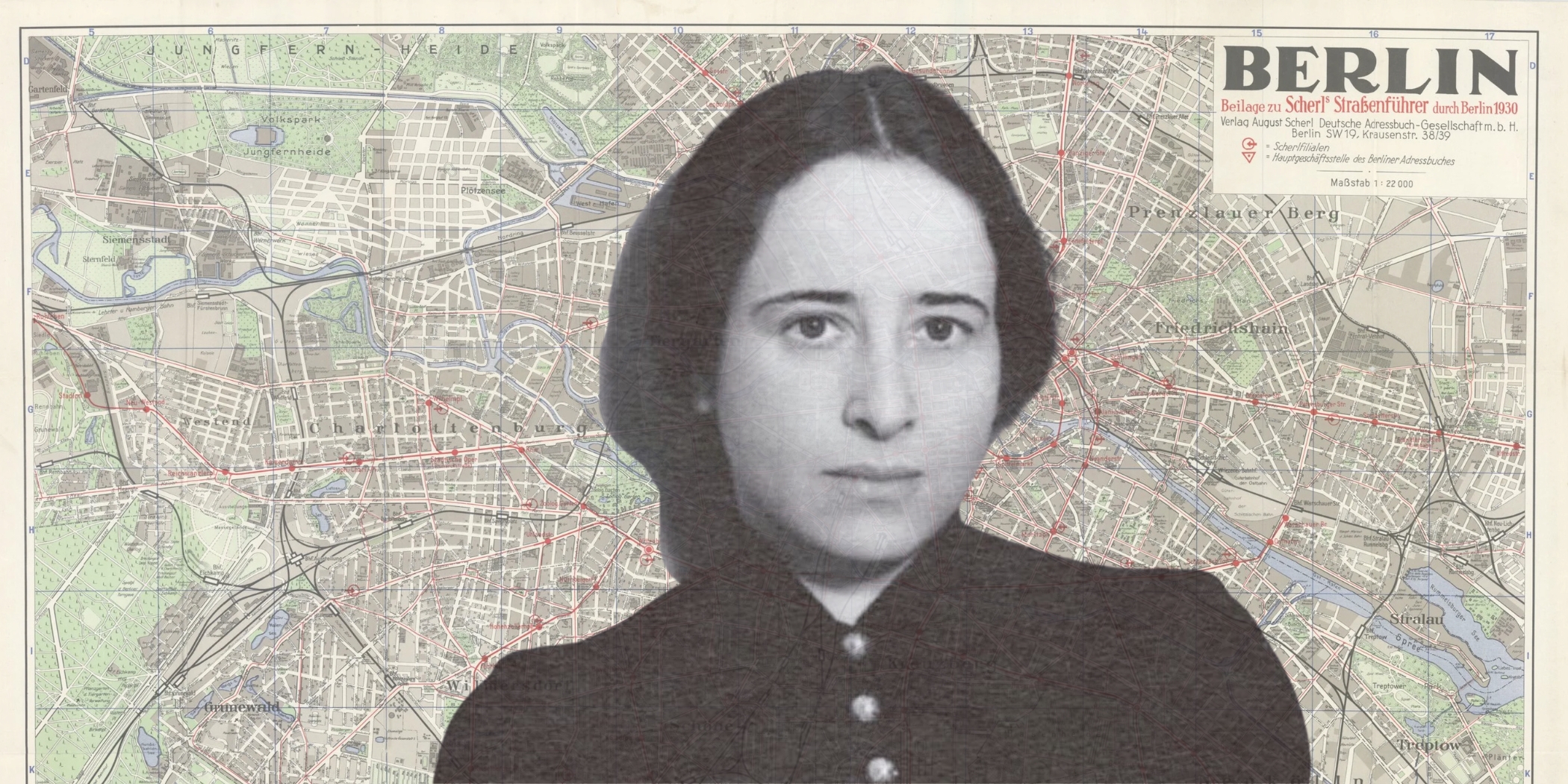
As Hitler Loomed, Hannah Arendt Undertook a Deep Analysis of German Antisemitism
Thomas Meyer Takes a Look at the Famed Intellectual’s Examination of an Ancient Hatred
Hannah Arendt’s 1936 lectures in Paris, where she had spent the past year and a half, were the first signals to the émigré population at large that she still had something to say. They were her attempt to introduce her work on modern antisemitism, which had been announced back in 1934 and was almost complete. She wished to open her work for discussion, and in the process reword or improve some of its sections.
The collection of Arendt’s papers includes a 159-page typed manuscript that was clearly intended for publication. The extant typescript, the last section of which (“The Aristocracy Turns Antisemitic”) notes that it is a “personal copy” and lacks a chapter number, is still incomplete; the last page of the text makes reference to a “next chapter.” Someone wrote the years “1937-38” on the manuscript, which might indicate that this was a written draft of the lectures. Very few texts written after 1933 are referenced here, so it would appear that at least large parts of the manuscript were planned for inclusion in the book project Arendt had mentioned back in 1934.
The chronology is significant here. Up to the time of the Nuremberg Laws of 1935, quite a few observers of the developments in Germany were undecided as to whether the National dictatorship would last. Not Arendt.
Pessimism runs throughout the manuscript. Arendt had no doubt that the form of antisemitism that had been empowered in Germany could exist only in that country. She began her text with Christian Wilhelm Dohm’s Ueber die Verbesserung der Juden (On the Civic Improvement of Jews, 1781), and in the next paragraph she referred back to Johann Andreas Eisenmenger’s Entdecktes Judenthum (Judaism Unmasked), published in 1701, which was regarded even by his Jewish contemporaries as a threatening compendium of all ancient and medieval lies about the peril posed by Judaism for the majority societies in which Jews lived.
While Dohm’s and Eisenmenger’s books had often been cited and discussed in tandem, Arendt brought in a third book, Carl Wilhelm Friedrich Grattenauer’s Wider die Juden (Against the Jews, 1803), which she associated with the Romantic movement’s intellectual elite: Brentano, Arnim, Kleist, and the influential German Christian Table Society. Arendt then cited Wilhelm Marr’s Sieg des Judentums über das Germanentum (The Victory of Judaism over Teutonism, 1869), thus lining up all the antisemitic pipe dreams that came close to fulfillment. Now that the National Socialists, a “political movement whose catchword is ‘antisemitism,’ ” had assumed power in 1933, they could realize the remaining piece of their dream: “the perennial suggestion for solving the Jewish question by slaying all the Jews.”
Arendt had no doubt that the form of antisemitism that had been empowered in Germany could exist only in that country.
Arendt’s analysis of antisemitism also offers an analysis of Jewish history, because she was convinced that these went hand in hand.
Arendt’s analysis employed language that would capture both the disfiguration and configuration of what had taken place. The years of freedom—and a limited freedom, at that—were evidently enough to make the “Jews from the East” the object of the German Jews’ arrogance and sense of superiority. But in 1933, within a matter of days, they were jerked back into reality. The superiority of the German Jews turned out to be nothing but a mirage. Those who remained behind wondered what they had done wrong, while the “Jews in the East” observed that the German Jews were “hopelessly inferior.”
The year 1933, Arendt contended, marked the close of the age of bourgeois emancipation and Jewish liberation, which brought an end to a feeling of security in the West and signaled that the new sense of security in the East was a pipe dream. If such things could happen in Germany, it was only a matter of time until something similar occurred elsewhere. For Arendt, the experiences of German Jews served as “an example,” a call to other nations to begin a battle of annihilation, because they would be met by a weak adversary.
Arendt argued that the “German catastrophe” and the weak reaction of German Jews and of “world Jewry” shed light on the past 150 years, that is, on the decades of emancipation. This development could have taken place only in Germany, a structure of history that had always been centered on antisemitism, in no need of the old “ventilation theory,” which held that a scapegoat had to be found for national discontent. It was possible not to see this because Jewish history was always conceived as a history of victimization. In the nineteenth century, Arendt explained, two forms developed, with the West hoping to merge into “world history,” that is, without the baggage of suffering and without God. The Jews in the East attempted to construct a “national history” that sought Jewish traces in individual histories while establishing the existence of a Jewish people as a whole. The Western variant, by contrast, had already reached its ultimate objective; in creating a Reform synagogue, it opted to put unwanted distinctions in the past.
But both sides had failed to grasp one thing—and this was Arendt’s overarching point throughout the analysis presented here—that within this model, antisemitism was always regarded as merely an “opinion” held by individuals. This, she argued, was a fatal error. “Our history”—Arendt was always speaking as a Jew who inserted herself into analyses that extended into the present—could eventually fold into the history of the majority societies that surrounded them. “The Jews were Germans and nothing more.” Zionism, she said, was to be credited for putting an end to what Kant had termed “dogmatic slumber” for this uncritical acceptance of the state of affairs. It had failed where it substituted for assimilation, adaptation, and achieving equality the notion of two substances: of a given “host nation” and of the Jews, both eternal, both immutable. Hence both interpretations were dangerously misleading, because both left it to non-Jews to define Jewish history.
Arendt cited Otto Heller’s book Der Untergang des Judentums: Die Judenfrage, ihre Kritik, ihre Lösung durch den Sozialismus (The Decline of Judaism: The Jewish Question, Its Critique, Its Solution Through Socialism) to point up the dramatic impasse that Jewish historiography had come up against as part of the analysis of the current situation. Heller, who was born in 1897 in Brno and died of exhaustion in late March 1945 at the Ebensee concentration camp, a subcamp of Mauthausen, was not a true theorist or authority in the subject he chose to write about. He had been living in Paris since 1936, and his book was translated into French, but it never had the role that Arendt ascribed to it: No one regarded it as exemplary, and it did not broaden out into more general issues.
Far more momentous was Arendt’s own analysis of the situation. She found it disastrous that the status of emancipation, as stipulated by the German majority society, was regarded not as a reason for rethinking people’s own actions, but instead as an impetus to adapt to the current circumstances. In the end, the German Jews were confronted by the “true representative” of the German people—Hitler—who informed them that they were a “race” to which he was issuing special regulations and laws.
At this moment, complete inertia, helplessness, or escape seemed to be the only ways to react, but Zionism offered a strategy for coping with the changing circumstances, a strategy that had begun with Theodor Herzl. The aim was preserving the “Jewish substance” in the face of antisemitism, even when that substance was attacked in the extreme. In juxtaposing National Socialist and Zionist dogmatics, Arendt concluded that the former sought to eradicate a populace it considered alien, fundamentally different, and hence incompatible with its values, while Zionism insisted that Judaism, as the Other, needed to seek a way to thrive as the only means of securing its substance. Whether in economic analysis (Herzl) or in “pseudophilosophical profundity” (Martin Buber), the outcome was what both, in their different ways, strove to avoid, namely for the substance in need of rescue to adapt to the prevailing zeitgeist. Arendt’s conclusion sounded bitter: “The bankruptcy of the Zionist movement caused by the reality of Palestine is at the same time the bankruptcy of the illusion of autonomous, isolated Jewish politics.”
The first chapter of the manuscript was written before her involvement with the Youth Aliyah. But Arendt likely saw that it was possible to engage in “Jewish politics,” at least in the form of a reaction to an existential threat to all Jews, because Arendt had argued time and again that Germany was only the first stage in the history of a new type of antisemitism and the danger of annihilation impended.
In the second chapter, “The Classic Land of Antisemitism,” Arendt noted that the developments in Germany triggered a pan-European alignment of the various Judaisms with their specific histories and environments. Hitler’s so-called seizure of power made all Jews indistinguishable; he forced all of them into the same mold, with varying degrees of perceptible consequences. German antisemitism was universal and applicable to all, and made enemies of all Jews. The Jews’ greatest achievement, the greatest model and the respect they had attained, was now followed by their downfall. Arendt drew an arc from Gotthold Ephraim Lessing to Alfred Rosenberg’s The Myth of the Twentieth Century. Seen retrospectively, they formed a narrative that had the Jews rising to the status of coequal human beings, only to be denied their humanity.
The crucial step along this path was abstraction, making living Jews into a principle, a bearer of traits leading to one thing: evil. Equating Jews and evil was regarded as significant progress in furthering antisemitism without the need for additional consequences; that was reserved for later generations.
For now it sufficed for this process to have become possible, accepted by society, and attained in a “scholarly” manner. The third chapter, “Antisemitism and Hatred of the Jews,” attempted to grapple with this issue. Arendt insisted that modern antisemitism was rooted in reversing processes of social differentiation. “Jews” were facing the danger of disappearing as they achieved assimilation and equality under the law, and only the introduction of a clear demarcation could prevent total integration. “One could discuss its history [that of modern antisemitism] as a history of associations—quite random associations that contain only a minimum of reality when it comes to Jews, but very necessary associations when viewed from amid the struggles of the period.”
Hitler’s so-called seizure of power made all Jews indistinguishable; he forced all of them into the same mold, with varying degrees of perceptible consequences.
The fourth chapter, “Usurers, Pariahs, Parasites,” reconstructs a historical development using sociological and economic categories. The essential point is that the three designations have become obsolete in the wake of nineteenth-century social and economic developments, but for that very reason are associated with Jews. The Other is not modern; its features are to be regarded as lodged in an era that is over and done with. What remains is the pariah, a figure of the present, with “neither rights nor a country…citizens of no nation.” As such the Jews go back to being parasites, because even refugees have to live somewhere, and so they become a “society outside of society—a caste.” This was the first time that Arendt brought into play a fully formulated theory that later became famous, although at this point it lacked the term she later paired with the pariah, namely the parvenu, in arguing that the Jewish emancipation gave rise to only these two types.
Arendt introduced ideal “types” in the fifth chapter. She was drawn to particular historical figures by the primacy they accorded to accumulating wealth as a means of achieving success, to attaining rights, and to gaining civic participation. The best they could hope for was an improvement of their legal status. The “court Jews” were far from having achieved a secure station in life, because they enjoyed privileges that could be snatched away at any time. The dissolution of the ghettos in the eighteenth century could be interpreted as tearing down barriers, but now poverty set in and the wealthy separated from those who formerly shared a similar destiny. When the walls came down, the differences between Western and Eastern Jews became even more marked, making it all the easier to instrumentalize contrasts.
The sixth chapter is devoted to “exceptional Jews,” those whose exclusion gave them something special to offer, and they intrigued or attracted the curiosity of outside groups, especially among the educated. Arendt regarded this situation as the basis for the emergence of the Jewish salons. The window of opportunity shut right back down, a phenomenon that Arendt explored here by explaining that the close, no longer merely economic connection between the aristocracy and the Jews led to new resentments. From the viewpoint of the bourgeoisie, both Jews and the aristocracy advocated revolutions and radical change, and thus both attacked the status quo. Resentment swelled among the aristocrats, who had no desire to be grouped with the Judenseite (Jewish side).
According to Arendt, this had far-reaching consequences. Those who were against the state were attracted to antisemitism. The alliance of the “exceptional Jews” with the state was a favored point of attack for modern antisemites; after all, they argued, what sort of state would fleece its own people and offer advantages to the beneficiaries of this swindle?
“As long as antisemitism cannot establish a basic link with the great political struggles of the time and as long as it is not supported by at least one unified level of society, it remains without political significance and poses no threat to Jews.” But if it does succeed, antisemitism goes beyond vague pronouncements and becomes a political problem, meaning that it affects society as a whole, at which point it becomes dangerous because it seeks out solidarity and gauges how far it can go, testing the limits in particular of the state, which needs to ensure domestic stabilization and look to the good of the state as a whole, not any specific individual interests. Arendt explains that assimilated Jews afforded antisemites the perfect opportunity to make their case. Assimilated Jews wished to make use of their freedoms while retaining their identities, and modify societal modernization to meet their special needs. At the same time, they had to ensure that neither successes nor failures would attract attention to themselves. Envy and schadenfreude are two emotions that are readily associated with old anti-Jewish stereotypes, and could develop dynamics of their own. But it had not reached that point quite yet. The functions of Jews and the images that were made of them continued to undergo changes.
The state discovered that reforms had to be beneficial to all, and so the political mission had to be implementing education and acculturation as a means of solidifying the nascent bourgeoisie. The goal needing to be attained was being a Jew, a citizen, and a German all at the same time. The bourgeoisie gradually evolved, and, like any new social stratum, it had to displace existing ones or become so strong that others would adopt its forms of employment and ways of life. The nobility was the first to be affected, and the bourgeoisie and the Jews seemed to be the beneficiaries of this development. With the two pillars of modernity merging into one, antisemitism, in its modern form, was also anti-bourgeois.
____________________________

From Hannah Arendt: A Life of the Mind by Thomas Meyer, translated by Shelley Frisch. Published by Penguin Press, an imprint of Penguin Publishing Group, a division of Penguin Random House LLC. Copyright © 2023 by Thomas Meyer, translation copyright © 2026 by Shelley Frisch.

Thomas Meyer
Thomas Meyer, born 1966 in Bernkastel-Kues, specializes in modern German philosophy and the history of ideas. He earned his doctorate in 2003 and completed his habilitation in 2009. Meyer is currently a professor of philosophy at LMU Munich and also works as a freelance author based in Berlin. He has held teaching positions at the Universities of Chicago, Vanderbilt (Nashville), Wake Forest (Winston-Salem), Zurich, and Graz. His writing has appeared in leading publications such as DIE ZEIT, Süddeutsche Zeitung, Jüdische Allgemeine, Frankfurter Allgemeine Zeitung, BR2, and Deutschlandfunk. He has published extensively on Ernst Cassirer, as well as on Jewish philosophy and theology. His 2006 biography of Ernst Cassirer was nominated for the Leipzig Book Fair Prize. His most recent works include Hannah Arendt: Die Biografie and Über Palästina (ed.).