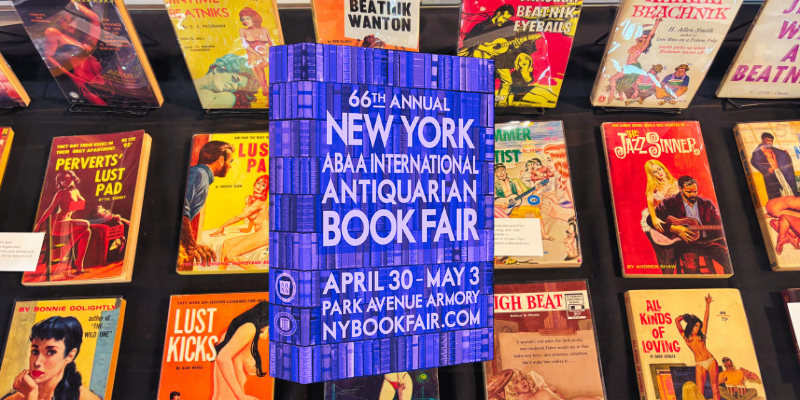
Who wants a $32,000 copy of Runaway Bunny ?
Field notes from a visit to the Antiquarian Book Fair.
This weekend, the Park Avenue Armory plays host to the New York Antiquarian Book Fair—i.e., Mecca, for a certain type of bibliophile.
At the press preview, I’m conspicuously underdressed, having (lazily) assumed bowties and sweater-vests would rule the day in this crowd. Instead, it’s a sea of chic blue suits. Multiple dealers arrive in sequined floor-length cocktail dresses. At the Bruce McKittrick Rare Books Booth, all the purveyors wear flowered headbands.
Visitors skew more eccentric. Leaning against the Armory entrance, I spy a fellow in cowboy hat and bright chartreuse pants. Which is all to tee up my first question: who are these people?
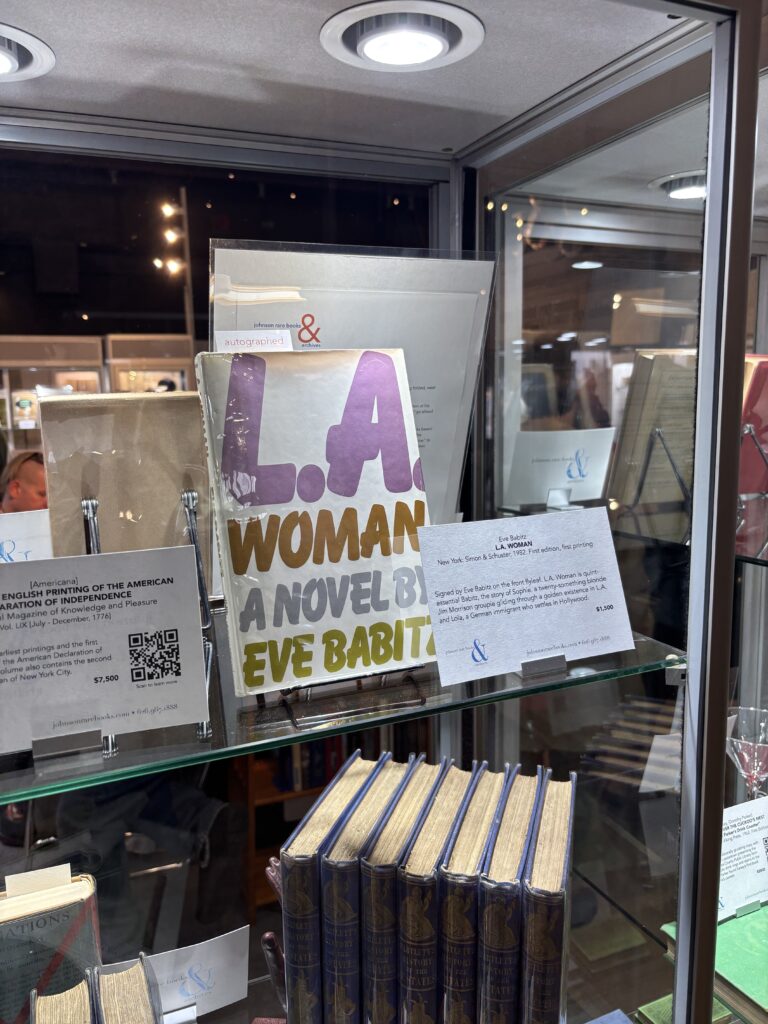 A rare Eve Babitz.
The first fair patron I spoke to—in a dapper newsboy cap—was Jeanne Hilary, a self-identified cartographer and the founder of Bicycle Utopia. An independent historian, Hilary makes maps of Gotham’s under-examined corridors. (“All five boroughs,” she confirms, with no small pride.) She tells me she’s visiting the show to seek out sites of interest for her city guides project.
On the trading floor, the world is represented. I spy sellers from Paris, London, Copenhagen, Milan, Stockholm, and Vienna. At the Illinois based Jeff Hirsch Books booth, I receive a short history of the broadside, a bygone book party favor co-proprietor Susie Hirsch refers to as the “‘Would you like fries with that?'” of readings.”
Wandering the grid, I catch myself looking for themes. Jurisdictions. But the collector with an extremely narrow specialty seems, well, rare. Of the 200 dealers represented, the majority pursue a wide mandate—everything from a general “Antiquity” to “African Americana, Cookbooks, Ephemera, and Medicine,” in one case.
Here at Bauman Rare Books, for instance, is a first edition Runaway Bunny ($32k) spitting distance from a copy of Milton Friedman’s essays ($6500). It’s jarring to see these titles as they’d never be shelved, in such close proximity. But perhaps I’m just overwhelmed by the offerings. So many books, so little context.
The Harper’s booth is an exception. When I’m caught ogling a signed Richard Hell and the Voidoids poster, apparently from a penultimate show ($2750) the proprietor tells me they went with a “pictures generation and downtown theme,” apparently counting on downtown nerds like this guy.
Another booth draws my eye with its display of pulpy paperbacks, all written to capitalize on the 60s “Beatnik craze.” I’ve lost Jeanne Hilary by this point, but I hope she finds this stall.
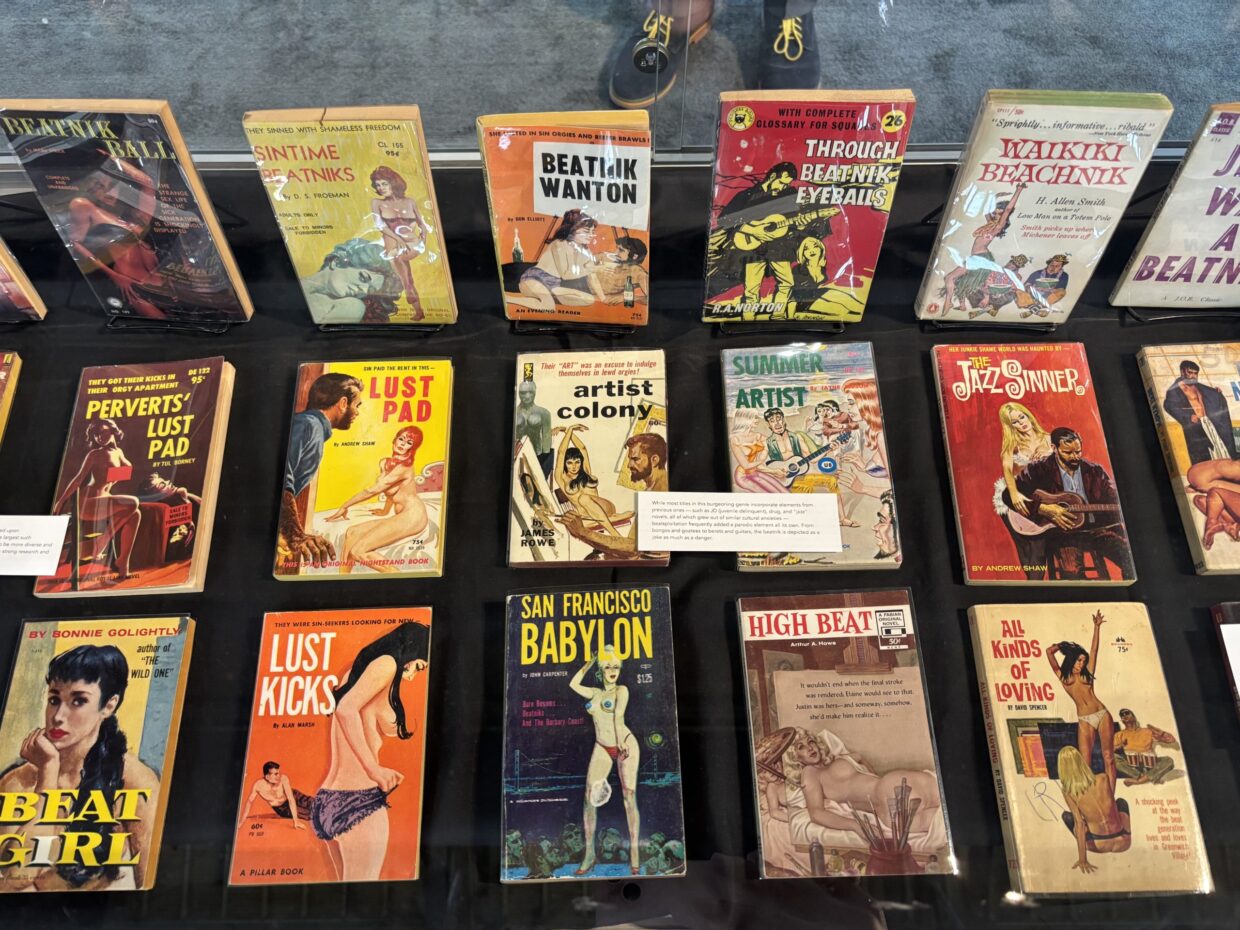 A selection of Beatnik pulp: a genuinely weird marketing trend.
Elsewhere, there’s antiquity. Lots of antiquity.
Here, the first printing of Euclid to be commissioned in Arabic ($88,500). I admit a genuine “ooh!” at the sight of a signed first edition of Shackleton’s “fascinating account of the British Antarctic Expedition of 1907-1909,” apparently “number 273 of only 300 copies printed.” That’s also going for $88,500. But this is by no means the high end of the spectrum, price-wise.
At Liber Antiquus, Early Books & Manuscripts, a 16th century first edition “printed by England’s first printer, William Caxton,” is priced at $350k. The mind reels, the wallet screams, and I’m struck by a paradox: the vibe of the fair is curious, but the event itself is designed to transfer knowledge from public to private space. Which does run a little contra to the whole concept of reading.
Given: books are fetish objects. I think this later, from my living room, where I sit at the foot of my own Mountain TBR. Books are fetish objects, and commodities—but what does it mean to grant them exorbitant monetary value? The fact that for a cool quarter million, a piece of history could be…well, not mine, but somebody’s? I can’t help but conjure the end of Indiana Jones, when the ark is wheeled into an anonymous warehouse.
Rare book dealing has rhymes with the art market in that we can trace its arc from eccentric hobby to a global luxury market. But another wrinkle: unlike visual art, most books aren’t designed for display. This gives the luxury collecting enterprise an ironic tint. You try to picture the dinner party where someone says, “Wanna see my Shackleton?” and everything comes up Causabon. For how do you admire an object you’re technically meant to read?
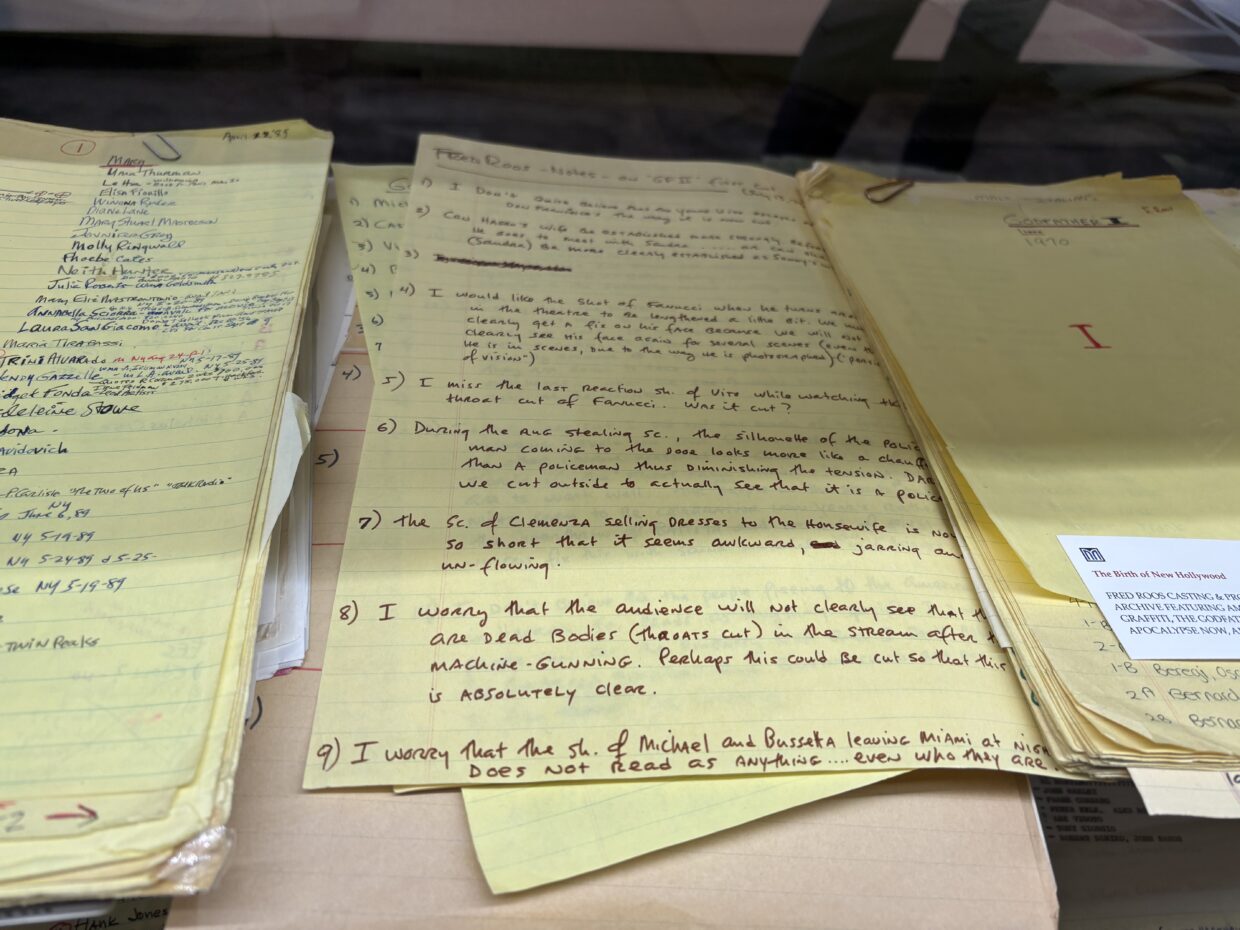 Fred Roos’ notes on The Godfather.
With its abundant broadsides, maps, and mountable ephemera, the fair does answer this question—while providing a pleasant reminder that the very definition of “book” is slippery. The New World Cartographic stall is heavy with the obvious. At Manhattan Rare Books, where a fair bit of Hollywood ephemera is on display, one can peruse Fred Roos’ handwritten notes on an early screening of The Godfather II.
And at Fugitive Materials, you can buy an OG Silence = Death sign—from ACT-UP’s first printed run of the slogan—for $50. Which seems almost reasonable. In the same glass case, issues of Voice of the Lumpen, the Black Panthers’ broadside, go for hundreds of dollars. Fascinating, moving, all this personal history, but I wonder again, who is the collector who needs these items? How are such things placed, in a human’s house?
Daylon Orr, the founder of Fugitive, assures me his mandate is civic-minded. He worked in book trade for a little over a decade and started dealing in 2020, and tells me the whole store’s mission is reparative/curatorial—he aims to collect and circulate “underground, oppositional, queer materials…broadly speaking, stuff that is underrepresented in the book world.”
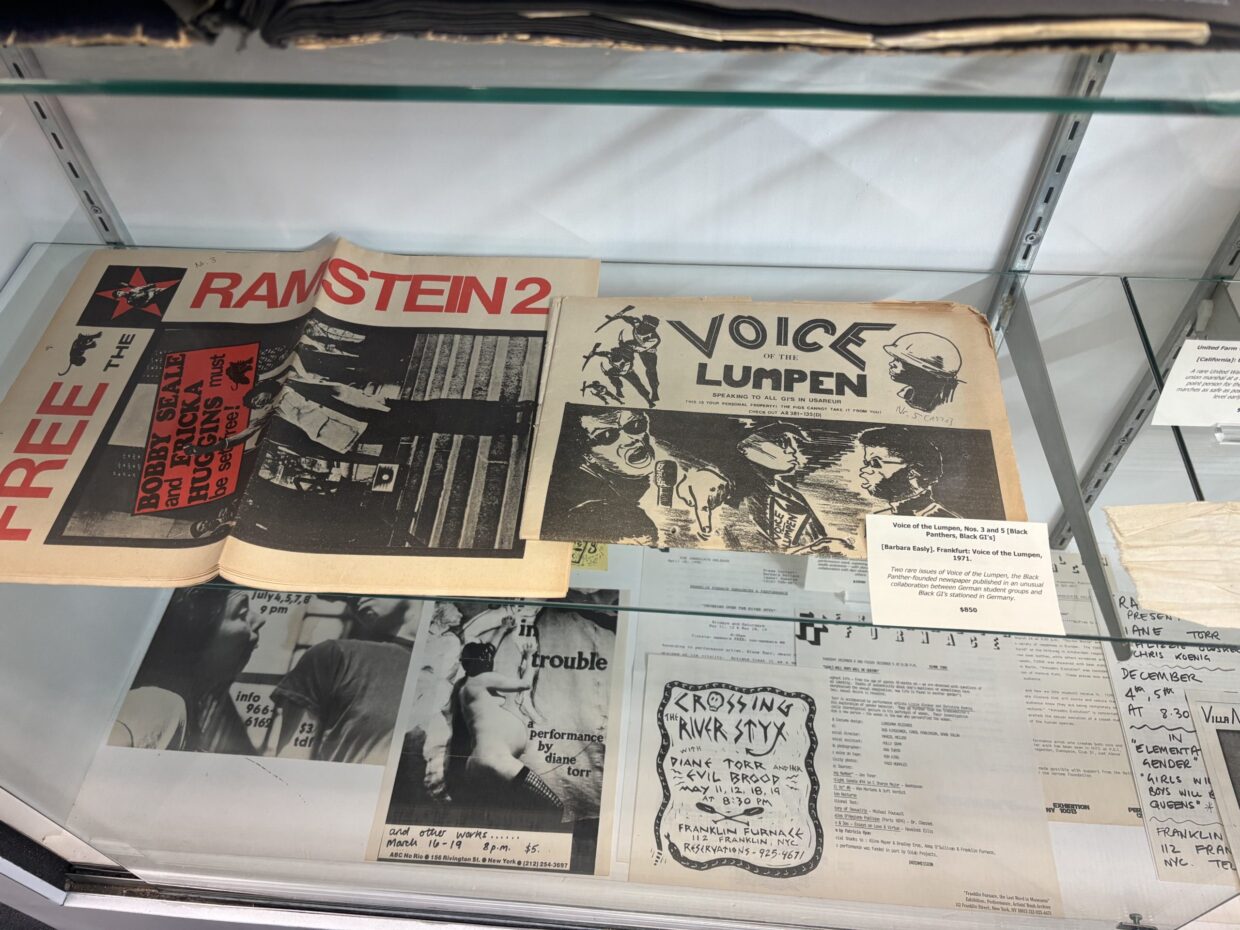 Some of the ephemera from Fugitive Materials
Fugitive works closely with universities, libraries, and museums. They also serve as personal archivists. As is the case with the photographer Dona Ann McAdams, whose collection “Arresting Images” is on display.
Orr points these things out with a historian’s true enthusiasm. And yes, okay, sure, I’m seduced by this shot from Annie Sprinkle’s street wedding. Insanely, I reach for my wallet, thinking: I do want some of this history. To have and to hoard, like I was there.
The whole fair appeals to just this sensibility: the magpie collector, the time traveling nostalgist. From the recent and overlooked, to the ancient and obsolete.
The first German language edition of a book “written to quell the growing hysteria around the conjunction of Jupiter and Saturn in February 1524,” raises my novelist’s antennae. Still more manuscripts offer serious historical discoveries.
Somewhere in these stacks is a working dossier of Étienne Charavay, the handwriting expert whose analysis gave technical credibility to the prosecution in the Dreyfus Affair. The marked text suggests that there was an effort to sway the man towards a predetermined conclusion. Something, perhaps, that should be in a museum. Or for the public, at least.
*
My favorite booth appears towards the end of my amble.
Here, the question of what-makes-a-book feels refreshingly beside the point. For Heide Hatry, a Heidelberg-born artist turned book dealer living on the Upper West Side, is interested in the porosity of the object. Book as aesthetic, and book as vehicle for story.
Her booth—Sanctuary Books, of New York—draws your eye for featuring dresses made of pages. Which she made.
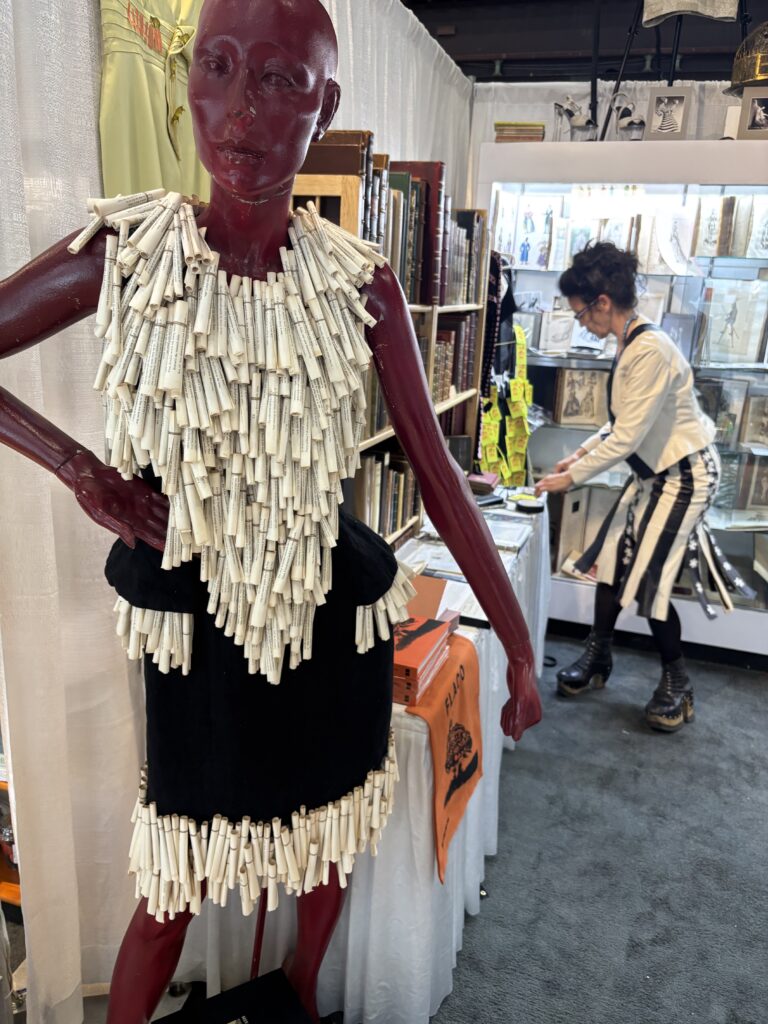 One of Hatry’s creations.
She shows me another personal project, a series of sculptures made in homage to the late Flaco the Owl, who she called a friend. From the found material of many tiny old books, Hatry’s assembled a physical elegy. A book of books, serving a highly specialized purpose. Which strikes me as one of the more precious and personal finds on the floor.
I try to picture the dinner party where someone says “hey, come check this out!” and think: I would. Then I realize: I have. And it’s been a lovely day at the fair.

Brittany Allen
Brittany K. Allen is a writer and actor living in Brooklyn.