Where Physics Meets Poetry: On Language and the Power of Metaphor
Chanda Prescod-Weinstein Considers Literary and Scientific Ways of Interpreting the World We Live In
When I was 16 years old, my beloved college counselor told me that it was a good thing I wanted to be a physicist because I wasn’t much of a writer. We were close—I had her home phone number for emergencies—and it wasn’t a mean-spirited comment. She was right—writing was my weak spot. When I went into my frosh exposition class at Harvard six months later, I was understood by the entire seminar to be the worst writer in the class.
Peer edits were a struggle; our instructor tried her best. I was a Black working-class student from an underfunded school district, and they treated me with the kind of pity that white liberals understood to be kindness. When I look back on my final essay, I see smart ideas and a writer who could not get comfortable inside of a sentence. I could not find my voice on the page. I was not at home in the figurative, and it showed.
We are producing our reality through the stories we choose to tell and the metaphors that we use to narrate them.
I was lucky to live around the corner from Grolier Poetry Book Shop, and in the years that followed that course, I spent hours combing their shelves, looking for words that resonated. I remember when they showcased the 2001 debut of Cate Marvin’s World’s Tallest Disaster. When I first read the collection—just days after 9/11, when I was already in the midst of organizing a student anti-war group—I felt like I was about to live through the world’s tallest disaster. Of course, the timely resonance of Marvin’s metaphor was a coincidence, and the collection is an intimate one; it is about personal relationships, not politics. But even so, I received an education by poetry. I still remember how the first poem, “Reader, Please,” taught me that I was allowed to speak directly to my reader, to say things like, “Sometimes, reader, I wish they’d taken/ me away, right there and then.”
Perhaps it is not entirely surprising, then, that while I initially planned to open my book The Edge of Space-Time: Particles, Poetry, and the Cosmic Dream Boogie with a discussion of my favorite quantum physics experiment, instead, the first chapter is about the power of metaphor. A confrontation with Robert Frost’s “Education by Poetry” and Nathasha Trethewey’s “On Abiding Metaphors and Finding a Calling” had forced me to reimagine my project, which I thought was about showing readers the universe through the eyes of a physicist.
In her essay, Trethewey writes: “Growing up in the Deep South, I witnessed everywhere around me the metaphors meant to maintain a collective narrative about its people and history—defining social place and hierarchy through a matrix of selective memory, willed forgetting, and racial determinism.” Trethewey is talking about the way language—rhetoric—is a political action that shapes how reality is interpreted. We are producing our reality through the stories we choose to tell and the metaphors that we use to narrate them.
Trethewey’s essay is in part a reflection on Frost’s declaration that “unless you are at home in the metaphor, unless you have had your proper poetical education in the metaphor, you are not safe anywhere. Because you are not at ease with figurative values: you don’t know the metaphor in its strength and its weakness. You don’t know how far you may expect to ride it and when it may break down with you. You are not safe in science; you are not safe in history.”
As I write in The Edge of Space-Time, I was stunned by this declaration. I was reading Trethewey in a craft book for Black writers (How We Do It, edited by Jericho Brown), not for an analysis of my role as a scientist. Yet there it was: if you don’t know the metaphor, you are not safe in science. I realized that I saw a corollary: education by science is also a kind of education by poetry. And if you are willing to feel at home with the strange wonder that is our cosmos, to grapple with the abstract, then you are better positioned to resist those who are hoping to take you for a ride, whether they are Christian Nationalists, manosphere Youtubers, or the President of the United States.
I find it notable that my book is one of several spring 2026 releases that grapple with the significance of the figurative in our political life. In Let the Poets Govern: A Declaration of Freedom, Black queer poet and former political communications strategist Camonghne Felix writes: “Poetry is where I go to become an architect of survival. I am abstracting survival, because I do not and cannot think of survival in concrete terms, because the world we’ve created and inherited does not want us to survive. Survival for the human being necessitates abstraction, it requires that we see outside the limitations of what is considered real.” Felix is showing us that figurative language is a powerful refuge, that within abstraction we can cultivate the seeds of freedom. Felix is not naïve about this process. Much of Let the Poets Govern is an analysis of what she calls “political theater and ritual to perform equality.” Language—and poetry—can be used to manipulate us. Poetics can become the foundation for dehumanization, as was the case with the settler colonial founding documents of the United States, which constituted people like me, Trethewey, and Felix as three-fifths of a human being.
Clare Follman similarly homes in on the power of figurative language and specifically the metaphor in her own work of science writing, Scapegoat: What the Invasive Species Story Gets Wrong. I do not know Follman, yet we both begin our books with a discussion about metaphor out of concern for what Trethewey calls our abiding metaphors—in this case the ones that are shaping our understanding of ecology. When we read the phrase “invasive species” a metaphor is at work on us: we are being told that there is a war going on and the species who have invaded are the bad guys. These species are defined by and merged with the narrative tale we want to tell about them. “This is the great linguistic alchemy of metaphor,” Follman writes. In the end, this metaphor orients us toward understanding the so-called “invasive” species as the problem—always an animal and never the colonizers who brought them into the ecosystem in the first place. In this way, settler colonial capitalism remains invisible, even as it ravages our planet.
If you are willing to feel at home with the strange wonder that is our cosmos, to grapple with the abstract, then you are better positioned to resist those who are hoping to take you for a ride.
But as Cortney Lamar Charleston declares over and over again in his new poetry collection, It’s Important I Remember, we have to notice “When the laws of mathematics meet the laws of the State.” Charleston, alongside Felix, writes in a Black diasporic tradition that uses the abstract and figurative to name, address, and illuminate the materiality of Black life in the wake of chattel slavery. Like Follman, Charleston turns to the dictionary for a definition of metaphor. The fact of the metaphor as a practice must be named and defined. He quotes Merriam-Webster and then explains: “America is a house on fire is an example of a metaphor/ America is like a house on fire is an example of a simile.” In this political moment, Charleston insists, our word choices do in fact matter because they tell us whether we understand that we are on fire.
In my own discussion of metaphor, I cheated. I say simile and allegory and metaphor are all kind of the same. There is a joke about astronomers, that as long as we get an answer that is within a factor of 1000, the number is the same. Astronomy is rarely an exact science; the error bars are often big. I grappled with what kind of errors I would be introducing to my readers with my metaphors, which is one reason I chose to talk to the reader directly about their prevalence in scientific thought. If I tell you an expanding universe is like a balloon, you may assume the universe is inside of something else, since a balloon is usually locatable relative to the outside world. I needed the visual metaphor of the balloon, but I hope I also taught my readers to ask how far they can ride it, and where it might break down.
The quantum physics experiment I hoped to write about did make its way into my book. The Stern-Gerlach experiment is a strange and fantastic phenomenon where particles “forget” information about themselves simply because they were observed. The forgetting here is something of a dangerous metaphor that anthropomorphizes subatomic particles which have no consciousness. Even so, it can be hard to find the words to summarize what is an utterly bizarre outcome. In sharing it with readers, I want them to see the universe the way I do. My hope also is that their confrontation with the counterintuitive results of the Stern-Gerlach experiment will be a good and useful education by quantum.
__________________________________
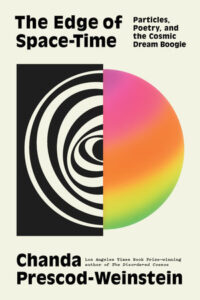
The Edge of Space-Time: Particles, Poetry, and the Cosmic Dream Boogie by Chanda Prescod-Weinstein is available from Pantheon Books, an imprint of Knopf Doubleday Publishing Group, a division of Penguin Random House, LLC.

Chanda Prescod-Weinstein
Chanda Prescod-Weinstein is an associate professor of physics and astronomy and core faculty in women’s and gender studies at the University of New Hampshire. She conducts award-winning theoretical physics research on dark matter, the early universe, and neutron stars, while also researching Black feminist science studies. Her first book, The Disordered Cosmos: A Journey into Dark Matter, Spacetime, and Dreams Deferred, won the 2021 Los Angeles Times Book Prize in Science and Technology, the 2022 Phi Beta Kappa Award in Science, and a 2022 PEN Oakland/Josephine Miles Literary Award. A columnist for New Scientist and Physics World, she is originally from East L.A. and now divides her time between the New Hampshire Seacoast and Cambridge, Massachusetts.