Where I End, the Writing Begins: What Undergoing Surgery Taught Me About Transcendence
Diane Les Becquets: “And I watched those moments unfold before me, as if in real time, and I felt everything.”
When I was diagnosed with five brain aneurysms, two of which were breaking down, I wanted to fling my arms wide and capture all the world that I’d missed. I wanted to live…Now! Now! There were my sons still to love, and books still to write, people to meet, woods to explore, the fungi and lichen—oh, what were their names—so much to learn and remember; rooms still to paint; sins to be forgiven; the stove to be cleaned, because if I died, oh, God, don’t let me die, the house should be clean. Right up until the surgery, my hands were fists, clasped around the heavy stones of everything I wanted, trying too hard to make a happy ending of my life, and praying to God it wouldn’t come soon.
I’d been living on the edge of a world, dipping my toes into its strangeness and warmth and brilliance while I dreamed and desired and fought and worked—until that day, the hour when it came, the moment and second when everything shifted. I was lying on the gurney. The giant operating room, with its other-worldly machines and too many doctors and nurses to count, lay on the other side of two glass doors, and next to me seven more nurses and doctors were scrubbing in.
A doctor turned to me and smiled, blue scrubs, her arms covered in suds. The stones fell from my hands—the things I’d held onto so tightly—the forests I wanted to explore, the lakes I wanted to swim, the nights I wanted to fill with lovemaking. Oh, what burdens I shed giving up my desires and impositions, like taking off a pair of muddy boots and sitting a while and finally learning to rest. The lakes were lakes, and the nights were stars and moons and darkness and blankets and rooms and houses. My sons were each their own, and the day was its own, just a day. This wonderful, glorious detachment. I stopped trying. I let go. I felt peace.
And there before us, we’ll finely observe moments, the kind a photographer might capture on film, translations of love and pain and heartache and devotion and human connection.
In the operating room, a beautiful nurse with brown skin and green eyes, asked me my favorite song. I told her, “What a Wonderful World.” She set the song to play from her phone, then sat beside me and held my hand. I saw my oldest son and me dancing at his wedding, surrounded by those we loved; I saw myself dancing in our yellow kitchen while my three sons sat at the counter eating grilled cheese, mouths full, bodies rocking from side to side as Louis Armstrong sang on.
I knew going into the surgery that I might lose my eyesight. After the seven-hour procedure, I awoke in the operating room—so many tubes from my body, so many machines. There was my surgeon walking toward me. “I can see!” I exclaimed. His eyes brown and tender; his thick, white hair like Einstein’s.
In the days ahead, my eyes and heart were open to everything. I returned to the novel I had been writing when I received the diagnosis, and I knew—my main character was more than what was on the pages before me. Her world was more.
A little over fifteen years ago, my second husband passed away from glioblastoma. He used to say that we were like milkweed. He’d talk about the fine filaments inside the milkweed pods. “If you rub them together, they’re silky and smooth. That’s how the two of us are. I love you, but it’s more than that.” And so I asked myself, how could I capture that same kind of feeling—the mystical more—in my novel, the kind of narrative that says to my reader, “Come here, sit with me, I need to show you something. Do you see it? Do you feel it? This moment in time that is so real. I must show it to you, from this place where we sit, because if I do anything less, we will miss its living heartbeat.” We’ll leave the furrows and fields, the reader and I, and walk barefoot atop a hill. I might show the reader a family that knows tragedy, where people have died, or divorced, or left. But that’s not the point. The point is this, I will say. And there before us, we’ll finely observe moments, the kind a photographer might capture on film, translations of love and pain and heartache and devotion and human connection, those still points in time, that make everything real, and everything more than.
It has been said that grief is the last chapter of love, but I want to say these moments are that last chapter, and they never end. The present is the future and the past; it is love transcendent.
One of my greatest fears before my surgery was that I would die, and my sons would forget all the moments I carried with me, those beautiful, ordinary snapshots in my mind, transcendent and sacred, that made up who we were together: My then seventeen-year-old son and I sitting on top of the garage, sharing a beer in kitchen glasses, the day at its end, supper dishes put away, because he was at that age where I knew he would start drinking soon, and I wanted his first beer to be with me; my two youngest sons, six and ten, sitting with me beneath an eighteen wheeler, eating greasy hamburgers and French fries, after a day of white water rafting, sun-baked skin, Colorado-bright sun, my oldest son sitting on top of a picnic table, thirty feet away; or the four of us around a campfire at the end of May, feeding old school papers to the flames—and their faces, and their laughter, their voices.
I want to say to the reader, “Can you hear those voices? I will never forget them.” Or the time I found my middle son in tears, his back to the garage in an alley, his twelve-year-old body slumped forward, t-shirt salty with fresh air and perspiration, his heart breaking, and my heart breaking, because I couldn’t put his father and me back together, because his dad was remarrying, and that made everything more real. It has been said that grief is the last chapter of love, but I want to say these moments are that last chapter, and they never end. The present is the future and the past; it is love transcendent.
Before my surgery, I wrote these things down, as many as I could recall. And after my surgery, in that grace-state of recovery, I experienced something similar with my novel. I surrendered myself completely, allowing the moments to come to me, as if my characters were saying, “Come here, come sit with me a while, I need to show you something.” And I watched those moments unfold before me, as if in real time, and I felt everything.
__________________________________
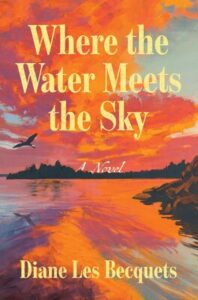
Where the Water Meets the Sky by Diane Les Becquets is available from Simon & Schuster.
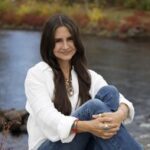
Diane Les Becquets
Diane Les Becquets is the author of Where the Water Meets the Sky, Breaking Wild and The Last Woman in the Forest. Breaking Wild, an Indie Next Pick and a national bestseller, received starred reviews from Publishers Weekly, Kirkus Reviews, and Booklist, and was featured on NPR’s Morning Edition. It was the recipient of the Colorado Book Award in Fiction, the New Hampshire Outstanding Work of Fiction, and was shortlisted for the Reading the West Book Award in Fiction.