What to Do When Your Activism Leads to Threats From the Powerful
Julia Angwin and Ami Fields-Meyer on Political Dissent and the Stages of Fear
Claire Atkin had just touched down on the tarmac in her hometown of Vancouver, British Columbia, when her phone buzzed.
On the screen flashed a series of texts from her neighbor: There was a man outside Atkin’s apartment building. He looked to be in his mid-fifties. He was wearing a gray leather trench coat. And he was waiting for Atkin.
Atkin is the chief executive of the digital advertising watchdog Check My Ads Institute. In 2016, working in software marketing, she noticed a strange trend on her social media accounts: bizarre conspiracy theories that claimed “elites” like Hillary Clinton were harvesting the blood of murdered children or that alleged a child sex ring was being run out of a Washington, D.C., pizzeria.
The stories made no sense, but they were traveling at an extraordinary velocity. More disturbing to Atkin was that the online creators spreading these harmful lies seemed to be doing it by using the same digital advertising tools she used to sell software to businesses.
Nandini Jammi, a fellow marketer, harbored the same concerns about digital marketing technologies. In 2017 she had used an anonymous Twitter account to inform brands that their ads were appearing on the far-right news site Breitbart.com. Her campaign proved remarkably successful: The media outlet hemorrhaged 90 percent of its revenue, and the site was eventually blocked by some four thousand advertisers.
Atkin and Jammi began working together. “We started to ask this question: Why is the advertising industry still funding hate speech, even though advertisers have made it so clear that they don’t want to be anywhere near it?” Jammi said in a 2022 interview with NPR. The answers they found were complicated. But they all seemed to grow from the same source: advertising technology companies that enabled advertisers to automatically buy placements across thousands of websites without knowing exactly where their ads would appear.
But success came at a cost: Atkin and Jammi had made enemies and were now a target for some of the most powerful people in right-wing media.
The pair took a big swing in 2022 around the first anniversary of the Capitol insurrection on January 6. Ad tech companies had made a promise to brands that they would never bankroll election disinformation. But as the January date approached, Atkin and Jammi’s research showed that intermediaries were still sending money to prominent peddlers of election conspiracies like Dan Bongino and Tucker Carlson. So the organization launched a pressure campaign, calling on ad exchange companies to “defund the insurrectionists.”
The campaign worked. Ad tech companies dropped media outlets associated with Steve Bannon, Glenn Beck, and Tim Pool, all of whom had promoted conspiracy theories about the 2020 presidential election. Google, the biggest ad exchange on earth, eventually stopped showing ads for Bongino’s website, citing “demonstrably false claims about our elections” and misleading information about COVID-19. Check My Ads estimates that the effort successfully blocked millions of dollars in income to the sites.
But success came at a cost: Atkin and Jammi had made enemies and were now a target for some of the most powerful people in right-wing media.
First came a federal lawsuit. Rumble, the video-sharing platform that hosted content from the podcaster Andrew Tate, the actor Russell Brand, and several January 6 insurrectionists, sued the Check My Ads cofounders after the organization encouraged advertisers to stop advertising on the site. Rumble’s CEO staked out a confrontational approach to the lawsuit. “Preserve all your documents,” he tweeted.
The influencers hit back, too. The Bongino Report, the website of the right-wing firebrand who would eventually serve a brief term as deputy director of the Federal Bureau of Investigation, claimed that Check My Ads was violating tax rules. Seizing on a tweet from Atkin offering to buy books for any teenager who’d had a book banned at school, Bongino called the Check My Ads cofounders “Soros funded perverts” and described them as “savages” seeking to indoctrinate children and censor free speech.
Between September and October 2023, Bongino tweeted about Atkin on at least seven separate occasions. His followers responded with a steady stream of invective, describing Atkin and Jammi in misogynistic and, at times, dehumanizing language.
Then, on a chilly night in December, a man in a trench coat came looking for her.
The level of fear that human beings experience on a day-to-day basis has a lot to do with how far away we think a predator is. Michael Fanselow, a professor of psychology and psychiatry at the University of California, Los Angeles, has spent his career studying this dynamic. He describes fear as an ancient set of tools that evolved to help protect people against environmental dangers.
The third stage is panic. This is when the predator pounces.
“The threat of predation is probably the most powerful evolutionary force that we confront,” Fanselow says. Our response evolves as the perceived threat gets closer. He breaks the process down into three distinct stages: anxiety, fear, and panic.
In the first stage—anxiety—a predator is in the distance, but we know it’s coming. This is when we have the most flexibility in our thinking. Though we’re aware of a looming threat, we’re still able to think strategically about our options—the range of possibilities and tools that remain available to us.
When the predator is close at hand, our body activates a set of automatic responses. Adrenaline rises, blood pressure spikes, heart rate changes, palms grow sweaty, breathing becomes more staccato. We also might naturally freeze up or clench our muscles—the body’s way of trying to preserve its options. “If you don’t move, you’re less likely to be detected by your predator,” Fanselow says. This is what he calls fear.
The third stage is panic. This is when the predator pounces. Another set of responses take control: We shout, we run, we jump, we fight. We do whatever we can to escape.
Sitting on the tarmac, Atkin froze up.
She tried to collect herself. Perhaps there was a rational explanation for the man outside her apartment. She’d been expecting to be served papers in the Rumble lawsuit. Maybe this was just a guy doing his job. But serving papers after business hours seemed unusual. Even an aggressive plaintiff would know that lingering past dark wouldn’t go over well in court. It didn’t add up.
Atkin replied to her neighbor’s message, wondering whether she should come home. The reply was instant: “I would say don’t.”
That night Atkin stayed at a friend’s place. At daybreak she took an Uber back to her apartment and slipped in through the back entrance. There she remained for two days, blinds drawn and door double-locked. Had the trolls toiling in the darkest tunnels of the internet shown up at her actual doorstep?
Atkin’s life as she knew it had changed. This was her new normal.
The previous year, troubled by the growing belligerence of the internet crowd, Atkin had enrolled in self-defense training in her neighborhood. The threat of violence was a new problem in her life, one she wasn’t quite sure how to think about.
The first lessons were more like a philosophy class. The instructor was preoccupied less with physical training and more with ideas like situational awareness, outlining an approach to safety that began long before a physical threat ever arrived. As the weeks passed, Atkin started to see answers come into focus: As a woman in this line of work, she was going to have to live with the possibility of violence. And if violence did arrive, there wouldn’t be a lot she could do. But there were other things in her control to keep the anxiety at a low hum, to make the threats ambient and hold the panic at bay.
“The thing to orient towards is not who wants to hurt me,” Atkin began to think. Instead, she would train her energy on another question: “How do I maintain a long-distance vision rather than myopic fear-based decision-making?”
The answer would require building for herself a world where she would be dramatically less likely to encounter daily threats—physical or psychological—and where help was at the ready when she did. Her best resource, Atkin figured, were the people who were closest to her. A mentor suggested she create a map of these people.
One day Atkin grabbed a pen and sat down at her desk. On a white 8½” by 11″ sheet of printer paper, she drew three concentric circles, like a dartboard.
And if you decide to confront the powerful, then personal risk will always be part of the equation.
Inside the bull’s-eye, she wrote the names of close friends and family—the people who loved her unconditionally. In the next ring outward, she jotted down the names of the people who believed in her, like friends and mentors, donors, and board members of Check My Ads. The names of foundation heads and others with resources who had shown their willingness to support the work of her organization went in the outermost ring.
As the days passed, Atkin wrote more names on the page. The new topography located her within a forest of allies. The map was simple, but it struck her as a profound resource, a reminder that she had in her immediate reach deep reserves of wisdom, experience, and help.
“It was much bigger than I thought it was when I first started,” Atkin recalls of the map. If a more immediate threat ever arrived, these were the people she would call.
If you want to pursue a career as a pastry chef, you’re going to encounter flour. If you want to be a surgeon, there’s going to be blood. And if you decide to confront the powerful, then personal risk will always be part of the equation. “I run an accountability organization,” Atkin says. “People are going to be upset with me.”
She has developed a personal philosophy for managing this risk and continuing her work in spite of the fear: Do it with open eyes and do it with others.
The first step is internalizing the logic of threats and understanding what makes them so debilitating. “When you are attacked or threatened, it feels like much more than ‘I’m going to take away some money of yours,’ or ‘I’m going to take away a reputation that you might have,’” Atkin says. “It feels to your body like someone is telling you that your life doesn’t matter.”
There’s a good way to avoid being persuaded by that argument, Atkin says: Surround yourself with a cadre who will testify on your behalf in this internal trial and as character witnesses vouching for your worth, your value, and your cause. Fanselow, the fear scientist, says there’s science behind that intuition. “Even in animals, having your friends and your littermates around will reduce your fear quite a bit,” he says. Being around people who feel familiar and supportive can tamp down your fear system and allow other motivations, like core values, to take over.
In a 2016 study, Fanselow and his UCLA colleagues Erica Hornstein and Naomi Eisenberger conditioned participants to fear a neutral image—such as a flower—by pairing it with a mild shock. But later, when the same image appeared alongside a photo of someone the participant relied on for support, like a partner, parent, or friend, the fear response diminished. The images of loved ones softened participants’ physiological reactions to fear.
Other approaches, like exposure therapy, physical warmth, and some medications, have also been shown to help. But medication reduces only the symptoms of fear, not the underlying trigger that stimulates it. To develop a resilience to events that generate fear, Fanselow says, surround yourself with familiar people. “Social support is very powerful in reducing fear,” he says. “Probably better than meds.”
That support can come from neighbors—though such relationships have grown increasingly rare. Fifty years ago, nearly half of Americans spent time with neighbors a few times a month. Today, barely one in four do. That disconnect is a problem in an environment of growing daily stressors, from rising federal law enforcement presence to social welfare cuts that prevent many from meeting basic needs. For those who may be at heightened risk, whether for their activism, their income level, or their identity, an extra set of eyes and ears can be key—people who know their needs, who have a sense of what their life is supposed to look like, and who can spot—and step in—when something is off.
Mentors can do this, too. People who have been at this work longer, or have survived similar ordeals, can help a mentee see around corners. That’s what happened to Atkin on the third day after the man in the trench coat came looking for her. She was finding it difficult to focus on work, distracted by a stream of questions. What new threats lurked around the corner? What could she do about it? She picked up her phone and dialed a mentor—someone she had placed in the second circle of her map.
The mentor told her to wait by the phone. A few minutes later, a call came in. It was the leader of a leading human rights group—a man some twenty years Atkin’s senior, whom she’d never met, with decades of experience fighting off lawsuits by right-wing governments. He had been in her shoes many times before and lived to tell the tale.
“First time?” the stranger asked. His tone was warm and welcoming. Atkin shared her many causes for concern. The lawsuits. The man in the trench coat. And then, as if moving down a checklist, the voice on the other end drew on his experiences and addressed each one of her fears: the ways he had learned to cope, the legal lessons he wished he’d known earlier, the dos and don’ts of leading an organization in the crosshairs. “Your first time is always scary,” said the caller, no longer sounding like a stranger at all. He stayed on the phone with her and answered her every last question.
“It feels so lonely when you’re sitting there in your room being like, what do I do?” Atkin says. “But you have to very quickly pivot to, okay, I’ve got to call someone. I’ve got to talk to somebody. I’ve got to be with somebody.”
__________________________________
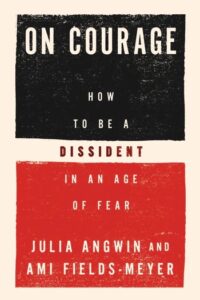
Excerpted from the book On Courage provided courtesy of Mariner Books, an imprint of HarperCollins Publishers. Copyright © 2026. Reprinted by permission.

Julia Angwin and Ami Fields-Meyer
Julia Angwin is an award-winning investigative journalist, a bestselling author, a New York Times contributing Opinion writer and founding director of the Independent Media + Audience Project at Harvard Kennedy School’s Shorenstein Center on Media, Politics and Public Policy. She is the founder of two nonprofit newsrooms – Proof News and The Markup – that investigate the impacts of technology. She is a winner and two time finalist for the Pulitzer Prize in Explanatory Reporting. She is the author of the New York Times bestseller Dragnet Nation: A Quest for Privacy, Security and Freedom in a World of Relentless Surveillance (Times Books, 2014) and Stealing MySpace: The Battle to Control the Most Popular Website in America (Random House, March 2009). Ami Fields-Meyer is a senior fellow at the Harvard Kennedy School’s Allen Lab for Democracy Renovation and a former senior policy advisor at the White House, where he led U.S. policy initiatives related to civil rights, consumer protection, and technology policy. He has served as a strategist to national civil rights organizations, political candidates, and high-profile public officials from Los Angeles City Hall to the West Wing. Fields-Meyer’s writing on issues of democracy and public policy has been published in The New Yorker, The Atlantic, Foreign Policy and other outlets. A former speechwriter, he is a term member of the Council on Foreign Relations.