What Ann Patchett’s Whistler Gets Right and Wrong About Horses
Janet L. Jones on the Fact and the Fiction of Equine-Centered Narratives in Fiction
Popular novels often stumble in telling horse stories. Authors have colts (male) growing up to become mares (female); regional riders competing in red (national) coats; horses at a lope (slow) winning speed contests. As a neuroscientist and horse trainer studying the interaction between equine and human brains, it’s hard to ignore such errors. We real riders rejoice when an exception appears. Ann Patchett’s new novel Whistler is one such case.
Literature’s gatekeepers may be quick to point out that Whistler is not a horse book, but the central story in Patchett’s nest of embedded tales revolves around a horse. The book is named after a horse; the cover bears the image of a horse; its pages are filled with talk of equine photos, sculptures, and statuettes; and the key metaphor of the narrative is grounded in a horse story. But it’s true that the book itself focuses on the power of story to defy death and inspire salvation. Along the way, it explores how good families protect, teach, and love one another.
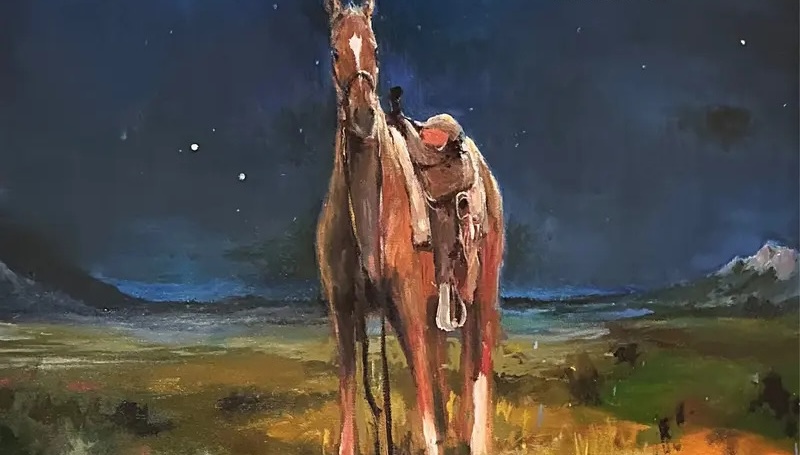
The nut within the nest of stories is the tale of a Wyoming ranch woman who leaves her home in a rainstorm. Mary rides her favorite horse Whistler—who came when she whistled—up into the mountains, searching for a missing horse. She falls and is unable to return home due to her injuries. Her mount, meanwhile, is frightened by lightning and runs off. Three days later, as Mary is dying from a collapsed lung, broken bones, dehydration, and hypothermia, she whistles for her horse. The horse returns and lies down next to her, allowing Mary to mount and be carried to safety.
Literature’s gatekeepers may be quick to point out that Whistler is not a horse book, but the central story in Patchett’s nest of embedded tales revolves around a horse.
Horses are surprising animals, capable of many feats that, to most people, sound almost fantastical. It is indeed possible to teach a horse to come from a distance at the sound of a whistle, though most owners don’t take the time to do so. Horses do become bonded to one person—just as they can become attached to another horse. The fact that Mary loved Whistler and trained her personally, “for years and years,” establishes the likelihood of a deep bond and could explain the horse’s affection, putting “her head on Mary’s shoulder. Not anybody else’s shoulder, only Mary’s…”
Horses have an extremely powerful sense of smell that allows them to navigate back home alone if necessary. Had there been no storm, Whistler would have followed her own body scent back to the ranch. Not only do the odors of both equine and human perspiration, body odor, and hormones linger in the air, but a horse’s hooves contain scent glands that stamp her scent into the ground. All of these clues allow horses to retrace their paths.
In Whistler, though, the storm’s wind would have blown away air-borne odors, and torrential rain would have soaked out ground odors. This explains why Whistler did not simply run home after Mary fell—a horse’s typical practice. An unmounted horse galloping into a ranch, saddle empty and reins flying, is a standard cue for horse people to seek the rider. But with no scent trail to follow, there is no indication in the book that Whistler returned home, where Mary’s husband and daughter would have realized that she was in trouble.
The biggest question is whether a horse would lie down to allow an injured person to get on her back. And the answer is that it’s highly unlikely, but not impossible. Mary had tried for years to teach Whistler to lie down, but had never achieved that goal. Patchett makes an interesting observation here: “Horses weren’t interested in lying down unless something was wrong.” This is a common myth, borne of the fact that horses can sleep standing up. But they don’t have to. In fact, healthy horses lie down most every day to rest their legs and achieve deep stages of sleep.
Did Whistler know something was wrong with Mary? Undoubtedly, she did. Horses get to know their humans quite well. They recognize our individual faces and voices, they know how each of us walks and smells, they’re aware of our clothing and who we’ve recently touched, of the meals we’ve eaten. Horses also know and can distinguish among certain human emotions. Smelling human hormones of fear, Whistler would have known that Mary was scared. As a prey animal, she would also have noticed that a bonded affiliate wasn’t moving and might be sick.
Patchett describes Whistler’s lying down for Mary as “an unheralded act of generosity.” But it’s highly unlikely that the horse lay down with the intent to save Mary’s life—most equine scientists would claim that such a complex intent is impossible given the capacities of a horse’s brain. It’s far more probable that Whistler imitated Mary’s position—her lifelong trainer and guide was lying still on the ground for a long time.
Despite my quibbles, the embedded stories of Whistler, each inside another, are memorable and compelling, drawing readers into their core.
Horses are herd animals who stick together for safety. Within the herd, they form close friendships with one or two other horses. These bonded affiliates often imitate each other—following each other around, eating or drinking when the other horses do, running or playing together, exploring new ground together. Two equine affiliates will often lie down next to one another, even sometimes adopting the same positions. Such rites of affiliation can be transferred to humans. Out on a distant mountain, Whistler would have sought comfort from Mary, wanting to be close to the person who had taken care of her and protected her all her life.
While Patchett’s depiction of equine behavior is fairly realistic, the decisions of the main character in this central tale are less so. Mary is introduced as a born-and-bred, three-generation, Rocky Mountain ranch woman who’s been riding and training horses all her life. Mary and Whistler left their ranch to seek a missing horse, Nutmeg, but very few horses leave a remote mountain ranch for long; they return to their herdmates. It’s unlikely that Nutmeg needed to be found, and a third-generation ranch woman would have realized that.
Mary had no reason to believe Nutmeg was in danger, so she would have waited for her husband and daughter to return before setting out to search. Patchett rationalizes Mary’s decision by establishing that Nutmeg was old. But an old horse would be even less likely to leave her herdmates behind.
When Mary decides to climb higher into the mountains on Whistler during the increasingly severe thunderstorm, hoping to spot Nutmeg from above, Whistler, a horse Mary had known and trained all her life, would have been communicating anxiety from the first step, reminding Mary of the danger. Meanwhile, Nutmeg would have taken shelter in the low brush of thickly wooded areas to avoid the rain, becoming invisible from above.
It can be difficult to read fiction about a subject you’ve devoted your life to studying. Still, despite my quibbles, the embedded stories of Whistler, each inside another, are memorable and compelling, drawing readers into their core. Only Ann Patchett could write such a pleasant, amiable novel about death, and only a horse could serve as her essential metaphor for peaceful salvation.
_______________________________
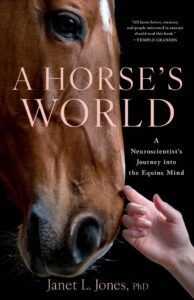
A Horse’s World: A Neuroscientist’s Journey into the Equine Mind by Janet L. Jones is available from Little, Brown and Company, an imprint of Hachette Book Group.
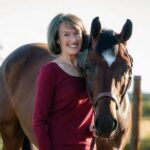
Janet L. Jones
Janet Jones, Ph.D., began working with horses in early childhood, trained for a large stable over many years, and later ran her own successful horse training business. She earned her Ph.D. in cognitive science from UCLA and taught perception, language, memory, and thought for 23 years as a college professor. She offers masterclasses in brain-based horsemanship worldwide, consults for companies including Nissan Motor Corporation, and won Japan’s Equine Culture Award in 2021, the first American author to receive that prize since Laura Hillenbrand won for Seabiscuit. Jones and her horse True live in the Rocky Mountains and may be reached at janet-jones.com.