Visiting Helen Keller’s Birthplace While Deaf: What it Means to Navigate Accessibility
Rachel Kolb Explores the Contradictions of a Post-ADA World
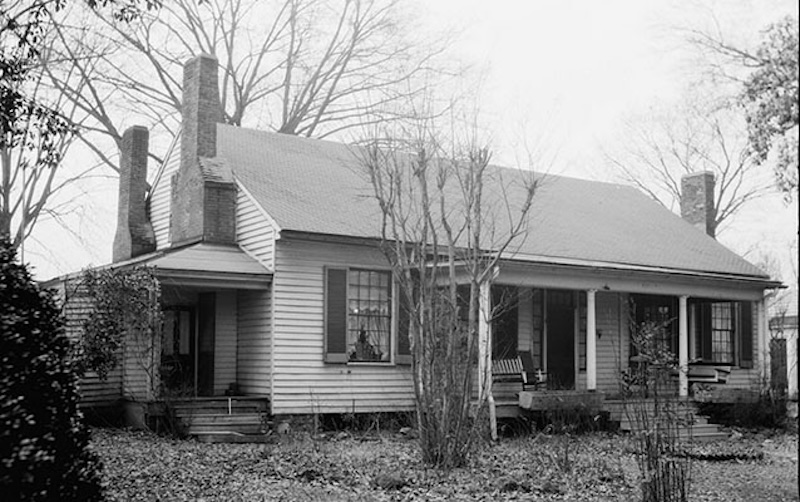
On a sticky Saturday morning in July, I stepped out of the air-conditioned car, and the Alabama summer hit me like a wet blanket. The brick pathway at my feet passed through a small ornamental fence, crossed some scrubby grass, then ran up the steps to the Helen Keller Birthplace at Ivy Green.
“So this is it,” I said to the hearing friend who’d come along with me to the quiet town of Tuscumbia, tucked beside the Tennessee River in the plateaus of northwestern Alabama. I exhaled in the muggy air.
The white-paneled house was surprisingly diminutive. Green shutters swung out from lace-lined windows. Two brick chimneys bordered a shingled roof, the front portico edged by columns. Only the visitor signs out front suggested an aura of historic preservation.
We’d decided to take a road trip from Atlanta to see several civil rights sites in Birmingham and Montgomery. Helen Keller didn’t fit with our program: she’d become an archetype of vanilla-white disability. She’d been friends with Alexander Graham Bell, who’d used her to advance his oralist goals, and since then her mythos had over-shadowed regional histories of slavery and Jim Crow. She, and not the towering civil rights leaders from Birmingham and Montgomery, was the one who’d been placed on the Alabama state quarter, alongside minuscule braille dots that felt more like tokens than real accessibility tools. Helen Keller—or her manufactured image, at least—tended to be shining and sweet and noncontroversial.
But, my friend and I thought that summer of 2018, why not add sweet Helen, the Helen Keller we knew had been distorted by the sighted and hearing people around her, to our Alabama tour? We might learn something about the forces of cultural memory. And if nothing else, we could laugh at ourselves.
I’d long noticed the discrepancies between my idealism and my pragmatism—between my desire for a fully accessible world and the realities I saw all around me.
“Time for our photo op with the water pump!” my friend joked as we locked the car and walked toward the house. I chuckled and flicked her shoulder.
“You’re ridiculous,” I said to her. Yet at the end of our morning there, we’d get that photo op—though not with the Pump, that talisman brimming with awe about Miracle Workers and W-A-T-E-R, but beside a perfectly ordinary green garden hose nearby. For years afterward, I’d pull up the photo on my phone and shake my head, seeing my friend’s arms splayed, her mouth open in exaggerated wonder.
When we entered the front hallway of the house, I saw that everything, all the photos of Helen Keller and the medals she’d received and the objects she’d used, sat behind smooth walls of glass. Even the braille books were behind glass. As Georgina Kleege has observed in her own later-day reckoning, Keller herself would not have been able to find her way around this house, and Godspeed to any other modern-day blind or DeafBlind person who tried. The house was embossed and elegant, more like a plantation house than I had expected. The display cases felt distant and cold, as though the warmth of Helen Keller’s body, of the other bodies that had worked and lived here, had been locked up inside the proverbial whited sepulcher.
The Helen Keller house wasn’t a space made for deaf people, either. My hearing friend had called to ask about an ASL interpreter for the tour. “I bet they won’t provide one,” I told her cynically. “Their website doesn’t say anything about it.”
“They should!” she protested.
“I know they should,” I said. “But they understand this house as a shrine to overcoming disability. It won’t be for anyone who’s disabled.” And sure enough, the lady who’d answered the phone had said,
“A what interpreter?”
My friend persisted. She explained that there was something known as American Sign Language, you know, for deaf people. Like Helen Keller? The conversation went nowhere. The Helen Keller house did not seem to know how to hire an ASL interpreter, or maybe they did not want to. She gave up and ended the call.
“This is so absurd!” she reported to me afterward. “Helen Keller also used tactile ASL, didn’t she?”
“Yes,” I said, and then I paused. “But you know, signing wasn’t the reason she became such an icon.”
“These people really need to be educated,” my friend huffed, then muttered, “The Helen Keller house!”
As we gazed at all those Helen Keller photos and braille books and medallions locked up behind glass, I noticed a small tour group congregating down the hall, near the wood-paneled staircase. A woman with a graying perm was announcing something. This group of white, hearing, sighted people gazed at the patterned wallpaper and rugs and mahogany chairs as they listened to her words, seemingly transported into some imagined past, some comfortable yet thrilling story of Helen Keller. I wondered what they expected to find there.
Do you want me to try to pass along what I can? my friend asked, in ASL this time, waving in my peripheral vision. I’m happy to.
I said no. I didn’t want to become an inadvertent tour demonstration. Look, sign language, just like at the water pump! I suppose I was feeling perverse.
If you hear anything interesting, let me know, I told my friend.
An hour or so later, we smirked for our garden-hose photo and left for Birmingham. As we drove along the highway, I looked out the window at the heavy summer clouds and thought about how I wished I’d been wrong about the Helen Keller house. I wished I was wrong about many things.
*
Why hadn’t the Helen Keller house, of all places, provided access? Maybe because the house understood Helen Keller too simply: as a remarkable person worthy of rituals near old water pumps, but detached from the disability solidarity that eventually led to laws like the ADA, which have now made it possible to request accommodations at all.
To me, the house felt like it still belonged to the world that had produced Helen Keller’s mythos, the mythos of the state quarter and its “spirit of courage.” This older world is often focused on common American ideals of individualism and grit as the primary tools for attaining personal success. It is less likely to consider the social and physical barriers that are typically the real obstacles to access, perhaps since these barriers can seem less compelling to narrate. Stories based in this more complex reality of access are not always heroes’ journeys, marked with clear protagonists and moments of self-realization. They require us to reimagine the communities we belong to, to consider our deep interconnectedness.
By the time I visited the Helen Keller house in 2018, I knew I’d be entering a place whose entire preservation revolved around one singular “miracle” from the 1880s. The house did not tell this collective story of disability, which contains much wider alliances, such as the ones Keller herself forged when advocating for fair labor laws and women’s suffrage, and as Black civil rights activists did in supporting the sit-in protests that eventually led to the ADA. When I stood in the front hallway at Ivy Green, I also knew that I could have fought harder to get an ASL interpreter for the tour, which could have helped make this place better for any other deaf and disabled people who came there after me.
And yet. My friend and I were just paying a drive-by visit to Tuscumbia. I already had so many access-related conversations in my life, and I was growing tired of them. After the phone call my friend made on my behalf, I noticed how her anger burned much hotter than mine did. I tried to explain to her that sometimes I did not like wasting my time.
I also dreamed of what it would be like to stop thinking about the trappings of access altogether. I just wanted to take my road trip with my friend, to savor the seemingly boundless freedom we shared during those years, to linger and talk and hop into the car and zip from place to place, making only the barest of plans. I wanted to live, to step outside the usual tethers of access, the ways it could make me overthink and over-argue and overplan, arranging my existence around its everyday constraints, all when I could have been doing other things instead.
Access often required time and energy, and its tensions could run deeper than whether a certain institution had an effective process for providing interpreters. When I visited the Helen Keller house, I also pondered what exactly I wanted access to, whenever I entered an older-world place like this one. Even if the house had provided ASL interpreters, what would I have thought of what the gray-permed guide might have said on the tour, what ideas she might have had about disability? Would she have turned Keller into a singular inspiration, and me into one, too?
If I’d pushed harder for access, would it just have felt like retrofitting? Was the Helen Keller house, as it was, a place that wanted me there—all of me?
*
A few years before my friend and I drove through Alabama, I’d started to consider the many expectations I had of access—as well as the many expectations access had of me.
My access origin story began in the summer of 1990, when I was first diagnosed as deaf and the ADA had just been signed into law. I’d unwittingly entered a new era of American history when disability accommodations were not only possible, but legally required. Growing up alongside these emerging accessibility systems shaped my entire life and worldview. It shaped my goals and priorities, the ways I presented myself to others, my budding understanding of human institutions and how to claim a place in them.
Of course it did. I’d grown up as part of the “ADA generation,” a term that dates to an address given by Arne Duncan, then the US secretary of education, in the summer of 2009 to commemorate the law’s passage. The ADA generation, Duncan said, encapsulated “a new generation of Americans with disabilities growing up with an expectation of academic achievement, employment, and the opportunity to give back to their community.” Disability activist Rebecca Cokley—then a member of Duncan’s staff—coined the term and wrote it into the speech.
Soon, the words circulated more widely. Senator Tom Harkin, known for celebrating the passage of the ADA with a speech he partly delivered in ASL so his deaf brother could understand, released a report in 2013 that proclaimed the “unprecedented educational success” of those who’d grown up since the shift toward viewing accessibility and accommodation as essential components of a fair society. As Harkin observed, the young people of the ADA generation “have high expectations of themselves and of our country.”
My access voice is formal, respectful, calm, clear, direct. It’s polite but not too stiff. Pointed but not too aggressive. Appreciative but not too chirpy. It’s as well honed as any other voice I know.
Among these high expectations: to have a job, to go to college; to make independent life decisions; to participate in broader public life. As a kid, I never questioned that such things were ahead of me, even if I did not always know how I was going to achieve them. What I did see was how much legwork it took to clear the paths I traveled, from the routine IEP meetings of my youth to later accommodations assessments. Nonetheless, I claimed my generational membership as a happy occurrence: I’m the same age as the ADA! To me, the ADA felt like a brazen birthright. The world wasn’t always accessible, but it should be. This was the law of the land.
There were deaf people I knew who had been born pre-ADA, people from my hometown and other places I later lived, people I thought of as being so brilliant and distinguished that their right to access seemed innate and obvious, regardless of the law, or lack thereof. (As if being brilliant and distinguished have anything to do with the human rights everyone deserves.) These people told me that, before the ADA, they had attended school without interpreters. They’d been denied jobs. They’d acquired information however they could: scribbling notes back and forth, borrowing class materials, lipreading until their eyes screeched, asking family and friends to interpret when all else fell through. I could not fathom how they’d done it.
A few months after I turned twenty-five, when I first moved to Atlanta, I saw the ADA twenty-fifth anniversary celebrations at Barack Obama’s White House. I watched video snippets from the ceremonial honorifics online. A medley of people gathered in the gold-curtained East Room, with their wheelchairs and their crutches and their ASL interpreters. The togetherness of the people in that room hit me hard: I saw how they’d congregated to honor such different bodies and minds and ways of participating in the world. I consumed news articles and opinion pieces that reflected upon what the ADA had done.
At that point, I didn’t know much about the ADA’s history. I didn’t know about the government office sit-ins in the 1970s—not even about Judy Heumann and her comrades planting their wheelchairs in front of honking Manhattan taxicabs in a defiant demand for accessible transportation. I didn’t know about the Capitol Crawl in 1990, just weeks before the law’s passage, when disabled people pulled themselves up the stairs of that illustrious government building to demand accessible spaces for all. I hadn’t read the law’s entire text for myself, its sections about employment and public facilities and telecommunications and auxiliary aids, because in my imagination the ADA always loomed larger than these individual parts. It might as well have been a national monument like the others along the Potomac River, some solid marble relic that soothed my naive modern sensibilities with the illusion that it’d always been there.
Some of those disability activists who were at the White House in 2015 had been present for the law’s signing in 1990. This older generation had a fuller sense of the political process than I did. They saw how the ADA had enabled a richer story of disability, and they also saw how this single law wasn’t the end. Surely the ADA had thrown open windows, flooding fresh air into the musty asylums that had once kept disabled people apart—and still, the work of access was continually in progress. The rights one gained could also be rolled back.
One thing I did know at age twenty-five was how slippery this ideal of access could be. I’d learned about the institutions that were exempt from the ADA, public places of worship among them, and had discovered the often-failed concept of retrofitting. The ADA didn’t always have teeth. It didn’t make funds available for smaller organizations. Accessibility services were grafted onto spaces that hadn’t changed much. Disabled people could be perceived as querulous and costly. Spats sometimes broke out over what “fair and reasonable accommodations” actually were. When I search Google for “ADA” and “accessibility,” I find pages of results about standards, compliance, regulations, lawsuits. All prose and no poetry.
Access wasn’t always something accomplished and finished and provided. It was an ongoing conversation. Even any one person’s needs and desires weren’t always consistent. Disability can vary in so many ways, shifting with experience and context, with time and bodily change. And as I’d learned by the time I visited the Helen Keller house, we’re all bound to experience such fluctuations at some point during our lives, whether temporarily or permanently, whether we encounter them for ourselves or through the people around us.
This deeply human adaptability was what the ADA had recognized. Because I’d grown up alongside this law, because it loomed over my life like a landmark, I knew I had the right to be here, too. Yet my soaring generational expectations were still unfinished. I’d long noticed the discrepancies between my idealism and my pragmatism—between my desire for a fully accessible world and the realities I saw all around me.
*
As I met more deaf people in Atlanta and elsewhere, our conversations revealed something else to me: that access can be a form of labor.
Living a life empowered by ADA-mandated accessibility services often involves bureaucracy, the various processes and requirements of modern-day institutions. It requires building relationships: with accessibility service providers, coordinators, secretaries, office managers, HR personnel, event organizers, colleagues, allies. Navigating these access systems is a valuable skill, but it can also lead to an oddly administrative existence. One in which it can be necessary to express oneself through a certain type of voice.
My access voice arises in the emails I write on a regular basis, requesting interpreters and sometimes captioning and written notes for the hearing-and-speaking events I attend. Sometime long ago, I learned to express myself through this institutional language, to call upon the accommodations processes various organizations had in place, or to highlight when they didn’t have a process and needed to create one. My access voice is formal, respectful, calm, clear, direct. It’s polite but not too stiff. Pointed but not too aggressive. Appreciative but not too chirpy. It’s as well honed as any other voice I know.
____________________________
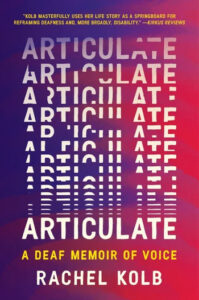
From Articulate: A Deaf Memoir of Voice by Rachel Kolb. Copyright © 2025 by Rachel Renee Kolb. Excerpted by permission of Ecco, an imprint of HarperCollins Publishers.

Rachel Kolb
Rachel Kolb is a writer whose work explores communication, language, and disability as central components of human experience. A graduate of Stanford University, she was the first signing deaf Rhodes Scholar at Oxford before receiving her PhD in English literature from Emory University and then completing a junior fellowship in the Society of Fellows at Harvard University. She has been published in the New York Times and the Atlantic, among other venues.