Personal Yet Systemic: On Antiblackness as a Social, Historical and Cultural Phenomenon
Patrice D. Douglass Considers the Distinct Forces That Underpin Anti-Black Racism
ANTIBLACKNESS
(noun)
1. that which engulfs Blackness with inescapable violence
2. a set of relations that mark and position Blackness as the nadir of sub-human or non-human qualities
3. Structural. Modern. Gratuitous
“Slavery and colonialism ushered antiblackness into modernity by using violence as the means to (re)produce Black captivity as unremarkable.”
4. a complex interplay of social, political, institutional, and metaphysical forces
5. the quality of (in)distinguishing Blackness
6. global, not geographically specific
7. Like air. Pervasive.
Forceful “Antiblackness is global.”
8. constant yet shifting
9. particular and nonspecific
10. “not at all…gender-specific” yet sexually sutured
11. illogical and anagrammatical
Antiblackness gestures to describe the indescribable. As a concept it seeks to connect and valorize seemingly disparate events as the products of a larger singular structure. As an analytic it refuses the progress narratives of liberalism. Instead, antiblackness surveys the constancy of Blackness as a site of dereliction despite assumed social and political advancements. As a term it refuses the jubilee of formal emancipation, various forms of decolonial revolutions, the acquisition of extended rights for Black people, and the neoliberal placement of Black bodies in positions of power. Furthermore, antiblackness clarifies how across subjective differences marked by age, class, gender, sexuality, ability, national origin, and so on Blackness is over-exposed to violation. Antiblackness expands beyond understandings of racism, which assume a misalignment between beliefs and/or actions and reality by antagonizing the insistence that there is a truth of Blackness that is uninhibited and defined without violent intrusion.
*
On June 2, 2020, I receive a text. “Our country needs a heart transplant,” it says, continuing, “I keep hearing George Floyd calling ‘mama’…I want the world to see and love your son like you do.” I am standing looking at my six-year-old son as he plays with his trains, staring back at my phone in utter disbelief. The text is from a neighbor. During the weeks prior, she collected phone numbers from moms in our subdivision to arrange socially distanced outings to escape the madness of quarantining with children. This is what she had my number for, but instead she has sent me a death omen about my son. Somehow saying my son will die an unremarkable death does not make the world flinch. This is antiblackness.
Antiblackness gestures to describe the indescribable. As a concept it seeks to connect and valorize seemingly disparate events as the products of a larger singular structure.
Before I can respond there is a knock at my door. I open the door and there stands another white woman neighbor. I’ve only seen her once in passing, where we exchanged very brief hellos. She is holding a card and some handpicked flowers she’s gathered from her garden on the way over. The white and purple flowers are arranged in a recycled Bonne Maman jam jar. Her sons are playing behind her in my yard. She begins to speak: “You are Patrice, right?” I look at her curiously. She continues, “What’s going on in the world right now makes me so sad. It’s all so overwhelming. What is happening?” She begins to cry. I am unsure of what the “what” is. The very recent murder of George Floyd, or the mass uprising happening around the world in response? I assume she means the latter. Regardless of what she is referencing, I do not have an ounce of sympathy for her tears.
My son walks over to see who is at the door. I push him away and gesture for him to return to playing with his trains. By now, I want to banish her from my porch, but I say nothing as she continues rambling about “the world needing to come together.” I accept the card and flowers and express to her that the world is different for different people and that in times like these there is no “we.” She looks at me curiously and says she needs to go. She then says our sons should play together. I respond, “We’ve lived here for two years” and close the door.
Inside the card she has written, “Black Lives Matter! If you need a friend in the neighborhood my family is here.” Again, we have lived here for two years. No one has thought to stop by until they needed a white racial catharsis.
I toss the card in the garbage and pour bacon grease on it. My own sort of Black catharsis, if such a thing exists. I also chuck out the jam jar and flowers. I say that no one should eat this much sugar. Sugar, of course, has been propelled into mass availability by the bodies of the enslaved.
My son asks me who those people were. All I can muster is, “They’re neighbors, honey,” to which he replies, “But I’ve never seen them before.”
I say to my husband, “This is too much. We need to move.”
*
Is this antiblackness? The question arises out of an ethical dilemma. A question of what conditions that which I feel and do. Antiblackness encompasses an assessment of action imposed upon Black people. It queries, “What will these white people do to my flesh today? How deep will they cut?” Although Black people may all feel and react differently to the violent thrust of antiblackness, Black response is not the issue or the point of assessment. The concern is with trying to articulate a violent relation (how people are conditioned and positioned in that world) that is so foundational to the constitution of logic and life itself that uttering the possibility of the death of a Black child is seemingly unremarkable. Placing the Black child at the forefront of death is a hallmark feature of antiblackness. Antiblackness reserves no protected class.
*
The predicament of the Black child illumines the precarious plight of all Black life. The spectacular exposures of Black death and dying gleam the surface of what is lived mundanely and goes so often unaccounted for.
The 16th Street Baptist Church bombing is just one example where antiblackness thrusts Black children onto the precipice of death. On September 16, 1963, at a minute just shy of the eleven o’clock Sunday service, a bomb exploded in the basement of the 16th Street Baptist Church in Birmingham, Alabama. This bomb killed four little Black girls. Their names: Addie Mae Collins, Denise McNair, Carole Robertson, and Cynthia Wesley. Sarah Collins, sister of Addie, survived; however, she lost her right eye. This violent act was plotted and executed by the Ku Klux Klan. These Black children were the (un)intended victims.
Although Black people may all feel and react differently to the violent thrust of antiblackness, Black response is not the issue or the point of assessment.
This bombing was not the first or last murder of Black children. Nearly a decade prior, Mamie Till-Mobley made the unbearable decision to display her murdered and disfigured child, Emmett Till, in an open casket for the world to see. The 2012 gunning down of seventeen-year-old Trayvon Martin by Latinx vigilante George Zimmerman catalyzed the movement for Black lives better known as Black Lives Matter, the same inscription written in the card gifted to me by a neighbor. Yet as Martin’s murder made explicitly clear, his suffering, like all suffering (re)produced by antiblackness, lacks a consensus on its meaning.
The murder of Black children under conditions where people “dispute” whether these were justifiable murders requires a complex understanding of historical, social, intimate, and perverse violent arrangements. The spectacular display of the individual dead Black child is not an anomalous exposure. Rather the Black child signifies the grip of illogical forces. What happens to Black children is but a glimpse of the terror and haunt of Black existence. Antiblackness as a theorem holds space for the children who died aboard and overboard slave ships, the Black babies beaten from the bellies of female slaves, the Black deaths that occur during pregnancy, birth and postpartum, the stolen and disappeared Black children of modernity, the Black futures that never arrived.
See: Dispossession, Fungibility
______________________________
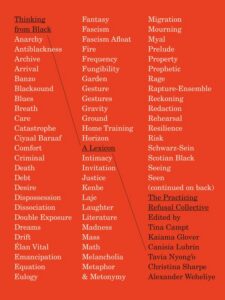
From Thinking from Black: A Lexicon by The Practicing Refusal Collective. Copyright © 2026. Available from FSG Originals, an imprint of Farrar, Straus and Giroux.

Patrice D. Douglass
Patrice D. Douglass is Assistant Professor, Gender and Women's Studies, University of California, Berkeley.