Tom Junod on Finding the Right Trick
A Lesson from a Long Career of Magazine Writing
This first appeared in Lit Hub’s Craft of Writing newsletter—sign up here.
You have some tricks.
You’re a magazine writer, after all—you have to write a lot of different kinds of stories, and sometimes tricks are what gets you to the end of them. Feeling too prissily self-conscious about the quality of your prose? Curse your f-ing head off, then remove all the blue language before you hand in the story. Feeling your story becoming impersonal? Write it as a letter to your editor, the way Tom Wolfe wrote “The Kandy-Colored Tangerine-Flake Baby,” or better yet, write it as a letter to the person you’re writing about. The story needs to be in the third-person? Write stretches of it in the first, and then do the opposite when the story is supposed to be first-person in the first place. Oh, you’ve got a million of them, because if there’s anything you’ve learned from your decades writing for magazines, it’s this: tricks work. They break up logjams. They take away your excuses. They banish boredom and encourage you to be counter-intuitive. They might be artificial, but they allow you to find your genuine voice. They get you to the end of the story.
But now your situation is different, because you’re not writing a magazine story. You’re writing a book, your first, and so you’ve spent a lot of your days at the desk unlearning what your years as a magazine writer have taught you. It’s taken a long time. How long? Nine years. You’ve been working nearly nine years on your book, and slowly, achingly, you’ve been coming face to face with one simple truth: books are different from magazine stories. Your tendency to explain, to stop and tell the reader what your story is about in an elegant “nut graf”? That doesn’t work in a book; indeed, it’s a ruinous instinct. And all your tricks? They don’t work either. They get in the way. They distract. They make you think you’re getting somewhere when you’re not. Worst of all, they really are artificial, and your book is a memoir that will live or die by dint of its authenticity.
And yet…you have to get to the end of your story, because, well, you finally have an ending. You’ve been writing the book for the last nine years, but you haven’t just been writing it; you’ve also been researching it, reporting it, investigating it, doing interviews for it, diving into archives for it, finding documents for it, even surrendering your DNA for it, all in the name of finding the truth about a family secret that has become your obsession. And here’s the deal: you’ve found what you’ve been looking for! You’ve succeeded! You’ve come to the end of your quest, and now, somehow, you have to find a way to give voice to all of that—the doubt, the diligence, the determination, the details, the drawn-out search that has led, at last, to a sudden and shocking discovery. But how? You’ve spent nine years writing the first two-thirds of your book. You have to write the last third—you have to finish—in six months.
If there’s anything you’ve learned from your decades writing for magazines, it’s this: tricks work. They break up logjams. They take away your excuses. They banish boredom and encourage you to be counter-intuitive.
You try not to panic. You’ve got this, you tell yourself—you’ve come so far since you’ve started writing the damned thing, basically turning yourself from a magazine writer to a memoirist right there on the page. But that’s the problem. The book is not just a memoir anymore—or at least not just a memoir of your father, which is how it began. It’s a memoir of your digging and your legwork, a memoir, that is, of your journalism, and so the last part of your book is different kind of book altogether.
In some ways, you’re back to where you started, a thought that scares you to death. You’ve worked so hard to reinvent yourself by inventing a voice suitable to your task—a voice that’s mostly present tense, alive and alert to the moment, and determined to be non-explanatory and non-analytical; a voice that summons some of your father’s voice in order to serve him up to the reader, whole. It’s your achievement, that voice, and you don’t want to surrender it to the investigative reporter coiled inside you in order to meet your perhaps impossible deadline.
But then you think about where that voice came from and how your first heard it. You were writing the book you’d wanted to write all your life and it was shriveling up and dying right before your eyes. You were writing, sure; but you were writing to no end, and you had accumulated 230,000 words about your father without ever quite capturing what made him so terrifyingly alive. So you tossed them, the nearly quarter of a million words you’d spent three years compiling, and started over, with the memory of a little boy waking up to the sound of his father waking up and wondering why the man he loved so much also scared him so much.
That little boy, of course, was you, and the voice you heard from him has stayed with you for the entirety of your second draft, growing up as you grew up. You wrote the first part of book from memory, the second from your journals. The third part will be drawn from your reporting, your interviews and document dives, your dogged gumshoe side….but it will still be you and only you, so why are you so afraid that you will lose the voice you created from memory, the voice that, after all, has served you so well your entire writing life?
And that’s when it hits you: you have a trick for this. It’s one of your favorite tricks, one that allows you to personalize the seemingly impersonal and to dramatize the dullness of mere legwork. Yeah, yeah, sure: tricks reek of magazines, and if you’ve learned anything over the last nine years, it’s that tricks don’t work when you’re writing books. But that’s the thing about tricks—they don’t work until they do. And so you start writing the final third of your book in the second person. It’s your favorite way to write, and as you’ve told anyone who will listen, it’s the easiest way to write, because writing to yourself somehow allows you to dispense with yourself, and just f-ing get on with it. There’s no such thing as writer’s block in the second person. There’s no crippling self-consciousness. There’s just you… and so there’s just me, a child born to find out his father’s and his family’s secrets writing about what he finally found.
I started my memoir about my father in the late summer of 2015. On the last day of January, 2024, I took a leave from my job as a journalist at ESPN to complete the final third of my book. I began writing in the second person about a month later, and on August 12, 2024, I turned the completed draft of In The Days of My Youth I Was Told What It Means to Be a Man to my editor at Doubleday, Bill Thomas, with the second-person rigorously edited out, the thousands of yous changed back to the more suitable, and readable, I. You see, that’s the problem with second-person: it’s more fun to write than it is to read. It’s just another trick, another way to reach the end, and I’ve got a million of them.
__________________________________
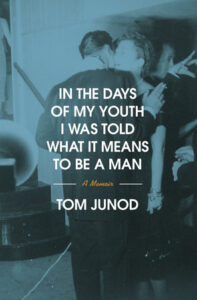
In the Days of My Youth I Was Told What It Means to Be a Man by Tom Junod is available via Doubleday.

Tom Junod
Tom Junod is a senior writer for ESPN, where his work has won an Emmy and the Dan Jenkins Medal for Excellence in Sportswriting. He is a two-time winner of the National Magazine Award for Feature Writing and a winner of the James Beard Award for essay writing. Previously, he was a staff writer at GQ and Esquire. The film A Beautiful Day in the Neighborhood was based on his article in Esquire. He lives in Atlanta with his wife and daughter.