On the Literary Afterlife of Japan’s First Working Woman Writer
Translator Bryan Karetnyk Considers the Work of Higuchi Ichiyō
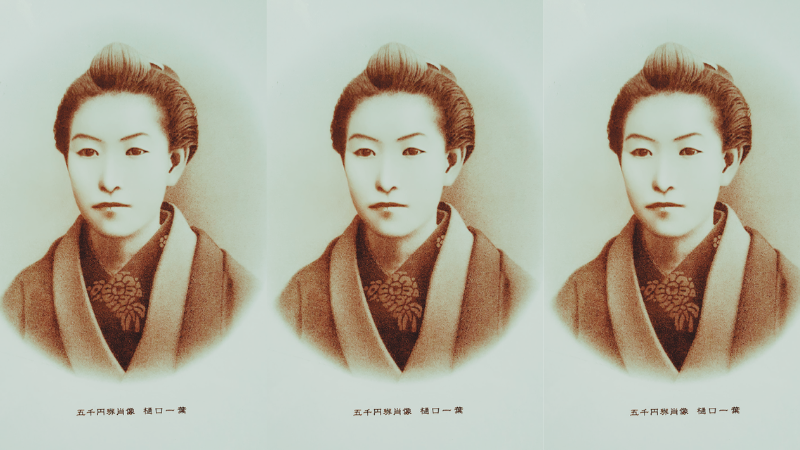
In February 1894, Higuchi Ichiyō was desperate. Aged only twenty-one and poverty-stricken, she visited a celebrated fortune-teller, hoping that he might change her luck. “I was born in the year of the monkey, on the twenty-fifth day of the third lunar month,” she told him.
This is the sixth year since I lost my father, and I find myself tossed upon the raging waves of adversity in this floating world—yesterday to the east, tomorrow to the west. Whereas once I dwelt above the clouds, amid the moonlight, passing my days in refined pursuit of leisure, I find myself now living in squalor, with an ageing mother to support and a younger sister who knows nothing of the world. Until last year, my life seemed like that of any other girl.
Her tale was no exaggeration. She was, in those days, struggling to eke out a living, running a stationery shop with her mother and younger sister in an area known as Ryūsen-ji, a down-at-heel neighborhood situated behind Tokyo’s red-light district, the Yoshiwara—a precipitous fall from the life she had formerly known.
Born to a humble family in the twilight years of the shogunate, Higuchi Natsuko (as she was born) was the fourth child and second daughter of a man with scholarly inclinations, who as a farmer had come to the capital to seek both fortune and rank. Through astute political maneuvering and financial positioning, her father, Noriyoshi, managed to have himself adopted into a samurai family in 1867, only for the class to be abolished by the sweeping reforms of the Meiji Restoration, which began in 1868. Enough money remained, however, to send his favorite daughter in 1886 to the Haginoya, a prestigious private school, where she studied classical poetry alongside the daughters of aristocrats and noblemen. Yet the times were changing, and, under the new Meiji administration, the status and wealth of former samurai decreased; unable to keep pace with the rapidly developing economic environment, the girl’s father made a series of imprudent investments, which, by the time of his death from tuberculosis in 1889, hastened by his grief over the death of his eldest son two years previously, ended up ruining the Higuchi family and lumbering his beloved daughter with the burden of financial responsibility. And so, hounded by creditors and distressed by mounting debts, the remaining family had to leave their formerly genteel surroundings for the gritty, unsentimental shadows of the Yoshiwara.
It may have been the will of Heaven that Ichiyō died soon after that desperate visit to the fortune-teller, but time has proved that her efforts were far from having been in vain.
Despite all this, and despite having been jilted by her fiancé shortly after her father’s demise, the young woman remained undeterred in her ambitions. Through her education and her father’s encouragement, she had nurtured a vocation for literature and was determined to make a career for herself in the bundan, Japan’s literary elite, not least after having seen the success of her former classmate Miyake Kaho, whose novel Warbler in the Grove (1888) had won widespread acclaim, to say nothing of substantial royalties for its author. Determined now to leave her mark on the literary establishment and resolved to support her family through her writing, she adopted the literary pseudonym Ichiyō and, with the help of her mentor (and sometime object of her unrequited affections), Nakarai Tōsui, made her debut with a short story entitled “Flowers at Dusk” in 1892. Even so, the path to literary acknowledgement would not run straight. Ichiyō’s was a tale of perseverance—through poverty and financial struggle, through personal ill health, and through the professional and social limitations that were imposed on her by virtue of her womanhood in male-dominated Meiji Japan.
The advice Ichiyō received that day from the fortune-teller was, ironically, predictable: Resign yourself to the will of Heaven. Yet what Heaven had ordained for Ichiyō was as tragic as it was perhaps heroic. As Ichiyō lamented her lot, she observed: “I wish I had spent this fleeting life as the moon, shining brightly before it wanes, or as a cherry tree, in blossom for its short season.” How prophetic those words were, for a mere two years later she would be dead from the same disease that had taken her father and brother before her. And yet, by that same stroke, she would also leave behind her a monumental body of work that encompassed some four thousand poems, an extensive diary that so many critics have likened to a novel in itself, a scattering of essays and, crucially, twenty-one short stories, which, bridging as they do the classical and the modern, were pivotal in the development of modern Japanese literature. Truly, her example was the epitome of fleeting genius.
Brief though Ichiyō’s life was, her perseverance and dedication to literary art was consummate. Within the short window of her career, her style underwent several major shifts as her writing matured rapidly. “A Snowy Day” (1893) is a gem of Ichiyō’s early work. This brief, impressionistic tale of infatuation and the folly of youth is vested in all manner of classical allusions and rich, multilayered poetic imagery and symbolism—all hallmarks of Ichiyō’s rococo early style. As a vista of a snow-clad landscape brings the young pseudo-autobiographical narrator to reflect on the past awakening of her maidenly desire, she is ultimately forced to confront her own disenchantment as well as the sorrows and regrets to which her passions have led her. Here, against the intimate interiority of this elegant narrative, untamed urges clash with Confucian ideals of filial piety and Buddhist undertones of the suffering caused by worldly attachments.
Ichiyō has already more than vindicated herself, appealing to the deepest and most humane of people’s emotions, depicting unflinchingly what lies true in their hearts.
Translating Ichiyō’s works in Troubled Waters has been both a privilege and a passion. Each of her narratives is written predominantly, if not entirely, in classical Japanese: that is, a strictly literary form of the written language that even in the Meiji era had maintained, unlike the vernacular Japanese spoken in Ichiyō’s day, all the inflections and conventions handed down from the Heian period across a millennium. To draw a more meaningful comparison for readers less familiar with Japanese, it is, with all the necessary provisos, as though the writers of the late-Victorian era still wrote in the English of Chaucer. Even so, Ichiyō’s prose, from beginning to last, stands out among that of her peers for its heavy debt to classical poetry and technique, so replete is it with the rhythms and cadence of traditional Japanese verse, to say nothing of its profusion of poetic allusions and extensive use of punning. It is also written with classical punctuation, whereby a paragraph or even an entire story might be written across the duration of a single period, the narration mingling with character voices that ifntrude unannounced. It is for this reason, and in the hope that the reader might have a more proximate experience of reading Ichiyō, that I have preserved her own idiosyncratic paragraphing and dispensed with quotation marks.
Even at the outset of her literary career, Ichiyō wondered about posterity. “As someone who has taken up the brush, I cannot allow myself to produce work that will be thrown away after a single reading,” she wrote of her literary apprehensions as early as 1891,
Human nature may be fickle. And though ours is a world in which what today brings joy may tomorrow be discarded, yet if I make my appeal to true emotions and depict that truth faithfully, then will Ichiyō’s scribblings not have some worth? It is not that I desire splendid apparel or stately mansions. But for the sake of one fleeting moment, I do not wish to tarnish a name that may last a thousand years. […] Even so, if all this ink and paper be spent in vain, I shall look upon it as the will of Heaven.
It may have been the will of Heaven that Ichiyō died soon after that desperate visit to the fortune-teller, but time has proved that her efforts were far from having been in vain. Ichiyō has gone down in history as Japan’s first woman writer to earn a living from her writing, and her legacy, which redefined Japanese literature for the modern age, lives on today. Her life and works are adapted for stage and screen, and her diaries have been serialized on radio. Many of Japan’s leading writers, including Enchi Fumiko, Tawada Yōko, Itō Hiromi and Kakuta Mitsuyo, have produced translations of her works into modern Japanese, while others such as Kawakami Mieko have gone so far as to claim Ichiyō as their greatest influence. Those thousand years may still be a way off, but one thing is certain: Ichiyō has already more than vindicated herself, appealing to the deepest and most humane of people’s emotions, depicting unflinchingly what lies true in their hearts.
______________________________
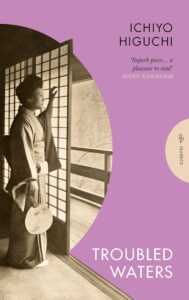
From Troubled Waters by Higuchi Ichiyō, translated from the Japanese by Bryan Karetnyk. Copyright © 2026. Available from Pushkin Press.

Bryan Karetnyk
Bryan Karetnyk is an award-winning British writer, critic and translator. His recent translations from the Russian include major works by Gaito Gazdanov, Irina Odoevtseva, Boris Poplavsky and Yuri Felsen. He is the editor and principal translator of the landmark Penguin Classics anthology Russian Émigré Short Stories from Bunin to Yanovsky and is a regular contributor to the Times Literary Supplement and the Financial Times.