
The Digital Economy is Destroying Our Lives and Our Planet—and AI is Only Going to Make It Worse
Matthew Cole Raises the Alarm
Our world has been flooded by a deluge of digital platforms, their ceaseless flow submerging our daily lives. From the planetary infrastructures of Amazon, Meta, Google, Apple, WeChat, and Alibaba, to the on-demand labor of Uber, Didi, Upwork, and Deliveroo, we’ve become networked datums in digital portfolios. The infrastructures of capitalism now flow through cables and cloud servers that states have been slow and economically disincentivized to regulate. We are all paying rent in the internet of landlords. This is an evolving machinery in which datafication facilitates dispossession.
Many have attempted to name the current era: a “second machine age,” the “fourth industrial revolution,” “industry 4.0,” “platform capitalism,” or “technofeudalism,” among others. The techno-optimism of the 2000s has evolved in increasingly dystopian directions. Today, environmentally destructive, data-thieving, “generative” AI companies such as OpenAI, Anthropic, and DeepSeek deskill human labor and undermine our very cognitive capacity. Transformations are occurring in nearly every sector and nearly every country, around the world. As platforms digitally colonize and commodify an ever-greater portion of our time, it becomes harder to find the cracks in capitalism where human culture can flourish and resistance can grow. To fight this techno-capitalist inertia, it is necessary to understand how paid and unpaid labor have changed through it.
Our current era contrasts with its historical antecedents: the post-war “golden age” of capitalism, known as the Fordist era (1945-75), which gave way to its undoing in the neoliberal, post-Fordist era (1975-2005). The Fordist era was characterized by robust manufacturing exports from rich countries alongside strong organized labor and institutions that redistributed wealth and protected social need from the excesses of capitalism in the West. The post-Fordist era saw deindustrialization in rich countries, the industrialization of many low- and middle-income countries, an erosion of social welfare and labor protections, and increasing inequality. Capital and its representatives became significantly more powerful.
Like the power looms, automated threshers, and robotic assembly lines before them, platform technologies are not neutral.
Financial markets were deregulated throughout the 1980s, supply chains were further internationalized, and public assets were privatized, hollowing out state capacity. Seventeen OECD countries witnessed a fall in the labor share of income from 75 per cent in the mid-1970s to 66 per cent in 2005, and it has only fallen further since. This Wild West of neoliberal globalization was the condition of possibility for platform capitalism to emerge as the hegemonic force it is today.
In the early 2000s, as home and mobile datafication provided computing and ICT capacity beyond specialized industrial applications, tech companies took aim at expanding their power through a wealth of networks. Online and offline machines congealed with natural life, as “Cyber-Physical Systems,” or “the seamless integration of computation and physical components” grew into digital ecosystems. A surge of investment and innovation helped this emerging paradigm rise to dominance. Research shows a concentrated “open-ended burst” in technological development from 2006 to 2017, which corresponds to a rise in ICT investment from 2005 to 2015 among OECD countries, as well as the acceleration of AI-related patent-making since 2005. This decade also saw the acceleration of cloud connectivity, enabling web domain expansion and the expansive datafication necessary to train more powerful AI systems.
As technological access and capacity expanded, so too did use-cases. Platformization subsumed ever more activities to the algorithmic calculations of marketized efficiency. Entirely new industries emerged as commodified services. In national accounts, platforms are classified under the technology and consumer services sector, which comprised 16 per cent of the top-twenty companies by market capitalization in 2009. By 2018, this surged to 56 per cent. Four of the top-ten firms in 2018—Amazon, Alibaba, Facebook, and Tencent—were not even in the top 100 in 2009. Today, Apple, Amazon, Meta, Google, Microsoft, Tencent, and Alibaba constitute seven of the ten most valuable companies.
A triad of structural transformations has accompanied the technological burst. First, changes in intellectual property rights anticipated some of the needs and protections in this datafied landscape. The World Trade Organization’s 1995 Agreement on Trade-Related Aspects of Intellectual Property Rights (TRIPS) established an arbitration framework for stolen patents and other intellectual property. The 2008 changes in the System of National Accounts (SNA) ensured intellectual property and intangible assets were included in various national and international accounting frameworks. This changed the code of capital to privilege the value of intellectual monopolies. Second, while the US was the global leader in this technological revolution, China rapidly caught up to rival US dominance, especially in AI. Third, tech oligarchs’ platforms have become increasingly powerful relative to the public infrastructures of states, since the latter have become utterly dependent on the former, even at the level of national security.
Like the power looms, automated threshers, and robotic assembly lines before them, platform technologies are not neutral. They are designed to allow management to wield unilateral power over production and scale rapidly to become infrastructural, thereby extracting monopoly rents. Failing that, platforms are sold to a larger competitor for a hefty sum, a strategy has been termed the “new economy business model.” It is a distinct monopoly-oriented approach epitomized by tech capitalist Peter Thiel’s mantra “competition is for losers.”
Platform labor is typically organized according to a core-periphery system whereby salaried, professional workers run the company with equity options, while a vast army of low-paid and precarious workers generate value. For example, Google employees are typically software engineers and other professionals with high salaries. However, the people who work to train the algorithms by moderating content on YouTube or correcting the generative AI output of Gemini work as self-employed subcontractors overseas. This dynamic is epitomized by labor platforms such as Uber, whose accounts employees, for example, make around £44,000 a year for a normal 37.5-hour week, while drivers work up to fourteen hours a day and can earn below minimum wage after costs. Platforms delegate the illusion of control and trade on a libertarian myth to obscure the autocratic reality. Their rapid and unchecked spread has had dire consequences for workers and society.
*
What do platforms do to the boundary between paid and unpaid labor-time? It depends on the platform and the context. Uber, Deliveroo, Upwork, Doordash, Meituan, and Didi cut across different sectors, but there are really only two types of platform. We can call the first type “ground” platforms, as the services they provide—such as food delivery, cleaning, taxis, and so on—require the work to be done in a particular location. The second type we can call “cloud” platforms, since the work does not need to be performed at any particular location. Cloud platforms provide services from microtasks like data labelling to freelance design and copy-editing. In 2021, the International Labour Organization (ILO) estimated there were at least 777 digital labor platforms operating globally.
Digital labour platforms tend to use self-employment contracts and piecework systems, which result in insecurity, exploitation, and wage theft. “Self-employment” (UK) or “independent contractor” (US) status effectively treats every digital platform worker as an individual business without any of the advantages that real businesses have. This classification is used to deny workers the right to collective bargaining, sick pay, or any guaranteed income at all. In rich countries with more formal labor markets, such as the US and the UK, this has catalyzed the decades-long erosion of social protections under neoliberalism. Attacks on statutory rights are pushing these countries back to conditions reminiscent of the late nineteenth century, when poverty and slums were the norm for a working class with no social safety net. There has, however, been a counter movement in less-rich countries towards an expanded formal labor market via platforms themselves. Still, data and intellectual property are siphoned off to rich countries, echoing centuries-old dynamics of colonial extraction.
*
The US has been at the vanguard of the tech boom, with hundreds of ground platforms, covering nearly every service: dog walking, child-minding, housing, cleaning, ride-hailing, warehousing, food delivery, snow ploughing, and more. In 2021, the Pew Research Center estimated that some 16 per cent of American adults, roughly 41.3 million people, have earned money through these platforms. Nonetheless, very few of these companies provide reliable, fair pay or protections for workers. Many have been challenged for wage theft. Amazon US, for example, recently agreed to pay more than $61.7 million to settle allegations that they cheated their drivers out of nearly a third of their tips from customers over two years.
Platforms delegate the illusion of control and trade on a libertarian myth to obscure the autocratic reality. Their rapid and unchecked spread has had dire consequences for workers and society.
A 2023 study by the Oxford-based Fairwork project found that only two out of thirteen US platforms could ensure their workers earned at or above the minimum wage after costs. These were Alto, a ride-sharing platform, and Bluecrew, a staffing platform, which classified their workers as employees. The eleven others—Papa, DoorDash, EatStreet, GrubHub, Handy, Instacart, Lyft, Shipt, TaskRabbit, Uber, and Wonolo classified workers as “independent contractors” rather than employees. They could not guarantee that workers earned at least the local minimum wage after costs, let alone a living wage. Ten out of thirteen platforms scored zero points on Fairwork’s dashboard measuring guaranteed minimum thresholds of decent work.
Most platforms use an algorithmic pay and job-allocation system. This is essentially a way to calculate the lowest rate that workers will accept, and the highest rate consumers will accept. These algorithms factor in variables such as a base rate, distance, tolls, surcharges, surge multipliers, booking fees, route adjustments, promotions, time of day, and even the behavior of individual workers and consumers. While the formula varies, the general structure is as follows: (base fare + time rate + distance rate) × (surge multiplier) + tolls and fees. The so-called “dynamic pricing” (the US Federal Trade Commission has called it “surveillance pricing”) piecerate model was pioneered by Uber and is spreading to other industries such as retail.
Driver unions have pushed back against the asymmetry of information this model creates. In response, Uber introduced “upfront pricing” in 2022, which provided drivers with a base fare for each job. Yet the calculation of the price is anything but upfront. One driver in California claimed it was “a pay cut in disguise” that lowered base pay while not increasing fares for longer trips adequately. Drivers rely on surges (multipliers for rates) and “quests” (completing a set number of rides within a week for additional wages of $50 to $200) to make up for low rates. According to a member of the union Rideshare Drivers United, “everyone has different levels of surge at any given time. If the median surge is 10, someone else might have 8.” Drivers claim that quests are not consistently offered, that bonuses vary, and that Uber reduces the ride allocation rate near the end of their quest, taunting them with the prospect of losing their “bonus.” This bargaining asymmetry facilitates what law scholar Veena Dubal has called “algorithmic wage discrimination.”
According to Malang Gassama, a former driver and New York Taxi Workers Alliance (NYTWA) member, Uber and Lyft stole “at least $25,000” from his pay. In their terms of service, Uber claimed that only the platform’s commission would be subtracted from driver fares, but the platforms actually deducted sales taxes and Black Car Fund fees (8.875 per cent and 2.5 per cent of the ride price, respectively) from drivers’ pay instead of charging passengers. Uber also claimed that drivers could charge passengers for tolls, taxes, and fees despite providing no means for them to do so via the Uber Driver app. Lyft employed a similar tactic, skimming an “administrative charge” of 11.4 per cent equivalent to the sales tax and Black Car Fund fees from New York drivers.
There have been legislative attempts to curb platforms’ exploitative practices in the US. For example, California legislation (Proposition 22) guarantees platform drivers 120 per cent of the minimum wage in the area in which they are driving. However, this only applies to “engaged time,” which the platform defines solely as driving time; no waiting time, transit time, breaks, maintenance costs, or the like are included. The Rideshare Drivers United (RDU) trade union found that drivers were making just $6.22 per hour on average after expenses. “No one believed they were making so little,” according to Nicole Moore, a driver and leader of the RDU, although the numbers did not lie.
Platforms are designed to have a large reserve of workers logged in at any given time, which reduces both labor scarcity and the bargaining power of workers, increasing the likelihood that workers will accept low pay. According to studies, delivery workers spend 39 per cent of their time waiting or “on-call.” As a result, they can’t earn a living from just one platform. Many must multi-app, though this practice is greatly overstated by the platforms themselves. In NYC, while 56.3 per cent of delivery workers work for more than one app, only 17.7 per cent of working time is logged concurrently. In 2022, drivers for food delivery platforms Uber Eats, Grubhub, DoorDash, and Relay were revealed by New York’s Department of Consumer and Worker Protection to be earning half their income in pay, and half in tips. These workers were paid an average of $14.18 per hour with tips, and just $7.09 per hour without. For a food order of $33.09, only $4.32 is paid to the worker (plus a tip of $4.11), while the platform receives $8.54. Delivery workers’ hourly expenses are $3.06, reducing their take-home pay to $11.12 per hour with tips and $4.03 per hour without.
If Uber Eats, Grubhub, DoorDash, Relay, or any other ground platforms were required to pay an NYC worker as if they were an employee in 2022, the hourly wage would have been $21.09 per hour, or triple the base rate they made before tips. This would include at least $15 an hour plus up to fifty-six hours of paid leave per year under the NYC Paid Safe and Sick Leave Law, unemployment insurance, workers’ compensation insurance, employer coverage of half the mandatory 15.3 per cent Medicare and Social Security contribution, and shared liability for failure to pay. The fact that there was a legal dispute over these entitlements, with the workers and the State of New York on one side and the platforms on the other, demonstrates the political stakes of their struggle.
______________________________
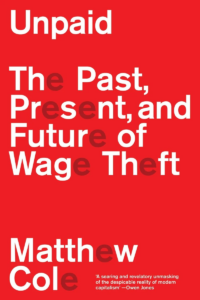
From Unpaid: The Past, Present and Future of Wage Theft by Matthew Cole. Copyright © 2026. Available from Verso Books.

Matthew Cole
Matthew Cole is an Assistant Professor of Technology, Work and Employment at the University of Sussex and a life-long trade unionist. His research revolves around the political economy of work and technology, with a particular focus on wage theft. His writing has been published in Jacobin, Novara, Vice, OpenDemocracy, the Independent, Salvage, and in various academic journals.