To Be Honest in Poetry Right Now is to Embrace the Abstract, Negative, and Weak
An Essay and Poem by Xuela Zhang
Witnessing the poor quality of transnational understanding at a time many cannot be more connected, I’m frustrated by the miraculous forms of self-congratulations in transnational poetry and poetics, often justified by a poetics of righteousness. What I have learned after almost 18 years growing up in China and almost 18 years studying and living in America: nobody can really have a “world view,” and nobody will ever deserve one.
I don’t think creative writing should ever strive for righteousness. Creativity should be used to challenge the simplicity, laziness, and opportunism of certain performances of righteousness. Human beings, individually, will never possess flawlessness in their judgment of cultural others or selves even if they think they possess flawlessness in their intentions—and I am afraid even the latter is a myth.
We want to either like or dislike cultural others or selves so that cognitively we are not overwhelmed. We want to endorse or chastise things so we feel like capable thinkers with a personality to hold onto in a party, a paper, or a poem. We want others to challenge us, but only in a way that we can process without feeling threatened. We want to believe we like being challenged, but most of the time, we can only handle being challenged by people who challenge us in a way that we know can be eventually rewarding, even marketable.
In globalization, concreteness in English is comforting.
I am nauseated by the certainties transnational poets are expected to keep performing. We are induced to be poets who can be constantly righteous—that our sources, theories, or archives will justify a cultural message and all we need to do is to poeticize a message that is worthy to be poeticized. The result: many passionately say things on the page they don’t actually feel enough—sometimes don’t even know enough. What many are actually feeling or knowing enough: how talking about justice in the way justice is expected to be addressed is what will feed them. To salvage the integrity of poets, activism in poetry must own its creative nature. The activism of poetry is in the creativity, however furthered by research, not in the research, however patched up with creativity.
In my debut collection To Compare, I struggled to put transnational thoughts back in contact with transnational feelings, the feelings however inconvenient for the thoughts to be neat enough for righteousness. If my poems can be regarded as abstract, negative, or weak, then I have been real in my work, since those are exactly the qualities of my feelings as a Chinese citizen in America through the time of Trump, Covid, and Trump—abstract, negative, and weak.
In globalization, concreteness in English is comforting. A clear image, even when sad, is a comforting image. Concreteness creates the feeling that others, including their sadness, can be accessible, and we can get access as long as we are curious. I don’t think so. To me, the abstract, the negative, and the weak feel most honest. At the end of the day, we know we won’t be comforted by premature concreteness. We have to struggle for what is the most difficult to show, but the most necessary to share in globalization.
*
Quarantine
The sea had a way of turning.
It made recoiling
a slow and constant sensation.
The entire shore breathed
regardless of tension,
an endless version of the pelvis.
She said you could not see
this muscle, but it would move.
Imagine this part of you
sucking up a piece of tissue.
Very counter-intuitive, she added.
You caught yourself breathing
carefully, but wrongly.
He insisted on talking; you looked
up, and became absorbed
in the pink, rubbed clouds.
Elsewhere, it was experienced
as “the tornado.” Was it unbelievable
to see one house destroyed,
and the one next to it
untouched, asked the anchor.
Yeah, unbelievable.
__________________________________
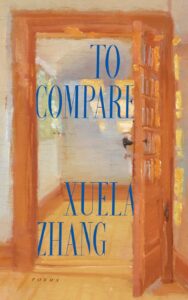
To Compare by Xuela Zhang is available from Fonograf Editions.
Xuela Zhang
Born and raised in China, Xuela Zhang writes in English and Chinese. Her poems have appeared in Poetry, Oxford Poetry, Gulf Coast, Bennington Review, PROTOTYPE, and 诗刊Shikan, among others. She received her MFA in poetry from Columbia University and PhD in Comparative Literature from Washington University in St. Louis.