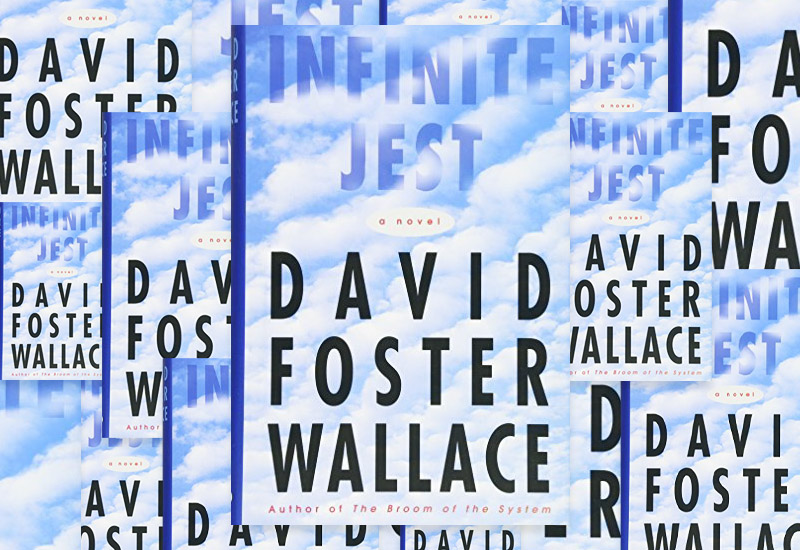
This Week in Literary History: David Foster Wallace’s Infinite Jest Was Published
And the Takes Began
This first appeared in Lit Hub’s Literary History newsletter—sign up here.
This week, David Foster Wallace’s Infinite Jest turns 30. When it was published, on February 1, 1996, the 1,079-page novel, for which you really need three (3) bookmarks to read properly, was, remarkably, an era-defining sensation—“it was more than a best-seller;”as Hermione Hoby wrote recently, “it was a phenomenon, a widespread, must-read accessory and experience,” and Wallace was immediately vaulted to literary stardom (something that did not exactly suit him).
In recent years, however, the book has become shorthand for a certain kind of pretentious, performative, male-coded lit bro, something certainly helped along by revelations about Wallace’s abusive behavior toward fellow literary superstar Mary Karr, but even more aggressively fueled by the (perceived) behavior of the book’s readership. It’s no longer cool, and might even be a red flag. Ah, aging.
But does Infinite Jest, now surely old enough to be getting its act together, deserve this reputation?
“Encountering the novel in my twenties, I was unaware that I was committing a form of gender treason;” Hoby wrote.
I knew only that little or nothing I’d read had come close in terms of sheer pleasure. The book had more brio, heart, and humor than I thought possible on the page. It was bizarrely grotesque and howlingly sad; it was sweet, silly, and vertiginously clever. It was also, by virtue of its relentlessly entertaining scenes and the high-low virtuosity of its language, a work that enacted its own theme of addiction. When I finished, I experienced withdrawal: Where to go after Infinite Jest? It was, in short, a supposedly unfun thing I would do again, and did.
“Something happens to a novel as it ages, but what?” wrote Tom Bissell in 2018. “It doesn’t ripen or deepen in the manner of cheese and wine, and it doesn’t fall apart, at least not figuratively. Fiction has no half-life. We age alongside the novels we’ve read, and only one of us is actively deteriorating.”
David Foster Wallace began writing Infinite Jest in the ‘80s. It is (mostly, probably) set in 2009 (AKA the Year of the Depend Adult Undergarment). “Read today, the book’s intellectually slapstick vision of corporatism run amok embeds it within the early to mid-1990s as firmly and emblematically as The Simpsons and grunge music. It is very much a novel of its time,” Bissell wrote. “How is it, then, that Infinite Jest still feels so transcendently, electrically alive?”
You might have to read it yourself to find out.