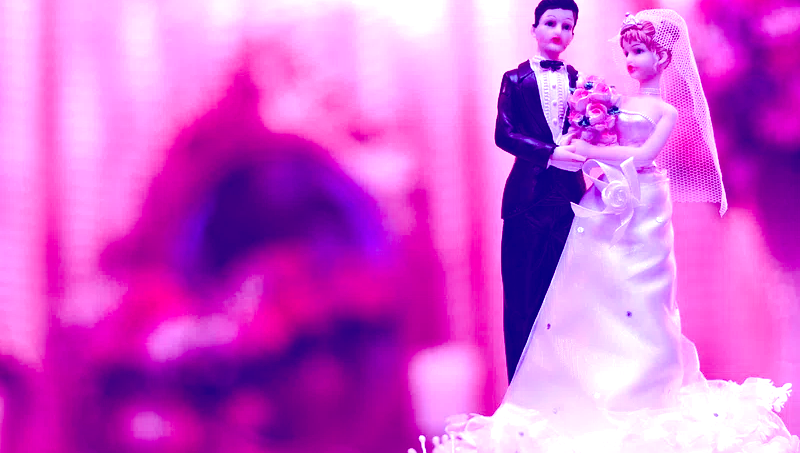
There’s No Such Thing as a Bad Wedding: On Finding Inspiration in Someone Else’s Nuptials
“The most wonderful thing about attending someone else’s wedding is that it’s not my own.”
I’ve been to a wedding where I and many others contracted COVID-19. I’ve been to a wedding where I banged my head on an ancient building’s low doorway, after which I spent the entire reception convinced I was concussed and would die in a hospital thousands of miles away from home. I’ve been to a wedding whose reception surprised many guests by not serving any food. I’ve been to a wedding where the only drinking water came out of a hose behind a barn, so I opened the spigot, bent over, and drank from it. I’ve been to a wedding that ended with my closest friends and I screaming at each other in the back of a hired minivan, its generous driver occasionally swiveling his head around to lighten the mood with unsolicited commentary. I’ve been to a wedding where guests were forced to endure the newlyweds being insulted by family members during two solid hours of unfathomably cruel speeches. I’ve been to a wedding where one half of the couple fell ill during the reception and went to the hospital, leaving their spouse behind to keep celebrating.
I’ve been to several weddings that fundamentally changed everything I thought I knew about the couple getting married, some of which effectively became the endpoints of my friendships with them; no hard feelings, just a champagne drenched conclusion. But I’ve never been to a bad wedding, because, to me, there’s no such thing.
It’s an idea that led me to write my third novel, We Are Gathered Here Today, which follows a 36-year-old gay man named Fin as he makes new friends, reconnects with old ones, and mulls his own recent engagement at the wedding of his cousin in central Texas. The weekend contains more than its fair share of chaos, tears, and vitriol, but every character departs after the nuptials feeling confident that the whole affair was, somehow, worth attending.
Being a wedding guest is hard work, but has always left me with a profound sense of relief.
If you can spare the time and the money, every wedding is worth attending because every wedding is good. And every wedding is good because, as a guest, you’re able to leave it behind. It’s a hermetically sealed environment meant for forced enjoyment: you enter it, you experience it, and then you return to your regular, toast-free life. Everything’s temporary, from the venue to the port-a-potties to the feeling that you wanna dance and/or feel the heat with somebody. Sure, it can be exhausting to spend hours (or even days) gawking at a couple, listening to stories about the unprecedented strength of their love, watching strangers cry, and crying yourself, all while feeling a suffocating pressure to maintain a happy disposition for the sake of the betrothed’s “big day”; being a wedding guest is hard work, but has always left me with a profound sense of relief.
It is emotional labor whose compensation is, beyond the open bar and room temperature rice pilaf, being able to go back to my old life. For the couple getting married, the stress of the event can be debilitating. They spend months suffering through bouts of anxiety over every minor detail, only to spend the actual wedding day in a fugue state, receiving clarity only after the event, lying in the honeymoon suite feeling like their lives changed without them being conscious enough to notice it. The guests, however, have the option to hit the reset button and return to the exact people they were on Friday morning. What a relief.
As a ritual romanticized for generations as one of the most significant events of a person’s life, the modern wedding tends to provoke a nebulous kind of introspection separating it from its most notable counterparts. Consider the other most existentially rattling moments shared with loved ones: at a funeral, the grief over losing someone far outweighs considerations of one’s own mortality; at a birth, the awe over experiencing the beginning of a new life swallows any other swirling emotions about the direction of one’s own. Weddings, no offense to the couples who have them, are socio-celebratory rorschach tests that are almost designed to hold a magnifying glass up to the lives of their guests.
If you’re in a happy marriage you find the whole thing affirming; if you’re single and yearning to be married your joy may be combined with a slight pang of jealousy; if you’re married and yearning to be divorced, you might feel nostalgic for a time when weddings were sources of hope, not dread; and if you’re disdainful of the entire wedding industrial complex, you may just wonder if the groom’s single cousin wants to have some fun before catching his plane back to Milwaukee tomorrow morning. When’s the last time a funeral left you with a feeling more powerful than a crippling devastation for the person you lost and will never see again? When’s the last time you welcomed a baby with 150 of your friends and family members? Weddings are just as emotionally overwhelming as either of those events, they just masquerade as parties. They ask guests to celebrate the married couple, consider the shapes of their own lives, and then, finally, to dance.
Weddings are like airports–liminal spaces that exist out of time and definable space. As a passenger, what happens at one is not real life, but instead a purgatory between Here and There.
I have left plenty of weddings feeling aimless, unaccomplished, and–after taking the subway home from one of the most storied and expensive venues I’ve ever laid eyes on–downright destitute. I’ve spent hours after weddings complaining with friends about specific decisions that bothered, embarrassed, or downright offended me. But those feelings never linger for too long after the “I dos.” Because, with distance, I inevitably come to realize that the most wonderful thing about attending someone else’s wedding is that it’s not my own. Their love story is not mine. Their venue was not my decision. Their menu was not planned in service of my own palate. The family members were not on my tree. None of it was paid for with my money or my sweat. The anxieties, the mess, the whole unwieldy tapestry of the celebration has nothing at all to do with me. As many invitations assert, my presence is a present. Why shouldn’t I believe them?
Weddings are like airports–liminal spaces that exist out of time and definable space. As a passenger, what happens at one is not real life, but instead a purgatory between Here and There. The fury at a TSA agent who selected you at random will quickly dissipate once you’ve taken flight. The disgust over spending $12 for a bag of M&Ms is forgotten by the time you’ve landed at your destination, where a generous old friend is waiting to pick you up at the arrivals gate.
When the time came to prepare for my own wedding, that was the realization that kept me from becoming a total wreck. (In the weeks leading up to the event, I believe I was only a partial one.) My husband and I planned an event at which we thought we would have the most fun, full stop. Having enjoyed all of the weddings I’d ever attended, I figured all our guests would ultimately not regret attending my own, whatever form it happened to take. If they had a terrible time, they didn’t tell me. I certainly wouldn’t tell them. Especially not here.
_______________________________
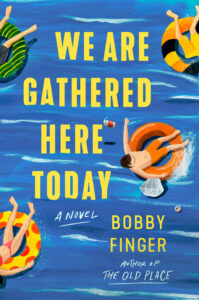
We Are Gathered Here Today by Bobby Finger is available from G.P. Putnam’s Sons, an imprint of Penguin Publishing Group, a division of Penguin Random House, LLC.

Bobby Finger
Bobby Finger is the author of The Old Place and Four Squares, and cohost of the popular celebrity and entertainment podcast, Who? Weekly. A Texas native, he lives in Brooklyn, New York, with his husband and cat.