What It’s Like to Interview For the Job of “Astronaut”
Leroy Chiao Remembers How He Got His Dream Job With NASA
The following is from Leroy Chiao’s Dinner with an Astronaut, and describes one step in Chiao’s late 1980s journey to becoming astronaut.
*
What was the astronaut interview like?
I flew to Houston the next week. It was September. I emerged from the Houston Hobby airport into a wall of stifling humidity. My shirt stuck to my skin; it was almost hard to breathe. My California-calibrated system was in shock. How can people live here?
Johnson Space Center, NASA’s ground zero for everything astronaut, arrived in this southern inferno just a year after I was born. But why here?
With JFK rearing to go to the Moon in the early 1960s, he needed someone to run NASA who could handle all the moving parts that such an extraordinary mission would demand. James Webb was fifty-four years old, semiretired, and involved in a whirlwind of projects and boards when he was asked to head NASA in 1961.
One of Webb’s first orders of business was to find a location where all the activity around manned space flight would live and breathe. With tons of money and jobs coming along with a big NASA installation, several cities vied for the opportunity, including St. Louis, Missouri, Boston, Massachusetts, and Lawrence, Kansas.
Delivering epic news to your Chinese American family and friends looks nothing like those American families on TV that gas you up, throw you a party, and brag to all their friends.
“Houston had a very large technical capability,” Webb said. There were aerospace contractors already there, like McDonnell Aircraft Corporation, and lots of brain power coming out of Rice University and Texas A&M. Webb also wanted the site to have access to water so they could move giant things like rockets around more easily. And they needed land. It just so happened that Rice University had a big ranch that they figured could get them a lot more clout as a space facility than a cow pasture and leased it to NASA for a rumored one dollar a year.
Heat and humidity be dammed, Houston it would be, Webb decided. “The basic reason was to get the space program done in the most effective way possible and to build scientific engineering and managerial strength for a long time into the future. We were not looking at the cheapest way of making stuff in tents or building poured concrete buildings,” he said. “We realize that when men left the air, when he had an engine big enough to leave the air and the Earth and to move around in space, you are entering a new and unlimited arena, and that we were not just constructing the fastest, quickest way to get a few payloads into orbit. We were building permanently.”
He was a thoughtful visionary. Thank you, James Webb. I arrived at a dingy commuter hotel NASA had booked me on a Saturday in 1989. As soon as I opened the door, I watched a cockroach run across the pillow on my bed.
Okay…This is awesome.
The next morning at 8 AM, everyone in the interview group gathered in a conference room. There were twenty of us. It was the late ’80s, and the group was still dominated by white male military pilots. I was the only Asian there.
One guy in my interview group was Rich Clifford. He was close to forty with prematurely white hair but still young-looking. Rich was already working for NASA (on loan from the Army) as an engineer on different parts of the Space Shuttle. His title was Space Shuttle Vehicle Integration Test Team engineer. He and I hit it off the day we first met, and he later became my best friend in our astronaut class.
We spent the day taking standardized tests, an IQ test, a psychological battery, cognitive tests on logic and memory—you name it. It took hours and hours. At the end of the day, we had a little social with the members of the committee who came out to meet us at the hotel. One of them was John Young, one of, if not THE greatest astronaut of all time.
John Young had the look of an English professor, and even at sixty years old with his hair white, he had a youthful appearance. Young walked on the Moon. He flew before that with Gus Grissom on the first Gemini. And he was the very first Shuttle commander in 1981. Young was a hero for all astronauts and anyone who knew anything about astronauts. He was a cool, collected, navy fighter pilot (they call themselves Naval Aviators) and the most impressive guy I’d ever met.
I was acting low-key in his presence, but I couldn’t have been more in awe if I was Catholic and he was the Pope. Part way through the conversation, a guy from Los Alamos interrupts John Young and said, “What was your name again?”
“John Young,” he replied.
And the guy said TO JOHN YOUNG, “And…what do you do?”
Me and the Air Force guy froze.
Oh my God, you don’t know who John Young is?
Needless to say, that guy was not selected to be an astronaut. The rest of the week seemed like one endless medical exam, the most thorough medical exam you can imagine. Men and women in white coats drew blood, scanned, x-rayed, checked our psyche, our balance, our urine. They did things I never had done to me before.
“We always like astronaut interviews because you guys will do everything we want you to do with smiles on your faces,” laughed the Chief Flight Surgeon. We thought that he might have been a bit of a sadist after the countless tests and poking and prodding, but he actually turned out to be one of the nicest people I’ve ever known.
We were also encouraged to visit the building where the astronauts’ offices were located. I approached their floor, hoping to catch some of the astronauts on the selection committee. It was a little intimidating. Up until then, there had been only seventy-eight astronauts who had gone to space. It felt like hallowed ground on that floor. While I walked around, hoping to randomly bump into one of my idols, I checked out all the names on the office doors.
There was not one Asian name at the time. A poster on the wall displayed every NASA astronaut who ever flew. I scanned it quickly. There was only one Asian American to fly in space at the time: Ellison Onizuka, a military flight test engineer born in Hawaii to Japanese parents. Tragically, he died in the Challenger explosion. It was his second mission.
Rather than let the lack of Asian representation intimidate me, I looked at it practically. I certainly wasn’t counting on my Asianness giving me any kind of advantage (it had been a huge disadvantage while applying for engineering school), and I knew that NASA was focused on a meritocracy at that time rather than fulfilling certain quotas.
The actual astronaut interview was only one hour long. I had mine near the end of the interview week.
When it was my turn to be interviewed, the head of the selection board said, “By the way, you get a gold star for keeping your essay to one page.”
“Really?” I said. “People write more?”
“Oh, God. We’ve had people that write thirty, fifty, one hundred pages. Nobody wants to read that!”
“You’re welcome.” I smiled.
It was a twelve-member board consisting of senior astronauts, some in management from both Houston and other centers, and some from the NASA headquarters. There was just one woman who was on the committee, Carolyn Huntoon. In 1989, while the recruitment of women at NASA was up, there were few women in senior positions.
Carolyn had been with NASA from the very beginning of manned spaceflight. She started full-time in 1968 when she helped set up a medical laboratory at Johnson Space Center and oversaw thousands of hours of groundbreaking research on how spaceflight affects the human body. At the time of my interview, she was the Center’s Director of Life Sciences, and she later went on to be the first female NASA director of the center.
The conference table was set up in a T arrangement. I was in one of the corners of the T so that I had my back to a couple of members of the committee. I think they did that to try to rattle me.
What do you think of working here? Would you do this here?
Would you do that here?
They were easy questions for the most part. Then they threw me a curveball:
“If you had all the resources in the world, what would you do to overhaul the education system in the US?”
I answered the best I could.
“I would put money into technology and computers. That’s obviously the future,” I said. “I would also try to bring some disadvantaged demographics and regions along, starting at a young age. I think that is the key.”
I wasn’t nervous. There wasn’t time for everyone on the board to ask a question. It was interesting that, though I was in Houston for an entire week, engaging in countless tests and health checks and social events, the interview portion was just one hour long. That was it.
At the end of the week, we had a social night at a Cajun barbecue place that was a hangout for the folks from JSC. It was a hole in the wall next to the Ellington Field airfield that NASA uses. I think this was where the real selections were made. They wanted to see how we would interact with them. We ate Cajun barbecue, red beans and rice, boudin sausage, and brisket. I had a couple of beers. I talked to a bunch of people and met some astronauts that I knew by reputation and others who were on the board. And then, I went back to California without a clue as to how well I did.
How did you find out you got in?
Just a few days after I got home, I got a call from the OPM (United States Office of Personnel Management) and the guy said, “Wow, they must be really hot on you because you just interviewed, and you’re being put in for a security clearance already.”
I took that as a good sign. Then I heard nothing. Months went by.
Finally in January of 1990 I got a phone call from Carolyn Huntoon.
I’d learned my lesson to shake myself awake for any early morning call.
I came to Houston with a fresh start and began a new life as an astronaut candidate—embarking on my life-long dream.
“Leroy,” Carolyn said. “You did great, but I’m sorry to tell you that we didn’t select you.”
Ouch. “Okay,” I said.
“But you’re welcome to apply again,” she said.
“Thank you, Dr. Huntoon. I’m disappointed, obviously, but I maintain the highest enthusiasm for the program and will definitely reapply.”
I was sad. But fortunately, I was enjoying my job Lawrence Livermore National Lab doing research work on processing thick-section composite materials for aerospace and other applications.
On the 17th of January 1990, my phone rang again. Six AM. It was the chairman of the selection committee, Don Puddy. Puddy was an engineer and heavy hitter at NASA since the Apollo days. I was immediately wide awake.
“I understand you had a conversation with Carolyn yesterday,” Puddy said.
“Yes, sir,” I said. “I’m disappointed, of course. But I maintain the highest enthusiasm and would like to keep applying.”
“Well, how’d you like to join this, this class?” Puddy said. Zero hesitation.
“Absolutely! I would love to join this class!” I was smiling from ear to ear.
And that was it. Delivering epic news to your Chinese American family and friends looks nothing like those American families on TV that gas you up, throw you a party, and brag to all their friends.
I tepidly called my girlfriend, Janny (also a first-gen Chinese American), who was in California doing a medical residency.
“Congratulations, Leroy. I know that’s what you wanted,” she said, sounding mildly excited for me. We both knew that this meant I had to move to Houston, but neither of us mentioned it. Things between Janny and I were rocky. We’d started dating when we were sophomores at Berkeley. By this time, we’d been together for seven years, and we were going in separate directions. It seemed to me that Janny had a lot of anxiety, which I didn’t understand or know how to deal with. Her parents were both medical doctors, so she felt immense pressure to be one too.
Next, I called Mom and Dad.
“Congratulation, Érzi,” Mom said. “I’m so proud and excited for you. But this is dangerous, right?”
“Mom, don’t worry,” I said. “It’ll be okay. I promise.” “I guess you’re going to leave engineering and go off and do this for a while,” Dad said. “But you should minimize how much time you do this. If you could fly in one year and get it over with, you can get back to work without too much loss of continuity in your real job.”
“Dad,” I said, “I don’t think it works that way. The basic training is a year. Then it’s going to be a few more years before I get a chance to fly.”
Dad harrumphed on the other end of the phone.
At twenty-nine years old in 1990, I was NASA’s youngest astronaut. I was not the youngest ever, but I was close. Charlie Bolden, an astronaut and member of the selection board, later told me, “You were very impressive, but you were so young that we decided to defer you and have you apply again. But then when this position became available, you were the next one on the list. So we brought you in.” Charlie was a Vietnam veteran pilot who became a good friend of mine and went on to become Administrator of NASA under Barack Obama. So cool.
Janny broke up with me before I left, which was a huge relief. I came to Houston with a fresh start and began a new life as an astronaut candidate—embarking on my life-long dream. Out of the 1,945 qualified applicants who applied that year, NASA invited 103 candidates for interviews and medical exams. Of that 103, just twenty-three of us were chose for NASA Astronaut Group 13. It felt great to be a part of that group.
_______________________________
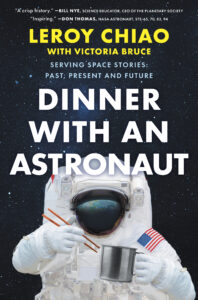
Excerpted from Dinner with an Astronaut: Serving Space Stories: Past, Present and Future by Leroy Chiao. Copyright © 2026. Available from Hanover Square Press, an imprint of HarperCollins Publishers.
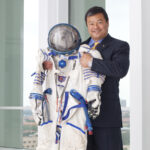
Leroy Chiao
Leroy Chiao is a former NASA astronaut and International Space Station commander. He is a a professional international speaker, and a co-founder and the CEO of OneOrbit, providing keynotes and training to companies and schools. A veteran of four space missions, Dr. Chiao most recently served as Commander and NASA Science Officer of Expedition 10 aboard the International Space Station. He has logged over 229 days in space – over 36 hours of which were spent on spacewalks.