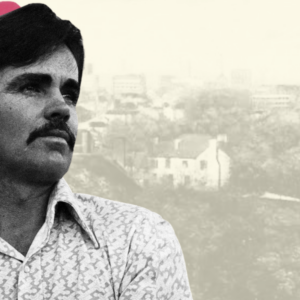
Greg Sarris on Telling the Stories of California’s Native Communities
Jane Ciabattari Talks to the Author of The Last Human Bear
Greg Sarris’s first novel, Grand Avenue, an urban Indian story set in Santa Rosa, California, was published in 1994, during the second wave of the Native American Renaissance, which included first novels by Louise Erdrich (Love Medicine), Sherman Alexie (Reservation Blues), Mona Susan Power (The Grass Dancer) and David Treuer (Little).
Sarris followed up with Watermelon Nights (1998), in which a young Santa Rosa man works with his community to achieve federal recognition for his tribe. He then took some time off from writing novels to restore his own tribe’s sovereignty (he is now serving his seventeenth consecutive elected term as Chairman of the Federated Indians of Graton Rancheria), to work as a university professor (he recently retired after thirty-some years) and to serve on various boards (he’s currently on the University of California board of regents and the Sundance Institute board). He also published a memoir (Becoming Story, 2022) and two story collections drawn from tribal origin stories—How a Mountain Was Made (2017) and The Forgetters (2024).
This week, Sarris’ The Last Human Bear, his third novel, and his first in twenty-eight years, launches, at a time when Native literature is flourishing, with fiction by Tommy Orange, Morgan Talty, Amanda Peters, Brandon Hobson, Margaret Verble, John Hickey, Dennis E. Staples, Oscar Hokeah, David Heska Wanbli Weiden, Eden Robinson, Kelli Jo Ford and Julian Brave Noise Cat, to name a few, drawing critical attention and awards.
How do you feel about the proliferation of Native American authors from the time of your first novel to today? I asked Sarris. “The evolution of Native American literature over the last thirty years has brought many new voices that broaden our understanding of the breadth and depth of what constitutes the American Indian experience,” he said. “There are over five hundred tribes in the United States, and the majority of American Indians live in urban areas. With Grand Avenue, we saw the urban experience of American Indians from a specific tribe from a special location in Sonoma County, local California Pomo Indians. More recently, with Tommy Orange’s There There, we see Plains Indians living in urban Oakland in northern California, Indian people from tribes out of the state of California. That gives us a sense of the great reach of American Indian people. Each of these writers writes about American Indians from a particular culture living in a particular landscape, whether it’s their aboriginal landscape, near or on a reservation, or in an urban area. In many of these novels, we see the intersection of race, gender, sexual orientation, and class. Absolutely remarkable!”
*
Jane Ciabattari: Your chilling opening lines, introducing Mary Hatcher, grab the reader: “I’m curious why you want to know about me. The Indians would say anyone listening to me got a lot of nerve, especially the old Indians. No end to the stories they’ll tell you about me and my numerous and abominable crimes….I’m the last link. I have no cape, no bearskin, to turn over to you. All that’s left is a story.” At what point in the evolution of this novel did you write this prelude?
Greg Sarris: I wrote it in the very beginning. It was in fact the prelude that set the stage for the rest of the story which I was able to tell easily from that starting point. The prelude sets up not just Mary’s voice and persona but so much of what the story wants to tackle: truth and memory; culture and history.
JC: Who is the real-life inspiration for Mary Hatcher, the last woman trained to be a Human Bear? How did you learn about her?
GS: I had heard about a particular woman in my community ever since I was quite young. I used to hear the old people tell stories about her abominable crimes and the power she had as a human bear. I was taught that the old people with these kinds of powers could not die until they pass the powers on to another person. I remember hearing that when this woman was quite old someone saw her late at night coming out of a creek bed followed by a young girl, presumably a person she was training to inherent her bearskin and powers.
I seem to be attracted to women characters but my main concern here was that Mary remained a rich and complicated human being full of the contradictions that characterize our lived experience.
JC: In your first section, Mary, who is raised by a Miwok stepmother, Saturnina, describes the family she was born into. She was given up by her mother, who she sees her working on the crops on Benedicts’ Rancheria, where Mary was born and most of the tribe lives. When Mary is seventeen, her mother hangs herself in the barn. After her mother’s funeral, Mary learns that her mother did not give her away, and that the man she thought was her father isn’t. She also learns she has a half-sister. This complicated web of lies, betrayals, and cover-ups leads her to be distrustful. And yet as a young woman, her passions pull her forward toward love and connection. How did you weave such a strong undercurrent of emotional ambiguity into this narrative?
GS: Thank you for seeing the complexities of her character. Mary is a very complicated character and like any of us who have had complicated and challenging situations in our young life, we do seek the kinds of love and human emotion that anybody else does going forward in our lives. Mary must learn in her journey to balance what challenges her as she moves ahead and finds the ways in which her past continuously influences her behavior in the present—until she could come to a point in her life where she sees that her past influences aren’t always in her best interest.
JC: How did you develop the narrative structure, which spans nearly a century in the life of a woman who is gifted yet cursed?
GS: The story is more or less linear, tracing Mary’s early life, middle years, and finally latter life. Often there will be flashbacks as Mary thinks back and reflects on how the past has influenced the decisions she has made and the actions she has taken for better or worse.
JC: How did you learn about the lessons Saturnina teaches Mary about herbs—mountain balm for chest colds, pneumonia; angelica root for purifying the blood and keeping ghosts at bay, the bulb of the red stem plant for ending pregnancies; the songs, the rituals used by a poisoner, and the interconnection with nature that infuses Mary’s world?
GS: I learned so much about my culture from elders, particularly from Mabel McKay. (McKay, the Pomo basket weaver and medicine woman was the subject of Sarris’s 1994 biography, Weaving the Dream.) Much of this knowledge has been lost and I somehow managed to retain much of it. But be clear, I haven’t learned to be a poisoner. I just learned a lot about what the human bears and others are reputed to have done and some of what was involved in their training. This is so much from oral tradition told to me again by elders. When I was young, many of the elders would tell me these things and I’m not sure exactly why. Ha! Maybe they thought I would remember.
JC: Saturnina teaches Mary to make traditional Pomo baskets, which is helpful when she learns dressmaking, a way to make a living in her later years. What sort of research allowed you to describe the intricacies of basketmaking?
GS: Here again I have to defer to Mabel McKay. I often helped her gather sedge root and willow cuttings for her baskets. I sat for many hours watching her clean the sedge and peel the willow rods before she even began to weave the beautiful baskets she made. I found myself also taking her to classes where she taught basketmaking to others. So, I learned quite a bit about basket making, first and foremost, that it is a difficult art that I was not able to quite master. Women were generally the best basket makers, but I’ve heard of some men who were also quite good.
JC: Mary Hatcher’s identity, her sense of class, her place in the Santa Rosa social structure, shift in many ways in the course of the near century of Sonoma County history covered in The Last Human Bear. How does this reflect the changes for your own Pomo/Coast Miwok tribal citizens? In what ways are Northern California Indian tribes distinctive?
GS: There is a lot to this question. First, my Coast Miwok and Southern Pomo ancestors were regulated to a small 15.5 reservation in 1920. Many of us were unable to live there and continued to live as farm workers on the various ranches. It was a dangerous time for us, as we were not citizens until 1924, which means an Indian woman could get raped with no recourse in the courts. Many of our ancestors, including my grandmother, claimed Mexican identity for protection for themselves and their children. However, we never forgot who we were; the stories, and, in some families, the indigenous languages continued. We are happy today to have reassembled our people under the banner of The Federated Indians of Graton Rancheria, and all of our citizens are documented descendants of Coast Miwok and Southern Pomo for whom the original 15.5-acre reservation was set aside for. That reservation was terminated in 1966. We regrouped in 1992 and finally on December 27,2000, President Clinton signed the bill acknowledging the illegal termination of our rancheria and restoring us as a federally recognized American Indian tribe. We are working very hard to revitalize our language, basketmaking, and performing many of the old dances. The success of our struggles continues to empower us onward. The character of Mary comes from a fictional band of Southern Pomo—I didn’t want to implicate or in any way get in trouble for talking about any of my relatives. But I still wonder if they might speculate about who I am talking about here. We’ll see.
JC: The locations you write about are real—the cave where the bear clan gathered, the places in and around Santa Rosa where Mary lived, from Saturnina’s hilltop shack to the Benedicts’ estate, the seasonal camps where Mary and Saturnina stayed when picking strawberries, cherries, grapes, apples and such, ritzy Macdonald Avenue, the Fourth Street shops. How do you know these places so well and how did you map their changes?
GS: I grew up in this community and didn’t leave until I was twenty years old. So much of what is important in my life was formed here in this community. I have fictionalized some of the places a bit, particularly those that might be relevant to sacred sites for my people, but places like McDonald Avenue and Fourth Street still exist. Many of the fruit orchards where I worked as young man have been replaced by vineyards, as we are now part of the wine country.
So much of what I experienced as a young man was hearing stories, listening to the old people talk and gossip, and that always fascinated me and spurred my curiosity about the life around me which is exactly what literature should do.
JC: Mary’s decades-long perspective brings a sense of the shifting tides of history when she describes her sense of sadness at how the “growing town was burying the landscape…the housing tracts that covered the land, the bridges that crossed the creeks, something new each time I looked. Not a single walnut tree remained on the land adjacent to the dairy. There were paved streets, curbs, and sidewalks in front of the concrete foundations, wood skeletons rising as far as the eye could see. Rock formations, old oak trees completely disappeared.” This ongoing erasure of the landscape continues. Do you think novels like this can re-story this landscape, giving a sense of the people who once lived here, what their lives were like? How their lives are now, as the Pomo continue to live and thrive in Sonoma County.
GS: Absolutely! That’s one of the reasons I write, perhaps one of the reasons many writers write, and that is, to remember. In the past, before European contact, the landscape was our bible. The features of the landscape such as an outcropping of rocks or a spring became mnemonic pegs on which we hung stories that reminded us of what are important lessons regarding our relationships with the landscape and one another. Obviously, so much of that is buried under concrete and housing now. Even the dairies and orchards that I remember as a young man are gone, which gives me a small sense of what the old timers must have witnessed, seeing our aboriginal landscape erased, buried under new houses, private property, pastures, cattle, horses, and so forth. It must’ve been absolutely traumatic—part of the trauma of colonization we still struggle with in so many ways. Memory can help bring back stories and stories can help us heal.
JC: Mary Hatcher has been compared to Moll Flanders, Tess of the d’Urbervilles, Olive Kittredge, the protagonist in Margaret Atwood’s Alias Grace, and Lucy Marsden in Allan Gurganus’s Oldest Living Confederate Widow Tells All, among others. Her distinctive voice shows her as a powerful yet vulnerable woman. Which authors inspired you while working on this novel?
GS: I’ve always been inspired by novels that have rich and complicated characters. I seem to be attracted to women characters but my main concern here was that Mary remained a rich and complicated human being full of the contradictions that characterize our lived experience. But I certainly like Tess of the d’Urbervilles and many of the other great women characters of course in literature. I want Mary to stand among them.
JC: How did you draw upon oral storytelling traditions to write this novel?
GS: As I was writing, I was hearing older people speak. Unlike many writers, I was not a reader as a young person. In fact, I really didn’t read a full novel until I was a junior in high school and that was The Old Man and The Sea by Ernest Hemingway. I remember feeling sorry for the fish, which isn’t exactly what the teacher had expected. But when I began to read seriously, I found that I was lonely, separated from my friends on the streets, and reading became fulfilling in the sense that once again I was experiencing stories. So much of what I experienced as a young man was hearing stories, listening to the old people talk and gossip, and that always fascinated me and spurred my curiosity about the life around me which is exactly what literature should do. I hope Mary inspires readers in the same sense.
JC: What are you working on now/next?
GS: I am working on a historical novel set at the time of the Mexican occupation here in Sonoma County. The novel moves from the last days of the Mexican occupation to the Bear Flag Revolution—all seen and told from an indigenous perspective. I also need to get going on a play that has been commissioned for me from the San Francisco Playhouse.
_______________________________
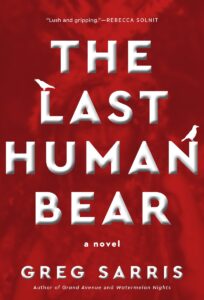
The Last Human Bear by Greg Sarris is available from Heyday Books.

Jane Ciabattari
Jane Ciabattari, author of the short story collection Stealing the Fire, is a former National Book Critics Circle president (currently on the Advisory Board ) and a member of the Writers Grotto and Page Street. Her reviews, interviews and cultural criticism have appeared in NPR, BBC Culture, the New York Times Book Review, the Guardian, Bookforum, Paris Review, the Washington Post, Boston Globe, and the Los Angeles Times, among other publications.