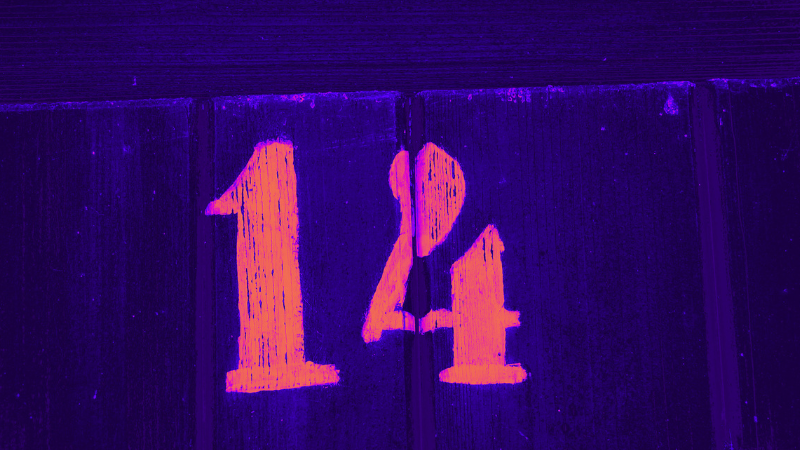
The Power of a Number: Erin Vincent on Grief, Loss, and a Fixation on Fourteen
“At fourteen I decided I would be hard as a stone and burn bright as the sun.”
A sonnet is a fourteen-line poem written in iambic pentameter.
Raymond Queneau’s book A Hundred Thousand Billion Poems plays with the form. In the tradition of humorous children’s picture books that contain pages cut in horizontal strips that can be lifted to reveal another image underneath—thus creating a new picture such as a man with cat legs or a duck in high heels—Queneau decided to cut ten pages into fourteen strips, one strip for each line of each sonnet. By simply turning just one strip, the sonnet is altered.
Sometimes I imagine what it would look like if I could cut the number fourteen from my life and create a whole new story. So many possibilities, but maybe not a hundred thousand billion of them.
Sometimes I imagine what it would look like if I could cut the number fourteen from my life and create a whole new story.
When Queneau was having trouble with his book of fourteen-strip pages, he asked mathematician François Le Lionnais for help. Their discussions led to the formation of the Oulipo group in 1960.
In the list of permission credits for The Penguin Book of Oulipo, the number 14 is missing.
*
Georges Perec, who was orphaned as a young boy during World War II, often spoke of his desire to write about a subject to the point of exhaustion; to “exhaust not the whole world…but a constituted fragment of the world.” I wonder if I can do the same.
*
On December 14, 2001, W. G. Sebald’s car hit a truck, killing the author on impact. His daughter Anna sustained serious injuries.
When I was fourteen my mother died instantly; my father didn’t, surviving for four weeks and one day with a broken, bloodied body.
It is advised that sutures be removed within fourteen days.
*
At fourteen, while my father was in surgery, I sat on my bedroom floor and played the game Operation with my three-year-old brother. If I could operate on the cartoon man without his red nose lighting up and buzzing, everything would be all right.
*
When experimenting to create the electric lightbulb, in 1879, Thomas Edison and his team succeeded in getting a carbon filament to burn for fourteen and a half hours.
*
Silicon (Si) is the fourteenth element on the periodic table. It makes up more than a quarter of the Earth’s crust and is its second most abundant element, surpassed only by oxygen. The name silicon derives from the Latin silex, meaning “flint” or “hard stone.” Early Egyptians used it in the form of rock crystal to make beads and small vases. Pure silicon looks reflective and silver, like a seventies disco ball.
At fourteen I decided I would be hard as a stone and burn bright as the sun.
Silicon’s performance degrades badly at high temperatures. The fourteenth element is also very poor at transmitting light.
“Titanium” is the fourteenth story in Primo Levi’s book of autobiographical short stories, The Periodic Table. At four pages, it is the shortest story in the book and is written from the point of view of a child who is fascinated by the white paint a man is applying to some furniture. When she gets in the way of the painter, he draws a chalk circle and tells her she must stay within it for the duration. She does and is set free once he is finished.
At fourteen I gave myself strict parameters, beginning with: No crying in front of Dad.
In Saint Ignatius of Loyola’s Fourteen Rules of Discernment, the last rule says that evil spirits will attack you if you are weak.
At fourteen I noticed that the titanium rods sticking out of my father’s legs made him look like something out of a science-fiction story.
Ray Bradbury began his writing career at the age of fourteen when he landed a job writing for George Burns and Gracie Allen’s radio show.
*
When I was fourteen my father would sing my brother to sleep every night with John Lennon’s “Beautiful Boy (Darling Boy).”
*
At fourteen I was told by the nurses, who wheeled him into the shower, that this was the only place my father would allow himself to cry.
At fourteen I trained myself to be the model griever. I would hide my pain. I would be a burden to no one.
In the 1960 film Psycho, fourteen stabs were reduced to three in the editing studio because the British censor, John Trevelyan, thought it was too sadistic.
When I was fourteen, my father told my older sister that it was all his fault. He wanted, and didn’t want, her forgiveness.
*
I wonder, is it a betrayal to write about a father, if that father did not live to become a better version of himself?
*
In one of the only photos I have of my father, hidden away in a drawer somewhere, his dark hair is Brylcreemed and brushed back, his moustache is thick, and his chin is slightly raised. He is looking straight down the lens as though willing the moment to be over.
Lidia Pereprygina was only fourteen when she became pregnant with Stalin’s child. The infant died shortly after birth.
*
At the 1976 Montreal Olympic Games, fourteen-year-old gymnast Nadia Comăneci scored perfect 10s. Her perfection was unprecedented, causing the scoreboard to malfunction, showing 1.00 instead of 10.00.
At fourteen I trained myself to be the model griever. I would hide my pain. I would be a burden to no one.
__________________________________
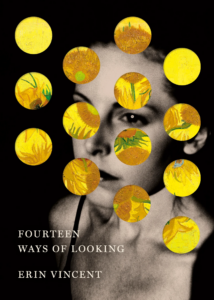
From Fourteen Ways of Looking by Erin Vincent. Copyright © 2026. Available from A Strange Object/Deep Vellum.

Erin Vincent
Erin Vincent is the author of Grief Girl (Penguin Random House) which was named a New York Public Library Best Book and an American Library Association Best Book Nominee. Her work has appeared in Electric Literature, The Guardian, Meanjin, The Offing, and elsewhere. She holds an MA in creative writing from the University of Technology Sydney and is currently studying for a PhD in creative writing with a focus on fragmentary literature written by women in the 21st century. She lives in a little cottage with her lovely and talented husband, Adam Knott, and their lovely and talented cat, Little Eve.