The Gays and Their Ghosts: Natalie Adler Recommends Queer Ghost Stories
Featuring Henry James, Vernon Lee, Shirley Jackson and More
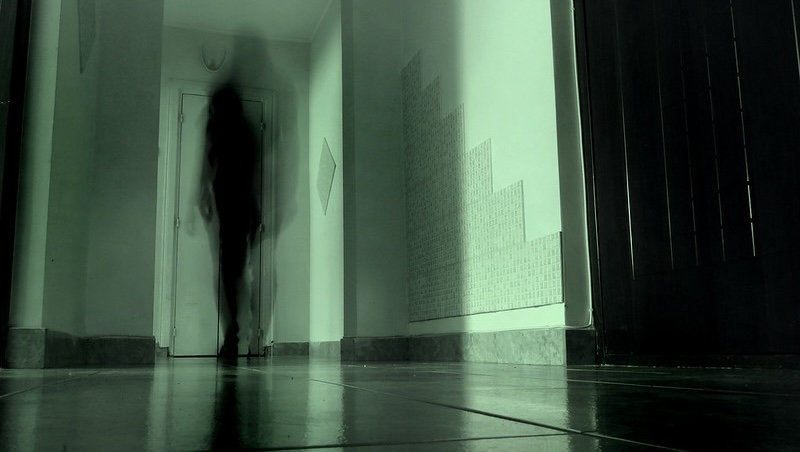
Gays and ghosts have a natural kinship. Both may elicit fear in unsuspecting passerby. You may feel vaguely unmoored, inexplicably nervous at their presence, particularly if you, yourself, have an unacknowledged kinship. But when you accept the presence and fully see them, you enter into a whole new reality. Ghosts have a cheeky answer to the question of “visibility.” Better, perhaps, to have the power to choose who can see you—a jangle of chains, a nod, a hanky, a flick of the wrist. Ghosts and gays; themselves abandoned by the living, they thrive in abandoned places, cruising around rotting piers or houses in decline. Their memories of their lives before are vague, the barest shading of a time and a place.
In literature, ghosts often represent the agency of the past, imposing itself on a repressive present. They are what remains when an injustice has been buried. In my novel, Waiting on a Friend, most of the ghosts are gay, and they appear to my main character, Renata, because of her patient willingness to see them and meet them where they are. And also, she’s gay. Ghosts are her friends and neighbors who were gone before they could understand what was happening to them. It’s the beginning of the AIDS crisis and the tipping point of downtown gentrification—they’re showing up to protest their own erasure. The more they’re pushed, the louder they get.
So imagine my surprise when I sat down to list all of the many gay ghost stories I was sure I knew and realized it wasn’t so easy. Jacob Marley, Hamlet’s Dad, sure, they all seem a little, you know. But picking up on vibes isn’t the same as close reading.
Here’s a list of gay ghost books, though the ghosts appear in different forms: the ghosts are gay and they are haunting closeted people; the ghosts are ostensibly not gay and they are furious about out gay people (though it stands to reason that if the haunted are gay, then those haunting them are too); the ghosts are gay and they are visiting gay people.
*
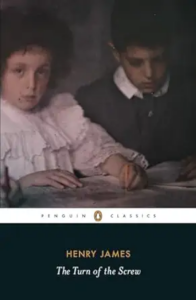
Henry James, The Turn of the Screw
A turn of the century novella about a governess in charge of two children, a girl and a boy, the latter of whom has been expelled from school for unnamed bad behavior. Soon, the governess starts seeing the apparition of the former governess, Miss Jessel, and former valet, Peter Quint, both recently dead. They had been “too free” with the children, and even after death, they are still perhaps a bit too interested in their former charges. The story revolves around the governess’s increasing concern that the children can see the ghosts, and if seeing the ghosts means knowing something they should not. Much in this story is unnamed, obscure, or ambiguous, down to the syntax (no one gets out of a Henry James sentence alive). Literary criticism is lousy with interpretations of the significance of sexuality in this story, and for that matter, the significance of sexuality in James’ own life. Suffice to say that the implicit threat of the ghosts is that they have corrupted the children sexually, either in word or deed, perhaps regarding a sexuality that is so dangerous that it may not even speak its name. The boy/girl-ness of the story seems a bit campy to me, along with the governess’ horror when she realizes “They know—it’s too monstrous: they know, they know!”
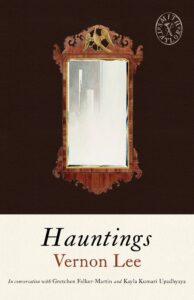
Vernon Lee, Hauntings
Vernon Lee (the pen name of Victorian lesbian aesthete, Violet Paget) was friends with Henry James, and if you haven’t heard of her, it’s likely because she was packed off into obscurity for her opposition to WWI. Recently reissued under the collection Hauntings, Lee’s ghost stories are about haunted minds, the mysteries of the past imposing themselves on the present, and the return of the repressed. Like James, she knows that the obscure, the half-understood, is scarier than anything. Though her era was outwardly fascinated by the apparitions of the Spiritist movement (more on that later on this list), what truly terrified them was more psychological than material: gender ambiguity, strangers, inversion, the degradation of the Empire. As she writes in her preface, “My ghosts are what you call spurious ghosts, of whom I can affirm only one thing, that they haunted certain brains, and have haunted, among others, my own…”
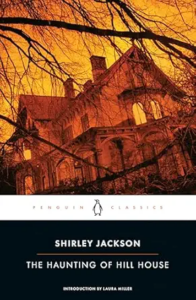
Shirley Jackson, The Haunting of Hill House
A researcher invites two women with experience with the paranormal to stay at a purportedly haunted house, in hopes of finding scientific evidence of the supernatural. Along with the heir to the estate, the four soon experience strange sights and sounds, but only one, Eleanor, sees things others do not. This isn’t to say Eleanor is the only queer person in the story; we meet the other woman, Theodora, as she has a messy breakup with her girlfriend in their bohemian city apartment (this is obvious if you’re queer, and subtext up for interpretation if you’re not). But the ghosts seem to focus on Eleanor, who may have telekinetic powers and who may have had experiences with a poltergeist as a child. Either way, something is repressed in Eleanor that is not with Theodora. What scares Eleanor the most: holding a girl’s hand. What scares Theodora the most: the sight of a family picnic in broad daylight.
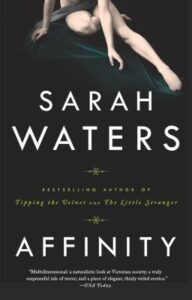
Sarah Waters, Affinity
Margaret Prior is almost thirty, unmarried, depressed, and living with her overbearing mother. Because this is a Sarah Waters novel, we know that no matter the decade, we’re in a world where it is possible to give lesbianism a go, but the closest Margaret gets is being a “Lady Visitor” to the woman’s wards of Millbank Prison, one of Jeremy Bentham’s panopticons. She falls under the spell of one of the prisoners, Selina Dawes, an infamous medium convicted of murdering the wealthy woman with whom she resided. She communicates through a spirit named Peter Quick (familiar?). She tells Margaret that the spirit world does not follow the straight and narrow. Some souls simply have affinities with others, as Margaret is about to learn.
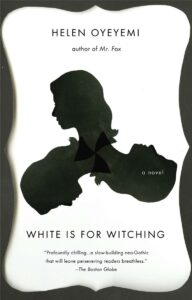
Helen Oyeyemi, White Is for Witching
The Silver family house does not like outsiders. Four generations of Silver women have lived there, and Miranda, the youngest, is starting to look like the three that came before her. This pleases the house. Though this is a haunted house novel, Miranda really becomes the ghost of the story, forgetting her birth year and sliding into disordered eating. But the real problems begin when she brings her Nigerian-British girlfriend home. The house is racist. The house is England. Miranda eats chalk instead of her girlfriend.
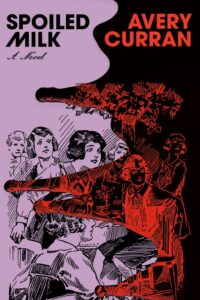
Avery Curran, Spoiled Milk
Violet, the prettiest girl in school, dies in the first chapter (no spoilers—she is listed as dead in the dramatis personae). The distraught girls of Briarley School are convinced it was no accident, that Mademoiselle, the French teacher, had been “too free” with her, to borrow a Jamesian turn of phrase. Naturally, the girls resort to a medium to speak to Evelyn and find out what happened. What’s that goopy white effulgence coming out of that girl—ectoplasm? Or…? As with other haunted house novels on this list, incipient lesbianism is enough to whip the ghosts into a frenzy.
The school is hateful. The school is England. But I think some of these girls just might make it after all.
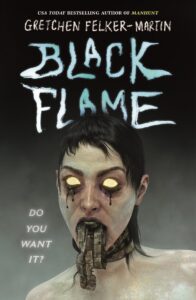
Gretchen Felker Martin, Black Flame
The deeply repressed make great ghost fodder. Ellen Kramer is a lonely film archivist restoring a snuff film that was thought to be destroyed in a fire after WWII. As her life begins overlapping with the events of the film, she’s confronted with her own degenerate desires, as the Nazis would call them. The ghosts are in the film, let’s say, and when she finally screens it, the ghosts are ready to gorge themselves on her.

Jiaming Tang, Cinema Love
In rural 1980’s Fuzhou, the Worker’s Cinema is a place where gay men can find each other. Old Second is a married gay man who frequents the cinema while his wife, Bao Mei, sells movie tickets. She protects the cinema and its patrons, including the ghost of her brother, a “sissy.” And she has a thing going on with the projectionist. The arrangement works until Old Second falls in love with Shun-Er, whose wife, Yan Hua does not take it well. Later, some of these characters will find themselves in New York. Horrors happen in Cinema Love, but it isn’t a horror story. Some ghosts stay behind (“Ghosts don’t emigrate like people do”) while others continue on, holding fast to that boundary between desire and letting go.
______________________________
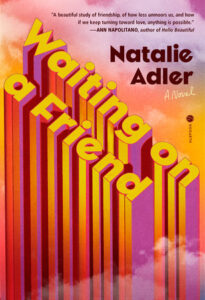
Waiting on a Friend by Natalie Adler is available from Hogarth, an imprint of Random House, a division of Penguin Random House, LLC.

Natalie Adler
Natalie Adler has an MFA in Fiction from Brooklyn College and a PhD in Comparative Literature from Brown University. She was a Susan Kamil Emerging Writer Fellow at the Center for Fiction and is an editor at Lux magazine. She is from New Jersey and lives in New York City.