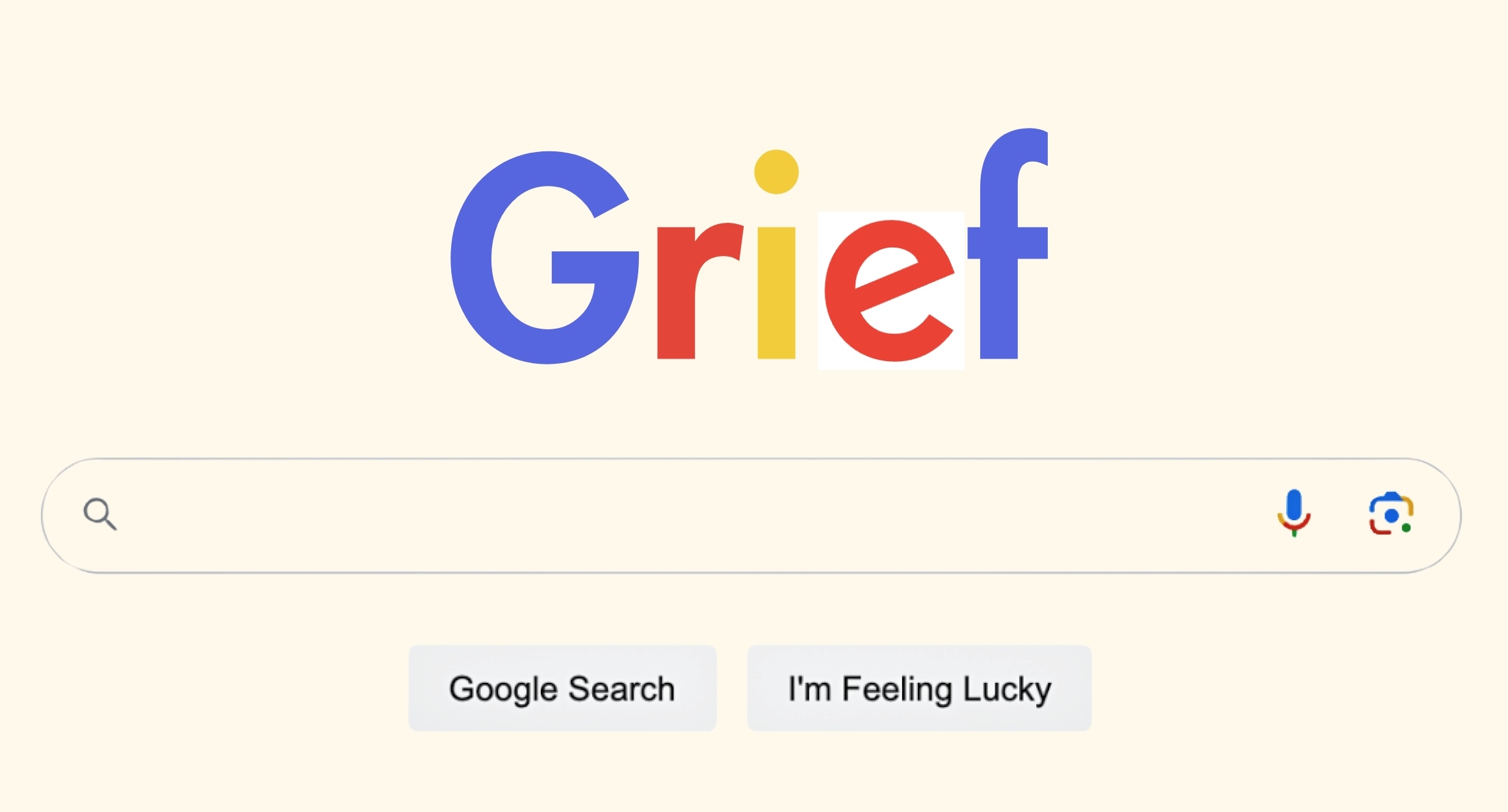
“The Data Shows We’re Never Truly Alone.” What Our Online Searches Say About Loss
Simon Rogers Considers Our Tendency to Find Solace In Anonymous Googling
As a Brit living in the US, I get two Mother’s Days every year—the UK celebration in March and the American one in May. It used to mean a double celebration, an extra excuse to send a card across the Atlantic. But when you have lost your mom, those days hit differently. They become a double reminder of what is missing.
Six months before I started writing my book, my mom, Janet, died. She was an artist and designer, a sister, mom, and grandmother who loved reality TV and painted every day. One day we had a mom, the next we didn’t. The questions were endless: Why did this happen? How long would it take to get a death certificate? Why do I feel this way?
None of it made any sense. But it turns out that none of it makes any sense to anyone. One thing I’ve learned from working with Google Trends data every day is that no one is truly alone in their emotions or experiences, although it often feels like it.
A loss is a loss, and grief is grief, no matter who it is for. Yet we need that acknowledgement that our grief is real for it to feel real to us too.
For the past decade as Google’s Data Editor, my job has been to glean insights from the world’s largest publicly available dataset. While researching my upcoming book, What We Ask Google, I analyzed data spanning two decades to see what it reveals about human nature. What this deep dive into our collective consciousness taught me is that search is an incredibly honest, non-judgmental environment. The data actually paints a surprisingly hopeful picture of humankind, proving that our baseline is a profound desire to understand the world and help each other.
What do we really know about grief? Not a lot. When we turn to search to understand it, the queries usually start with the informational, such as “How does grief affect the brain?,” or the intensely practical, like “What is bereavement leave?” These are the kinds of searches that speak to the fact that we often don’t know where to begin when big life moments happen to us, and we might even be too embarrassed to ask someone directly.
But some of the questions are really about trying to make sense of the unimaginable. We ask existential questions: “Is death real?,” “Is death painful?,” “Can grief make you sick?,” and “Can you die from grief?” The overwhelming nature of loss comes through again and again in the aggregated data.
Benjamin Franklin famously wrote: “In this world, nothing is certain except death and taxes.” It turns out that one of those is searched more than the other. Through 2019, searches for death and taxes matched each other, though tax queries drop off after filing season. Death is different in that it is a constant. But following the collective trauma of 2020, we have carried on searching about death at a higher rate than at any time in history. Worldwide, searches for grief have quadrupled since 2004.
One thing that really struck me in the data is the sense that somehow we might not be entitled to our grief. We see searches like “Does bereavement cover grandparents?” or “..uncles?” It’s a phenomenon known as disenfranchised grief—grief that isn’t openly acknowledged or socially sanctioned. A loss is a loss, and grief is grief, no matter who it is for. Yet we need that acknowledgement that our grief is real for it to feel real to us too.
We also desperately want to know when the pain will end. Searches like “How long does grief last?” and “How do I stop grieving?” come with one implicit question attached: “When will this be over?.” This leads to a massive volume of searches for the “stages of grief.” If grief brings chaos and turmoil, it’s natural to want to impose a structure on that, to want it to feel controllable and manageable. But experts will tell you that it’s not a linear process, and the data reflects this reality too. Take the top-searched “Why…” question related to grief: “Why does grief come in waves?” We also search for incredibly specific, evocative terms like “grief brain,” “anticipatory grief,” and “bureaucratic pain,” because the administrative process of managing a death is so complicated.
For something to show up in search trends, it has to be searched for by large numbers of people. To search for grief means you’re not really alone, even if it feels that way.
The isolation can feel profound. My oldest friend died a decade ago, and when I think of him now it’s in my dreams. I thought I was weird, but searches for dreams and bereavement consistently show up in the data. “Passed away came to hug and kiss me in my dream” is just one heartbreaking example of a shared phenomenon.
One thing everyone who has been through the grieving process will tell you is how lonely it feels, no matter how much love you are surrounded by. You might know objectively that you are not the first person to have experienced it, but it feels like you’re patient zero. It is raw and personal and incomprehensible. We see the result in the data with recent spikes for queries like “How to cope with grief and loneliness?” and “Why is grief so lonely?”
The fact that this shows up in the data at all is a profound irony. For something to show up in search trends, it has to be searched for by large numbers of people. To search for grief means you’re not really alone, even if it feels that way.
This point gets driven home when we look at grief from the other side. When someone you care about is grieving, the natural inclination is to want to say the right thing, hoping you have the magic words that will fix everything, or at least make things feel a little easier. We see a massive volume of searches asking “What to say to someone grieving?” or “What to write in a sympathy card?” People try to find solace and help in the words of others, searching for quotes and poetry to reassure or soothe a friend.
Since Mom died, I’ve been reminded of this. The data I work with every day supports the idea that my own friends and loved ones have wanted to help and comfort me. It has made things easier for me to realize that while we may be lonely, especially in these extreme moments, the data shows we are never truly alone.
____________________________
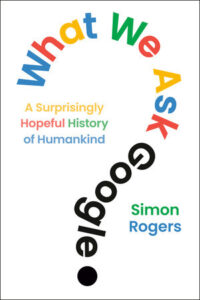
What We Ask Google: A Surprisingly Hopeful History of Humankind by Simon Rogers is available from Plum, an imprint of Penguin Publishing Group, a division of Penguin Random House, LLC.

Simon Rogers
Simon Rogers is Google’s Data Editor, leading a team of data journalists, analysts, and visualizers to tell stories with Google’s data. Previously, he was Twitter’s first ever Data Editor, and he is also the author of Facts Are Sacred, based on the Guardian’s Datablog which he helped launch. A lecturer in Data Journalism at Medill-Northwestern University in San Francisco, he has received the Royal Statistical Society’s award for statistical excellence in journalism. He lives with this family in San Francisco.