The Annotated Nightstand: What Stine An is Reading Now, and Next
Featuring Lee Jenny, Cynthia Cruz, Henry Goldkamp, and More
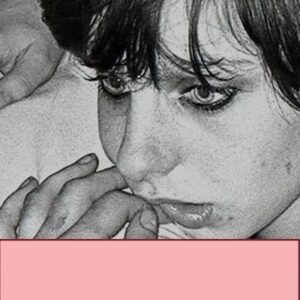
The poet Stine An, who is at the very least a finalist for best author/translator photo, is the translator of the recent poetry collection Winter Night Rabbit Worries by Yoo Heekyung. An received both NEA (rip) and PEN/Heim Translation Grants for her translation of Yoo’s Today’s Morning Vocabulary, published just last year. The newer volume is comprised of prose poems, penned beginning in February 2020, each with “Story” in the title (eg. “Story—Surface Patterns”). In her translator’s note entitled “Story—Clew,” An meditates on the notion of “story” alongside the collection’s first poem about Yoo’s grandmother singing while loosening yarn. An defines story as “a ball of yarn, a skein, a string—something with a beginning and an end that can transform… something infinite, like a circle or a loop.”
A story is something we follow, a thread—but it can also twist into any shape the storyteller desires, making for a potentially wild journey. Or it can be a way out, as with Theseus, “to guide him through the corridors of the Labyrinth.” (“Clew” is a synonym for skein—and a homophone of “clue.”) The titular rabbit of White Night Rabbit Worries is white with red eyes and, as with Alice in Wonderland, makes sporadic appearances. At times it’s wearing a beret, others asking for a nose scritch. Yoo, in the collection’s last poem, explains, “Like scenes from inside a kaleidoscope, stories repeat and reappear.”
While these poems have punctuation at times, more often than not are breathlessly without. Instead, Yoo provides pearls of thoughtful surrealist images on a long string, a new sentence only demarcated by a capital letter. An has amazingly translated this into a fluid experience in English, easy to follow yet pleasantly disorienting. The effect is like ripples on water—which you can only see from your position underneath the surface. Yoo’s images circle back on themselves in pleasurably circuitous loops. A tree in a bar goes through every season over the course of a night—when someone speaks his “voice cracks like an old branch.” Joyelle McSweeney says of An’s translation, “Translator and poet Stine An is the latest collaborator in Yoo’s photographic process, allowing English-language readers to recognize Yoo’s absurd and humane ingenuity and his location along the lyric coordinates of Yi Sang, Frank O’Hara, Kim Hyesoon, Georg Trakl, Tomaž Šalamun, and others.”
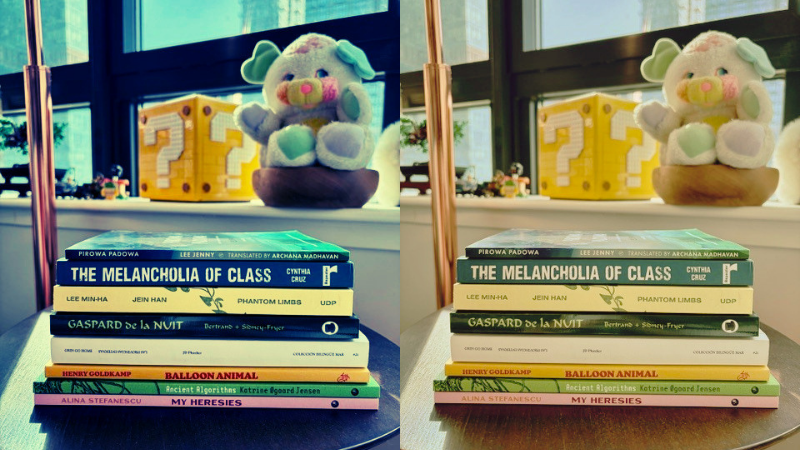
An tells us about her to-read pile: “Lately, I’ve been thinking about gender, genre, and language—a lot—and I keep returning to a phrase from The Melancholia of Class by the poet and critic Cynthia Cruz: “a phenomenological space in which to exist.” As an artist and as someone building a life through cycles of flight and fail, fleeing and falling, I find myself reading the works of fellow translators, performers, poets, and other nocturnal text-and-tongue worriers to divine a pocket of word to exist again and again. All to say, these are the books I hope to read and reread in the coming months: six by friends I carried home from recent gatherings at ALTA, AWP, and NOPF; one in spiritual communion with Winter Night Rabbit Worries by Yoo Heekyung; and one that renames class melancholia not as an enclosure, but as an aperture and awakening.”
*
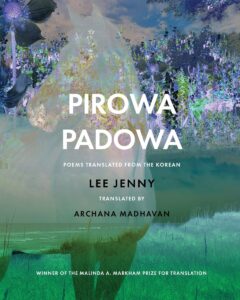
Lee Jenny, Pirowa Padowa (tr. Archana Madhavan)
The jacket copy for this collection reads in part, “In these poems, Lee juxtaposes real-world locations like Peru and Africa with imaginary lands like Kariponia, populating them with indefinable creatures that speak in neologisms—in doing so, she asks us to abandon preconceived notions of any specific place or word to arrive at our own interpretations.” You can read some pieces at The Adroit Journal here.
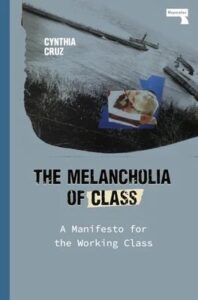
Cynthia Cruz, The Melancholia of Class: A Manifesto for the Working Class
A Paris Review staff pick in 2021, Rhian Sasseen writes there: “In a world that denies their very existence, [Cruz] argues, the working-class artist is a ghost: ‘neither dead nor alive, the working class exists between worlds.’…Cruz makes a convincing argument as to how the working class can best resist assimilation and instead continue to make provocative, formally experimental work that transcends the borders of both class and country.” This book is excerpted in an essay at the Poetry Foundation.
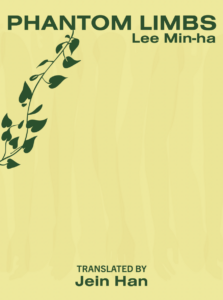
Lee Min-ha, Phantom Limbs (tr. Jein Han)
Our own Rebecca Morgan Frank listed Phantom Limbs on Lit Hub’s “Seven New Poetry Collections to Read in May” of 2025. Frank says, “The opening poem of Lee Min-ha’s 2005 debut, Phantom Limbs, newly translated from the Korean by Jein Han, catapults the reader into the grotesque interventions and intersections of humanity: the poem ends, ‘a man is shoving the rest of his hips into the tree’s torso.’ With dizzying acts of transformation—bodies breaking, morphing, bending, bleeding, Lee Min-ha blows up and estranges in something that explodes beyond the play of the most popular American prose poems past.”
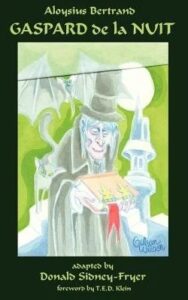
Aloysius Bertrand, Gaspard de la Nuit (tr. Donald Sidney-Fryer)
This highly influential early 19th century poetry collection seems to sit comfortably among Yoo’s work. Gaspard de la Nuit is generally considered the first collection of prose poetry as we know it. Published posthumously after Bertrand died from tuberculosis in 1841, it counted Baudelaire and Ravel among its fans. Bertrand begins by telling a story of engaging a random older man in a conversation about art and poetry, the man pushed a sheaf of pages into Bertrand’s hand, and walking away with promises to return tomorrow. (He doesn’t.) The result of this (arguably) meeting with the devil is the volume of poems.
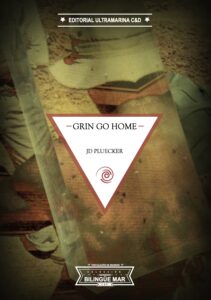
Jadine (JD) Pluecker, Grin Go Home / Las provincias internas
The jacket copy describes Pluecker’s amazing Grin Go Home / Las provincias internas as “a novel in poems or perhaps a verse memoir in continuous translation and transformation. An anti-road novel in which the road dwindles and is swallowed up by the land and then re-forms, looping back to its starting place. Or Grin Go Home is a collection of texts that, like their protagonists, travel through a haunted landscape of unequal crossings, a land where people living side by side are not quite neighbors.”
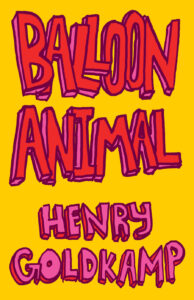
Henry Goldkamp, Balloon Animal
Juliet Gelfman-Randazzo says of this poetry collection, “These poems whistle and go silent and pop. They have props and characters and costumes. It’s hard to imagine them performed aloud but within these pages we are offered the distinct pleasure of trying to imagine how performance-poet-extraordinaire Henry Goldkamp might.”
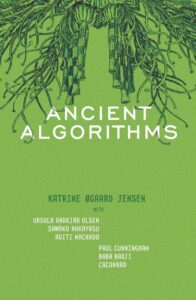
Katrine Øgaard Jensen, Ancient Algorithms
This collection is a collaborative deep engagement with translation with translation (and poetry) luminaries like Aditi Machado and Sawako Nakayasu. “Katrine Øgaard Jensen and her collaborators engage in transritual and transcreation as acts of writing—transwriting,” says Don Mee Choi of the collection. “Their varied triggers and processes are spectacular. Ancient Algorithms reveals immense possibilities of language and poetry to become fearless and unbordered.”
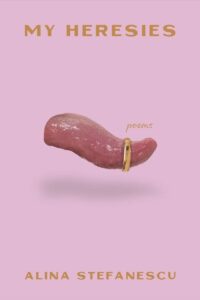
Alina Stefanescu, My Heresies
Candice Louisa Daquin writes in World Literature Today, “With verse not atypically American in its kaleidoscope of reference and history, writers like Stefanescu come from ancient nesting dolls, breathing the blue flame poetry from worlds we learn of reading [her]… Stefanescu’s multilingual, panoramic diorama is evidenced by her expansion and understanding of tension, whetting lines of deeper meaning: immigration, transplantation, carried memories, un-dissolved pains, alongside histories.”

Diana Arterian
Diana Arterian is the author of the recent poetry collection Agrippina the Younger (Northwestern UP, 2025), which received the 2026 William Carlos Williams Award from the Poetry Society of America. She is also editor and co-translator of Smoke Drifts (World Poetry Books, 2025), a collection of Nadia Anjuman's poetry. A Poetry Editor at Noemi Press, Diana has received fellowships from the Banff Centre, Millay Arts, and Yaddo. She writes “The Annotated Nightstand” column at Lit Hub and lives in Los Angeles.