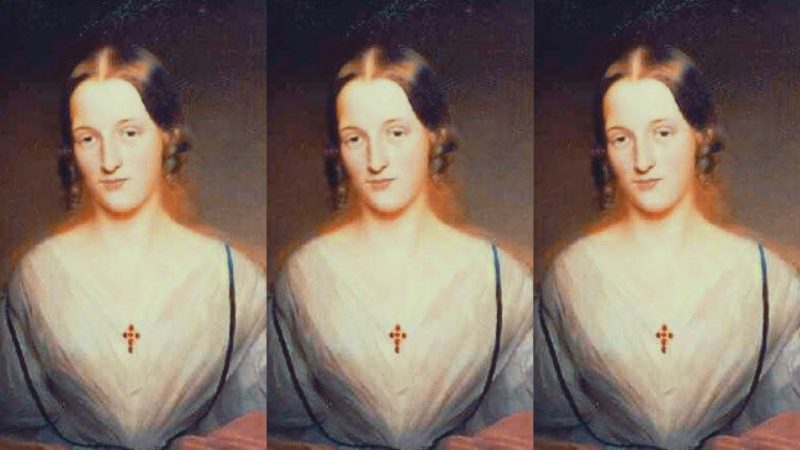
Out From the Shadows: On Rediscovering Mary Shelley’s Half-Sister, Fanny Imlay
Jupiter Jones Explores the Life of a Remarkable Woman Forgotten by History
It is an interesting challenge to write about someone who has been overlooked, who is overshadowed by more vibrant characters. If they are at first glance unexceptional, is that to say dull or uninteresting? Such overshadowing might be recognized as a pattern of light and shade, largely a matter of perspective—perspective that is relative and may shift over time. Despite being part of a major literary dynasty, one such woman, definitely overshadowed, and largely overlooked, is Fanny Imlay.
Fanny’s mother, Mary Wollstonecraft, was famously disparaged by Horace Walpole as “a hyena in petticoats.” It is now largely forgotten that it was not her feminist principles that Walpole was objecting to, but her republican views. He was offended that she “discharged her ink and gall on Marie Antoinette.” But times change, priorities shift, and from a twenty-first century perspective, Wollstonecraft’s politics are very much overshadowed by her feminism. Where once she was ridiculed as emotionally overwrought with outlandish opinions, now she is greatly admired for her bold life choices and the progressive views of her Vindication of the Rights of Woman. Thanks to a thorough re-evaluation in the latter part of the twentieth century, Wollstonecraft is recast as the fairy godmother of modern feminism. And somehow, along the way, the hyena insult became a feminist soubriquet—as for example in Angela Neustatter’s Hyenas in Petticoats: A look at twenty years of feminism. And feminism certainly brought about a change of perspective.
To write about Fanny is inevitably to write about how she was and is overshadowed by the originality and reputation of her mother, and by the fame and accomplishments of her half-sister.
But what of Fanny, the hyena’s daughter? In 1793, when Wollstonecraft was in Paris experiencing the French Revolution up close, she met the American “diplomat” (adventurer, blockade-runner, philanderer) Gilbert Imlay and they had a daughter Fanny. When Imlay’s affections cooled, Wollstonecraft tried to win him back by attempting to trace a cargo of silver plate (previously the property of French aristocrats) that had gone missing somewhere in Scandinavia. Imlay had been defrauded by a business associate, and he persuaded Wollstonecraft to undertake the search for the cargo on his behalf, promising that on her return, they would live together as a family—a promise that he did not keep. Taking with her only Fanny and a nursemaid, Wollstonecraft travelled to Norway, Sweden and Denmark, and during her travels, wrote dozens of letters to Imlay in which the infant Fanny might occasionally be glimpsed.
You know that as a female I am particularly attached to her—I feel more than a mother’s fondness and anxiety, when I reflect on the dependent and oppressed state of her sex. I dread lest she should be forced to sacrifice her heart to her principles, or principles to her heart. (Letters Written During a Short Residence in Sweden, Norway, and Denmark)
Was Fanny ever forced to make such a sacrifice of either her heart or her principles? Further reading leaves the question open to conjecture. Beyond a handful of letters and a rather cryptic suicide note, little hard evidence remains of Fanny Imlay.
For most writers and historians, Fanny is a minor character, overshadowed by her more famous relatives. She appears mostly in the literal and metaphorical margins of other stories and other lives. What is known, thanks in part to a report in the Cambrian newspaper of October 1816, is that at the age of twenty-two, Fanny traveled alone from London to Swansea, locked herself in a room at the Mackworth Arms Hotel and drank enough laudanum to end her life. Her body was neither officially identified nor claimed by her family, but a sympathetic coroner declared her simply “found dead” and she was buried in an unmarked grave at the expense of the parish.
It is quite probable that the distress and shame caused by Fanny’s suicide would have been enough reason for her family to erase all trace of her. Suicide, at that time, was considered to be a mortal sin and furthermore, was against the law—a law not fully repealed in England and Wales until 1961. Most of Fanny’s letters were destroyed—or at the very least, not preserved. There is no known portrait, no headstone, no heirloom, no lock of hair. Her family let it be supposed that she had gone to live with her aunts in Dublin and had subsequently died of a cold.
Why did Fanny kill herself? What drove her to this extreme action? Was it a matter of her heart or her principles? This is the story that interests me, but telling the story of Fanny Imlay is impossible without also telling the story of Wollstonecraft’s other daughter, Fanny’s half-sister.
After Gilbert Imlay had totally rejected Mary Wollstonecraft, and after—in desperation—she had made two unsuccessful suicide attempts, she met and fell in love with the political philosopher William Godwin. Despite their shared radical views on marriage as an “odious monopoly,” when Mary fell pregnant, they tied the knot. The marriage legitimized the expected baby, but by drawing attention to the fact that Wollstonecraft and Imlay had not been married, it exposed Fanny, according to Charlotte Gordon’s Romantic Outlaws, as “the most notorious bastard.” The new baby, another Mary, was born in August 1797 and would grow up to marry a poet and become Mary Shelley.
So, to write about Fanny is inevitably to write about how she was and is overshadowed by the originality and reputation of her mother, and by the fame and accomplishments of her half-sister, Mary Shelley. And there is a third sister that must be included in the story. A few days after giving birth, Wollstonecraft died of puerperal fever leaving the rather stern and bookish Godwin to raise her daughters. Finding being a single parent taxing, Godwin married his neighbor, Mrs. Clairemont, and besides a stepmother they didn’t really want, Fanny and Mary gained a stepsister, Claire Clairemont.
Claire was for a time a gooseberry in the famous relationship that blossomed between the then-sixteen-year-old Mary and the already-married poet Percy Bysshe Shelley. In 1814, when Mary and Percy scandalously “eloped,” Claire went with them. When, after six weeks abroad, they returned to London, Claire returned too and lived with them for many years. But in 1816, Claire set her sights on a poet of her own—the more wealthy, more famous, even more disreputable poet—Lord Byron. Of course she got pregnant: “this is what comes of putting it about” Byron wrote rather dryly to a friend. Of course, he subsequently dumped her, and wrote to his half-sister Augusta:
You know that odd-headed girl? I never loved her nor pretended to love her—but a man is a man—and if a girl of eighteen comes prancing to you at all hours of the night—there is but one way. (Byron: Letters and Journals)
So, scandal and drama played a considerable part in the early lives of Mary and Claire. It all makes for a good story, a story that has been told countless times. But Fanny hardly figures in it. In some retellings, she is written out and doesn’t figure at all—for example in Haifaa al-Mansour’s 2017 film, Mary Shelley.
While Mary and Claire were falling in love with Romantic poets, traveling abroad, getting pregnant, where was Fanny? What was Fanny doing? She was unconventionally educated but undoubtedly well read, intelligent and articulate. Fanny’s few surviving letters testify to her interests in poetry, education, art history, literature, current affairs, social politics, and the wellbeing of her extended family. She was entrusted by Godwin to deputize for him in his business and financial affairs. She counted Aaron Burr (former USA vice president), Samuel Taylor Coleridge (poet), Humphry Davy (scientist), Charles and Mary Lamb (writers), and Robert Owen (industrialist, politician and philanthropist) amongst her acquaintances. And yet, we know little of her day-to-day life. Fanny is a shadowy figure compared to Mary and Claire, who seem more vibrant, arguably bolder—or more reckless—and who have been significantly better preserved, better researched, and more widely written about.
But shadows are a trick of the light, a matter of perspective. Mary and Claire in their turn were overshadowed by the men in their lives: the Romantic poets Percy Bysshe Shelley and Lord Byron. Both poets achieved critical acclaim for their writing and notoriety for their behavior. They burned brightly and died young (Shelley at twenty-eight, Byron at thirty-six), which seemed only to add to their allure. Some of what we know about Fanny, Mary and Claire, we only know thanks to the intense nineteenth-century interest in the lives and works of Shelley and Byron. Letters, journals and manuscripts were assiduously collected, catalogued and archived by figures such as Lord Abinger whose collection is now in the Bodleian Library in Oxford, and Carl H. Pforzheimer whose collection is in the public library in New York.
Henry James captured the intensity of the literary scavenger hunt for relics of the Romantic poets in a novella first published in The Atlantic Monthly in 1888. James’s novella The Aspern Papers tells the story of how an ardent admirer of a dead poet attempts by various means to get his hands on some of the poet’s old letters. He has heard rumors that a cache of letters has been stashed away by a very old lady who was once the poet’s friend—or perhaps lover. Henry James based the narrative on real events, when American Shelley superfan, Edward Augustus Silsbee, contacted an elderly Claire Clairmont with a view to obtaining any information or documents she had concerning Shelley. Silsbee visited Claire regularly and took copious notes.
After the death of Claire and Byron’s daughter Allegra (aged five), and Shelley’s death in a boating accident, Claire and Mary finally separated. Claire then made an independent living as a governess and tried hard to distance herself from the scandals of Shelley and Byron. Such scandal, “a handle for mischief” as she called it, damaged her prospects. She wrote to Edward Trelawny who had been with them in Italy when Shelley drowned.
I disapprove of Mr Rossetti’s mentioning me at all in his Life of Shelley—my actions have nothing to do with the Poet […] Mr Rossetti should have remembered an individual’s private history is their own property, whom no one has a right to publish. (The Clairmont Correspondence)
Yet some of the snippets of information about Fanny come from Claire: from her letters to Trelawny and her conversations with Silsbee. One such snippet is that when Shelley first became a regular visitor to the Godwin household, it was not Mary that he was attracted to, but Fanny. Was Fanny upset by this transfer of Shelley’s affections, or was it she who rejected his advances? Of course, Trelawny and Silsbee were never particularly interested in asking such a question. Fanny was unimportant. She was almost entirely eclipsed by her more famous half/stepsisters, as they in turn were overshadowed by Shelley and Byron.
In a way, Claire got the last laugh. She had written no masterpiece, published nothing, but she had managed to survive the others by several decades. There was no one left to contradict her, and she got to tell her version of events.
*
It is then impossible to write about Fanny without writing about Mary and Claire, and impossible to write about Mary and Claire without writing about Shelley and Byron. Just as Fanny was overshadowed by her sisters, her sisters’ lives and reputations were overshadowed by the men they outlived. For early biographers such as Trelawny (1858), Rossetti (1886), Dowden (1886), Ingpen (1927), and White (1940), the women figure mainly as romantic interest, as muses, as admiring acolytes.
Arguably, times have changed. Mary Shelley is of considerable scholarly interest and is more talked about than her husband whose poetry is less in vogue than it used to be. She wrote many novels, short stories, biographies of other writers and was widely published, though all are eclipsed by the first novel she wrote—you know the one? The one that was originally published anonymously, the one that early readers attributed to Percy Bysshe Shelley, because it is an extraordinary story and hardly likely to have been penned by a girl. Early scholars pored over her original manuscripts to prove that he not she should be credited with authorship. Later scholars of a more feminist bent have pored over the same manuscripts to argue that she not he was most definitely the true author. And although issues of attribution have now largely been settled, there is still an issue with overshadowing.
This is what makes Fanny worth writing about. Her openness, her immediacy, her frankness in sharing how she saw things.
Frankenstein, or The Modern Prometheus is more read about than read. But at least its reputation now exceeds “mad scientist creates monster” and themes of man’s overreaching, paternity, and nature versus nurture are recognized—as discussed recently on Dominic Sandbrook and Tabitha Syrett’s Book Club podcast Frankenstein: Horror, Humanity, and Hubris. The novel been repeatedly dramatized for stage and screen. Some treatments have closely followed the text, such as Nick Dear’s stage play for the Royal National Theatre (2011), directed by Danny Boyle, with Benedict Cumberbatch and Jonny Lee Miller interchangeable as Frankenstein and his creature. Others have a looser take, including Guillermo del Toro’s 2025 film starring Oscar Isaac and Jacob Elordi which aims for gothic spectacle rather than fidelity to the text. However, I suspect that in the cultural imagination Mary Shelley’s original characters are even now overshadowed by a green-headed, bolt-necked Boris Karloff.
*
Where is Fanny amongst all this scandalous conduct and penning of literary masterpieces? She seems to have lived a quiet life in Skinner Street, Holborn with her stepfather William Godwin and his second wife. Her own prospects were limited, and to some extent damaged by scandals that were not of her making. I imagine she felt rejected, left behind by her sisters, shut out from their lives. I imagine she made herself useful and anticipated a quiet future perhaps as a schoolteacher. Then in October 1816, some unknown catalyst prompted her journey to Swansea.
An assumption made by Shelley’s early biographers was that Fanny killed herself because of unrequited love. According to historian Burton Pollin:
“She was hopelessly in love with Shelley and desperate about Mary’s having captured him […] for herself.” (Pollin, 1965)
This is a theory that I find wholly implausible. From her letters, it is evident that Fanny was pragmatic about her prospects. Surely it is more credible that she would have come to terms with any hurt caused by Shelley’s early attention to her—attention which in any event, she may have rejected due to his pre-existing marriage. Pollin’s theory places Shelley at the epicenter of Fanny’s world, eclipsing all other concerns and interests. This theory is a product of its time—a more chauvinistic era, confident in the significance of men, the necessity of men, and their unquestionable desirability. It suggests a mindset that was overly invested the appeal of Shelley as a partner, and in the love-plot as every woman’s overriding desire. Contrary to this, I think Fanny’s few remaining letters and the breadth of her interests show that she was more complicated and more self-reliant. Also, Fanny seems to have been a fair judge of people. In reply to a letter from Mary mentioning Lord Byron, Fanny wrote,
“do in your next oblige me by telling me the minutest particulars of him for it is from the smallest things that you learn most of character.” (The Clairmont Correspondence)
I imagine that Fanny enjoyed Shelley’s company and admired his poetry, but was clear sighted and fully cognizant of his weaknesses as a man.
*
What makes Fanny Imlay worth writing about? Despite—and strangely because of—the slightness of evidence, Fanny is a lens through which we might view her scandalous literary family. But additionally, Fanny’s letters reveal her to have been thoroughly alive to herself and to her world; she is interesting in her own right. In a letter to Mary, she wrote:
I endeavour to be as frank to you as possible that you may understand my real character. (The Clairmont Correspondence)
An in October 1816, a week before her suicide, Fanny wrote to her half-sister:
My dear Mary, I write immediately on the receipt of yours because I think one always expresses oneself better immediately under the influence of any impression which has been made upon our feelings—and we, to a certain degree see things in a much more vivid manner under those circumstances. (The Clairmont Correspondence)
This is what makes Fanny worth writing about. Her openness, her immediacy, her frankness in sharing how she saw things. She offers a unique and objective sensibility, caught as she was, on the cusp between the Enlightenment thinking of her Godwinian upbringing and the Romanticism her sisters embraced.
In the absence of Fanny’s own explanation, it is impossible to know what was in her mind as she took the stopper from that bottle of laudanum, but I would certainly argue for reframing her, not as an infatuated love-sick girl, but as an intelligent and independent thinker. I suspect that for Fanny, rather than one overwhelming thing, there was a plurality of causes and causal contexts stacked against her. Whether we now choose to see the balance of probability tipped in favor of self-determination or irrational sentimentality—to see Fanny’s suicide as motivated by reason or romanticism—maybe it comes down to the same dichotomy recognized years earlier by Mary Wollstonecraft: Principles or heart?
__________________________________
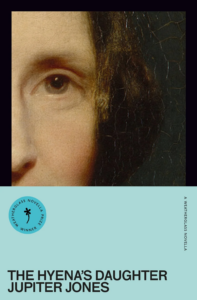
The Hyena’s Daughter by Jupiter Jones is available from Weatherglass Books.

Jupiter Jones
Jupiter Jones is the winner of the Philip Hoare Prize for creative non-fiction and the Colm Toibin International Short Story Prize. She is the author of three previous novellas: The Death and Life of Mrs Parker; Lovelace Flats; and Gull Shit Alley and Other Roads to Hell.